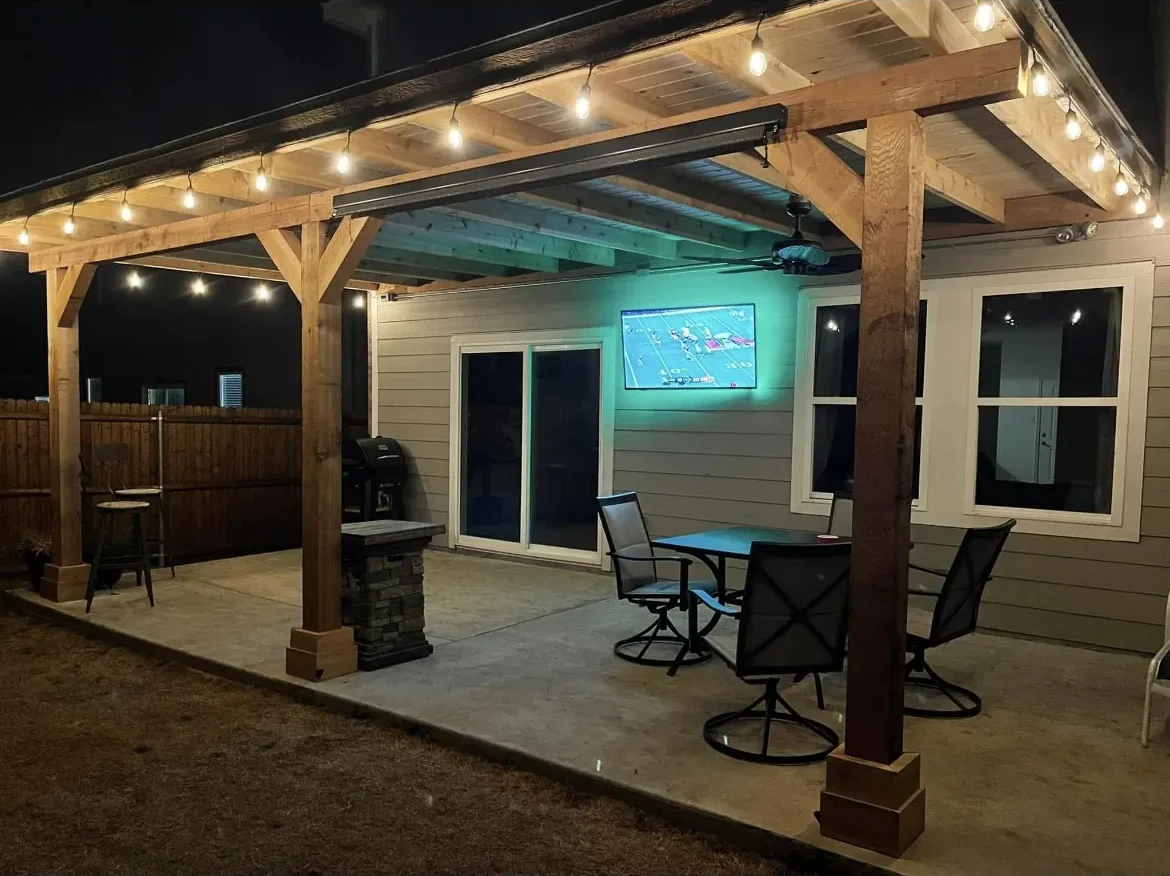
We found no lifespan study done in Texas, so the year figures below are national claims or federal research done outside Texas, and we say which is which.
How long does a pressure-treated deck last in Texas?
Plan on 10 to 20 years by the makers' and sellers' numbers, but the USDA Forest Products Laboratory says a deck kept water-beading with a finish can pass 40 years, because wood decks usually fail by splitting, not rot.
Trex, a composite maker, citing the home inspectors' group InterNACHI, says treated pine deck boards "generally last 10 to 15 years." Advantage Lumber, a hardwood seller, says 15 to 20 years when maintained, without citing a test. Fixr, a national cost guide, says wooden decks last at least 10 to 15 years. The USDA Forest Products Laboratory (FPL) says wood decks "are most commonly replaced because of checking and splitting, not decay," and that keeping water beading on the surface can give 40 or more years.
No study we found measured treated decks in Texas. What Dallas adds is heat: Block Renovation's Dallas guide says summers regularly top 100°F from June through September, with intense UV from May through September. The FPL explains that sun dries the top of a board while the core stays wet, and that stress causes checks, cracks and cupping.
For how boards, framing and hardware wear out on every kind of deck, see how long a deck lasts in Texas.
What pressure treatment is: MCA, copper azole (CA-C) and ACQ
Today's treated pine is pressure-impregnated with copper plus an organic co-biocide. Copper azole, often micronized (MCA), is commonly used for yard decking and lumber, ACQ is another copper option, and arsenic-based CCA left homeowner use at the end of 2003.
| Preservative | What's in it | Where you see it | Corrosion note (Simpson Strong-Tie) |
|---|---|---|---|
| MCA (micronized copper azole) | Copper ground into very fine particles, plus tebuconazole | Yard decking and framing; YellaWood uses micronized copper and a co-biocide | Less corrosive than ACQ-D |
| CA-B and CA-C (copper azole) | Dissolved copper (96% amine copper) plus triazoles (4%) | Commonly used for decking and dimension lumber | Less corrosive than ACQ-D |
| ACQ (types A to D) | 50% to 67% copper oxide and 33% to 50% quat | Standardized as types A, B, C and D, which differ in carrier and quat content | ACQ-D is the more corrosive one |
| CCA (before 2004) | Chromated copper arsenate | Dominated from the late 1970s until 2004; now mainly industrial, generally not sold at retail yards | Less corrosive than ACQ-D |
All of these are waterborne. The FPL notes the treatment puts water into the wood, so it will dry and shrink after installation unless it was kiln-dried after treatment. That is why KDAT lumber exists.
If your deck was built before 2004
The EPA says CCA makers voluntarily stopped making treated wood for homeowner uses in December 2003. It does not require removing an existing CCA deck, and it suggests regularly applying a penetrating oil-based or water-based stain to reduce leaching.
Above ground vs ground contact: UC3B, UC4A and UC4B explained
Deck boards and railings can be UC3B (above ground), but posts, the ledger and any joist or beam that is hard to replace, under 6 inches from the soil, poorly ventilated or often wet should be UC4A ground contact. UC4B is for heavy-duty structural posts and permanent wood foundations.
These use categories come from the American Wood Protection Association's standard, AWPA U1:
| Deck part | Minimum AWPA category | Why |
|---|---|---|
| Deck boards and railings | UC3B (above ground) | AWPA lists decking and railings as above-ground, exposed uses |
| Joists and beams, well above grade and easy to reach | UC3B | AWPA's residential chart allows above ground here |
| Joists and beams that are hard to replace and critical to the structure | UC4A (ground contact) | AWPA says they "shall be treated" to UC4A |
| Joists and beams that are low, poorly ventilated or often wet | UC4A (ground contact) | AWPA Note 1 triggers (below) |
| Ledger and posts | UC4A (ground contact) | AWPA's residential chart; sawn deck posts are listed as UC4A |
| Building structural support posts and poles | UC4B (heavy duty) | Critical parts in severe conditions |
| Permanent wood foundation | UC4B or higher | AWPA's residential chart |
AWPA Note 1 says above-ground sawn parts must be UC4A or higher when:
- soil, leaves or debris can build up against them;
- the build or plants block air under the deck and between boards;
- they sit less than 6 inches above final grade on treated wood or concrete supports without a moisture barrier;
- they touch untreated or decayed wood;
- they get wet often, for example from a fixed watering system;
- they are in a tropical climate.
YellaWood, a Southern pine treater, advises ground contact for hard-to-replace, critical parts such as joists, beams and ledgers, and for frequent wetting from sprinklers, pools and hot tubs. In Dallas yards the triggers come up a lot: low decks near the clay, sprinkler heads aimed at the frame, pool decks wet all summer. If your deck will sit close to the ground, see our guide to ground-level and floating decks.
Retention: how much preservative is in the wood
For Southern pine treated with MCA or CA-C, the FPL's typical retentions work out to about 0.06 pounds per cubic foot (pcf) for UC3B, 0.15 for UC4A and 0.31 for UC4B. For ACQ-D they are about 0.15, 0.40 and 0.60 pcf (calculated from the FPL's table using its divide-by-16 conversion). YellaWood's MCA warranty lists the same 0.06 and 0.15 pcf, and YellaWood claims ground contact gives "twice the protection."
On the code side, the American Wood Council's DCA 6 deck guide (based on the 2015 IRC) says deck lumber must be naturally durable (90% or more heartwood) or treated to AWPA standards, and "all lumber in contact with the ground" must be ground-contact treated. Your city inspector has the final say.
How to read a treated lumber end tag
The plastic tag on each board's end tells you the standard (AWPA U1), the use category, the preservative, the retention in pounds per cubic foot, the exposure (above ground or ground contact) and the inspection agency.
- Exposure. "ABOVE GROUND USE" or "GROUND CONTACT USE." YellaWood prints the end use at the top of its tags; check it matches the part and your local code.
- Standard. Look for "AWPA U1." Viance, a preservative maker, says if it's missing, the wood probably doesn't meet AWPA standards.
- Use category. UC3B, UC4A or UC4B, matched to the table above.
- Preservative. A name or abbreviation such as CA-C or MCA.
- Retention. AWPA's sample above-ground tag shows .06 pcf; Viance's copper azole example shows 0.15 pcf.
- Agency mark and treater. An ALSC-accredited agency's quality mark, plus the treater and plant location.
The grade may be on the tag or stamped on the board. Keep the tags and receipts: the treater's warranty requires both for a claim.
KDAT vs wet treated lumber: shrinkage, gaps and checking
Standard treated pine can arrive soaking wet, and it shrinks as it dries. KDAT (kiln dried after treatment) is dried to 19% moisture or less, so it is more stable and gets a 1/8-inch gap when installed.
The FPL says "considerable shrinkage is to be expected" as treated wood dries, and some is still above saturation when delivered: very heavy, with water squeezing out.
How much a wet board shrinks
Using the FPL's green-to-dry shrinkage formula (Equation 13-4) and loblolly pine's 7.4% tangential shrinkage (The Wood Database), a 5-1/2 inch wide flat-sawn board drying from 30% to 12% moisture narrows by about 0.24 inch, roughly 1/4 inch (calculated by us from those two figures). The FPL notes that commercial lumber is often not perfectly flat-sawn, so estimates like this tend to run high for width. The 12% end point is its average recommended moisture for exterior wood in most of the US.
Gaps between boards
- KDAT: YellaWood says gap it the width of an 8d nail (1/8 inch), pre-drill near board ends, use screws, and keep the material dry during installation.
- Code guidance: DCA 6 says space boards about 1/8 inch apart, each bearing on at least 3 joists.
- Wet boards: we found no published gap rule. Since a wet board can lose up to about 1/4 inch of width, ask your builder how they plan for the shrinkage.
Why treated boards check and cup
Sun-warmed boards dry and shrink at the surface while the core stays wet, and rain re-swells them quickly. The FPL says that stress causes checks, cracks, warping and cupping, that decks "are often the worst affected," and that darker finishes heat up and check more.
Is KDAT worth it?
YellaWood says KDAT minimizes shrinking, cupping and warping and can be finished right away, while wet lumber "may take weeks or months" to dry enough to stain. It says KDAT costs "a fraction of the price of composite" but gives no number, and availability varies by region. We found no sourced price gap between KDAT and wet lumber, so ask for both on your quote.
Pressure-treated wood deck lifespan in the Texas climate: claims vs USDA research
The 10-to-20-year figures are seller and cost-guide estimates, not field tests. The long-run federal data are USDA stake tests in humid Mississippi, where CCA-treated pine at a ground-contact level had no failures after 40 years, but those tests don't include today's copper azole or ACQ lumber.
| Source | Who they are | Figure | Basis |
|---|---|---|---|
| Trex | Composite decking maker | 10 to 15 years for treated pine boards | Cites InterNACHI |
| Advantage Lumber | Hardwood seller | 15 to 20 years, maintained | No test cited |
| Fixr | National cost guide | At least 10 to 15 years, wooden decks | Cost guide figure |
| USDA FPL Wood Handbook | Federal research lab | 40+ years with water beading kept up | Finishing chapter |
| USDA FPL stakes, CCA at 0.40 pcf | Federal research lab | No failures after 40 years | 2x4 pine sapwood stakes in the ground, Mississippi |
| USDA FPL stakes, CCA at 0.15 pcf | Federal research lab | 28.7 years average | Same test |
What the research does and doesn't tell you
- It doesn't cover today's lumber. The FPL table has no rows for ACQ, CA-C or MCA, and the FPL says lab-treated stakes "may not reflect" commercially treated lumber.
- The test is harsh on purpose. Stakes go in warm, wet climates, usually the Southeastern US or Hawaii, and above-ground tests are less severe.
- Above ground, treated and durable woods are close. As decking they have "quite comparable" service lives, and treated decks are most often removed for splitting and checking, not decay. Regular penetrating sealer reduces checking.
- Humidity alone won't rot a deck. Serious decay needs wood above about 30% moisture, which takes liquid water such as rain or wet ground. That's why drainage and airflow matter.
One builder's view, labeled as opinion: remodeler Doug Horgan wrote in Green Building Advisor (2024) that formula changes beginning in 2004 "yielded lumber that is not as rot-resistant as it used to be." He found rot in 70 framing members on a 2013 deck and now uses only ground-contact lumber, flashes joist and beam tops and treats field cuts. No federal data we found settles whether modern treated pine lasts as long as CCA.
Pressure-treated lumber grades: No. 1, No. 2, Prime and Premium decking
For the frame, No. 2 is the code baseline, since DCA 6 span tables assume it. For the walking surface, buy 5/4 Premium radius-edge decking, or a No. 1 or Prime 2x6, if knots and bark edges matter to you.
| Grade | What it means | Best use on a deck |
|---|---|---|
| No. 1 | SFPA: "high strength, stiffness and good appearance"; smaller, fewer knots | 2x deck boards and visible framing |
| No. 2 | SFPA: "most general construction uses"; YellaWood: more knots and bark edges, "used mainly for non-appearance applications" | Joists, beams and ledgers |
| No. 3 | SFPA: where appearance isn't a factor | Not the grade DCA 6 spans assume |
| No. 1 Prime, No. 2 Prime | The base grade with wane and appearance traits limited | 2x6 deck boards where looks matter |
| Premium radius edge decking | SFPA: smallest knots, "where appearance is of utmost importance" | 5/4 deck boards |
| Standard radius edge decking | SFPA: slightly less restrictive than Premium, for a more rustic look | 5/4 deck boards where a more rustic look is fine |
SFPA's radius edge decking is 1-1/4 inches thick and 4 to 6 inches wide, with a maximum recommended support spacing of 24 inches on center (16 inches for imported Southern pine). DCA 6 also says deck ledgers must be at least a 2x8 treated No. 2, posts at least 6x6, and all lumber must carry an approved agency's grade mark.
What a pressure-treated deck costs in Dallas
Block Renovation's 2026 Dallas guide puts pressure-treated decks at $15 to $30 a square foot, about $4,500 to $9,000 for a 300 sq ft deck (calculated from Block's range), against $15 to $25 installed nationally (Fixr, 2023).
- Dallas: $15 to $30 per square foot for a built deck, per Block Renovation, which lists composite at $25 to $50.
- National: $15 to $25 per square foot installed, $3 to $8 for materials alone (Fixr, updated 2023).
- Dallas resale: the 2025 Cost vs Value report puts a Dallas "Deck Addition | Wood" at $15,841 with $15,813 resale value, 99.8% recouped (national: $18,263 and 94.9%). It doesn't state the lumber species or deck size.
We found no sourced price difference between ground-contact and above-ground lumber. For railings, stairs and permits, see how much a deck costs in Dallas. For your own deck, Archetex owner Matthew gives a written price after a free site visit.
When to stain or seal a new pressure-treated deck (and how long to wait)
Don't go by the calendar. Sprinkle water on the boards, and when it soaks in instead of beading, the deck is ready. The treaters put that at roughly 30 to 60 days for wet lumber, while KDAT should be sealed right away.
- FPL: one week should be enough for the surface of copper-treated wood to dry, but preservative can bleed through latex paint and solid stain if the wood is still wet.
- YellaWood (regular lumber): could be ready in about 30 days. Apply a clear water repellent within six weeks and reapply annually.
- Viance: typically ready 60 days after installation, depending on sun, temperature and weather.
- KDAT: must be stained, painted or sealed immediately after installation.
Use a penetrating finish with a water repellent and UV stabilizer, not a film. The FPL says it is "extremely challenging to get film-forming finishes to adhere to decks," while penetrating finishes need only a refresh every few years. In Dallas sun, lean lighter, since darker finishes check more. YellaWood notes the finish is about weathering: no maintenance is needed to keep the treatment's rot and termite resistance.
| Task | How often | Source |
|---|---|---|
| Clear water repellent | Yearly | YellaWood; Viance |
| Semitransparent stain, new smooth decking | 2 to 3 years | USDA FPL, Table 16-2 |
| Semitransparent stain, weathered or saw-textured decking | 3 to 6 years | USDA FPL, Table 16-2 |
| Tinted deck finish | 1 to 2 years (new), 2 to 3 years (weathered) | USDA FPL, Table 16-2 |
| Paint | Low suitability on decks | USDA FPL, Table 16-2 |
The FPL's finish lives are US averages, and it says expected life "depends on climate and exposure," so a deck in full Dallas sun may need it sooner.
Fasteners and hardware for pressure-treated wood: G-185, hot-dip galvanized or stainless
The code-based DCA 6 deck guide calls for hot-dip galvanized, stainless, silicon bronze or copper fasteners and G-185 galvanized or stainless connectors, and the two must match. Simpson Strong-Tie recommends stainless for high-exposure uses, such as above-ground lumber treated past 0.06 pcf (MCA, CA-C).
- Fasteners: DCA 6 says screws, bolts, nails and washers in treated wood must be hot-dip galvanized (ASTM A153), stainless, silicon bronze or copper.
- Connectors: joist hangers and post anchors must be G-185 galvanized or stainless, and "fasteners and connectors shall be of the same corrosion-resistant material."
- Treatment matters: Simpson says ACQ-Type D is more corrosive than copper azole, MCA or CCA-C, and "even stainless steel can corrode." Ask the supplier what treatment you're getting.
- When to go stainless: Simpson calls above-ground retentions over 0.06 pcf (CA-C, MCA) or 0.15 pcf (ACQ) "high exposure" and recommends stainless there, adding that "Stainless Steel is always the most effective solution to corrosion risk." YellaWood says to use only stainless where wood stays wet for long periods.
- Flashing: DCA 6 says not to put aluminum flashing against copper-treated lumber.
One mismatch: YellaWood's fastener page lists G90 hardware as its minimum, lighter than the G-185 connectors DCA 6 calls for. Follow the code: G-185 or stainless.
Lifespan extension: 8 ways to make a pressure-treated deck last longer in Texas
Most of a treated deck's extra years come from keeping water out of the end grain and off the frame: ground-contact framing, treated cut ends, matched hardware, airflow and drainage, and a penetrating finish that keeps water beading.
- Use UC4A for posts, the ledger and low or hard-to-replace framing.
- Treat every cut and drilled hole. Cutting exposes the untreated core. DCA 6 says "all cuts shall be field treated," the FPL recommends copper naphthenate (1% to 2% copper), and the American Wood Council notes the field product (2% copper) is sometimes sold at paint, hardware and building supply stores. Viance, citing AWPA M4, says "deck stains and sealers do not provide adequate protection."
- Match the hardware. G-185 or stainless connectors with matching fasteners.
- Buy KDAT, or let wet lumber dry before finishing.
- Keep 6 inches of clearance, airflow and drainage. No mulch, soil or leaves against the frame. These are AWPA triggers and warranty exclusions.
- Aim sprinklers away from the deck, and treat pool and hot tub decks as frequent-wetting areas.
- Keep a lighter penetrating finish water beading.
- Look it over once a year for termite mud tubes and soft wood. Our guide to signs a deck isn't safe shows how to probe for rot.
Joist tape is covered in the deck lifespan guide linked at the top.
Termites and pressure-treated wood in Dallas
Treated pine resists subterranean termites, which are active statewide in Texas, but cut ends, untreated wood touching the frame and soil contact are the weak points.
Texas A&M says homeowners in all areas of Texas should watch for subterranean termites, and "wherever wood comes in contact with the soil there is a high risk for termite entry." It reports Formosan termites in 31 Texas counties, including Dallas, Collin, Denton, Tarrant and Rockwall, with colonies that can top 1 million, but also says there is "little chance" of meeting them outside the upper Gulf Coast.
The FPL says the termite hazard is greatest in substructure wood close to the ground, and good drainage helps against both termites and decay. YellaWood's warranty covers structural failure from termites, but only when the lumber is used as rated. For how other species compare, see the best wood for decks in Texas.
What pressure-treated lumber warranties cover, and what they exclude
YellaWood's "lifetime limited" warranty on its MCA-treated lumber covers only structural failure from rot, decay or termites, replaces or refunds the wood (not the labor) for the first owner only, and excludes splitting and checking (the FPL's most common reason treated decks are removed), warping, fastener corrosion and above-ground lumber used where ground contact is required.
| Covered | Not covered |
|---|---|
| Structural failure from rot, fungal decay or termites | Weathering: "raised grain, splitting, checking, cupping, twisting, warping, shrinkage" |
| Replacement wood, or a refund up to the purchase price | Removal, disposal, delivery and installation |
| The original buyer | Later owners (not transferable) |
| Fastener or hardware corrosion and failures it causes | |
| Above Ground lumber where ground contact is required, such as deck joists and beams, or under 6 inches above grade on permeable supports | |
| Debris build-up, no airflow, or construction that doesn't drain | |
| Frequent wetting from pools, hot tubs or watering systems |
Claims must be filed within 30 days of finding the problem, with end tags and receipts. The warranty's end-cut rule names Douglas-fir and Hem-Fir, not Southern pine, but DCA 6 requires field-treating all cuts either way.
Is pressure-treated pine the right deck for you?
Pick treated pine if budget leads and you'll refinish it every few years. Pick composite boards on a treated frame if you won't.
- Pick treated pine if price matters most ($15 to $30 a square foot in Dallas, per Block Renovation) and you'll keep a penetrating finish on it.
- Pick composite on a treated frame if you don't want a staining schedule. Block lists composite at $25 to $50 a square foot in Dallas, and the frame still follows every rule above.
- Pick cedar boards for a different wood look; see cedar deck cost and care.
- Still comparing? The decking materials guide for Texas puts every option side by side.
Archetex Outdoor Design Co. designs and builds custom composite and wood decks across Dallas and nearby cities. If you'd like someone to look at your yard and give you a written price, see our Dallas deck builder page to book a free site visit.