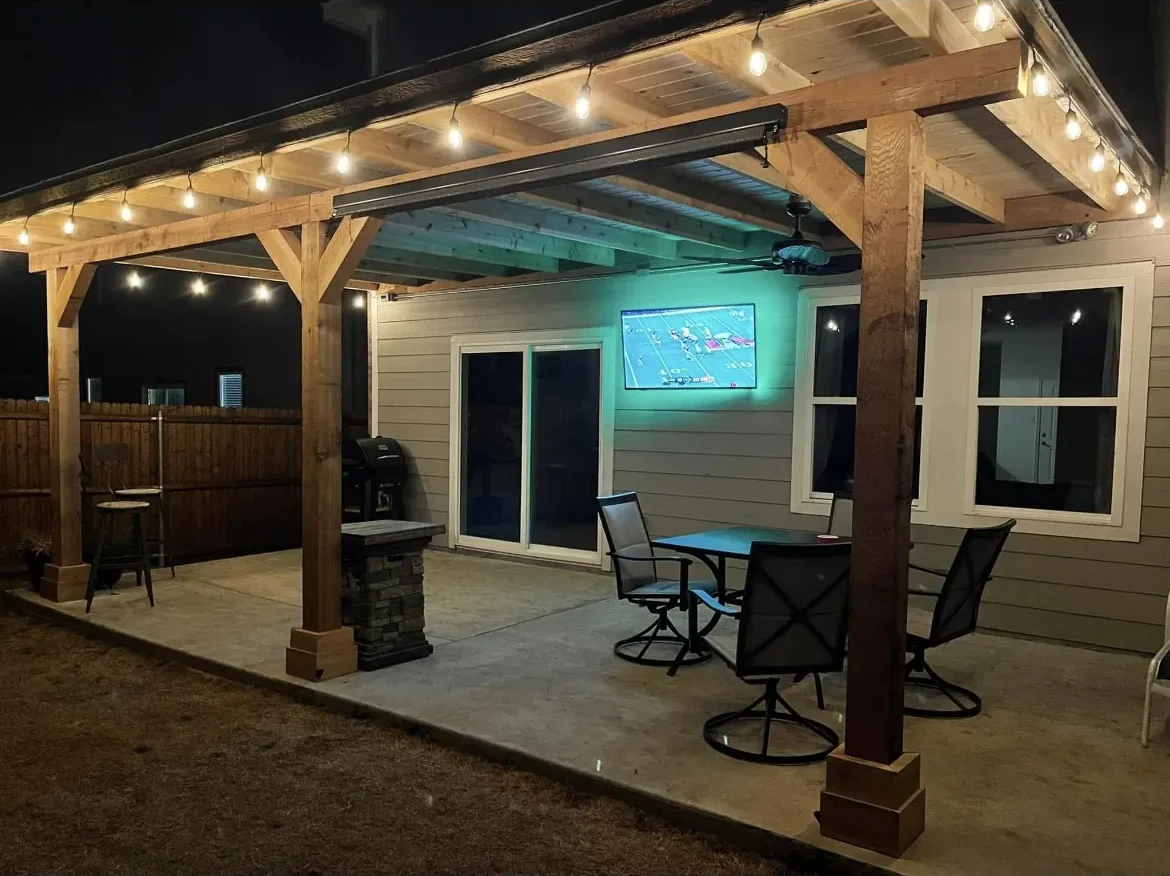
A deck is three parts that wear out at different speeds: the boards you walk on, the frame underneath, and the metal that holds it together. This guide covers all three, what the warranties actually cover, and how Texas heat, storms, termites and clay change the picture. Every figure comes from a named source listed at the end.
How long does a deck last in Texas?
Plan on about 10 to 15 years for a wood deck and 25 years or more for composite or PVC boards, going by the makers' own figures. Those numbers are national, and they describe the boards. A deck is three parts that age at different speeds (boards, frame and hardware), and any one of them can end the deck first.
There is no Texas or Dallas study of deck lifespan. Every figure in this guide is either national research or a claim from a maker, seller or trade group, and it is labeled that way.
A Fairfax County, Virginia building official says a deck built and inspected to code and properly maintained should last 20 years or more, with an evaluation every year and more often as it ages. The North American Deck and Railing Association (NADRA) counts over 60 million decks in North America, many now over 20 years old. Its message: every deck has a life expectancy, and if yours is 20 years or older, take a serious look and get a qualified inspection.
The USDA Forest Products Laboratory (FPL), the federal wood research lab, adds the most useful fact of all. Wood decks are most often replaced because the boards check and split, not because they rot. FPL also says a wood deck kept water-beading with a finish can give 40 or more years of service. So the range is wide, and how the deck was built and kept up decides where yours lands in it.
| Part of the deck | What usually ends it | Main source |
|---|---|---|
| Boards | Checking, splitting, warping and cupping from sun and rain cycles | FPL |
| Frame (joists, beams, posts, ledger) | Rot where water sits, an unflashed ledger, termites, ground movement | Trex, FPL, NRCS |
| Hardware (screws, hangers, connectors) | Corrosion from treated lumber chemicals, which then damages the wood around it | Simpson Strong-Tie, NADRA |
Decking material lifespan: pressure-treated, cedar, ipe, composite and PVC in the Texas climate
Board life runs from about 10 to 15 years for treated pine to 50-plus years claimed for PVC, but every year figure here comes from a maker, seller or trade group, not an independent Texas test. The most useful column is the last one: what federal wood research says about each material in heat and humidity.
| Board material | Claimed life (and who claims it) | Warranty that backs it | What FPL research says |
|---|---|---|---|
| Pressure-treated pine | 10 to 15 years (Trex, a composite maker; TimberTech gives 10 to 15 for wood decks in general) | YellaWood "lifetime limited": structural failure from rot, decay or termites only, not weathering | Most untreated pine is rated slightly or nonresistant to decay. Treated wood and naturally durable woods have "quite comparable" service lives as deck boards |
| Western red cedar | 25+ years (Western Red Cedar Lumber Association, a trade group) | None found in our sources | Heartwood rated "resistant," with a note that resistance may be lower in warm, humid climates |
| Ipe | 40+ years, "up to 75" in optimal conditions (Advantage Lumber, an ipe seller; no test cited) | None found in our sources | Heartwood rated "very resistant" |
| Composite | About 25 years on average, up to 50 by product line (Trex); 25 to 30 years (TimberTech) | Trex: 25 years (Enhance), 35 (Select), 50 (Transcend). TimberTech Composite: 25 to 30 years | Decay fungi can break down the wood fibers in wood-plastic composites once moisture gets in (mostly tested on experimental boards) |
| PVC | 50 years or more (TimberTech) | TimberTech Advanced PVC: limited lifetime product warranty, plus a 50- or 35-year fade and stain warranty depending on collection | No independent long-term data in our sources |
Two things stand out. First, the only research-based year figure in this whole topic is FPL's 40-plus years for a wood deck kept water-beading. Second, a board claim says nothing about what the boards sit on. If the frame is wood, it ages on its own clock, which the frame section below covers.
For cost, heat and upkeep side by side, see our guide to every decking material for Texas heat.
Manufacturer lifespan vs warranty vs real life
A 25- or 50-year warranty is not a 25- or 50-year promise. The Trex and YellaWood warranties cover the material failing on its own, and they exclude most of what actually ends a deck: weathering, rusted hardware, wet sites, poor gapping and ground movement.
What the Trex warranty says (2019 version)
Trex's published fade and stain warranty for Transcend, Enhance and Select (the 2019 version we opened) runs 25 years for homes, but claims in years 11 to 25 are prorated: 80% in years 11 to 13, 60% in 14 to 16, 40% in 17 to 19, 20% in 20 to 22 and 10% in 23 to 25. Fading counts only beyond 5 Delta E units (a measured color change), and the warranty itself says "no material is fade proof." The remedy is replacement boards or a refund of the board price, not the labor to tear out and reinstall.
What a treated-lumber "lifetime" warranty covers
YellaWood's micronized copper azole warranty, issued by Koppers, covers only "structural failure" from rot, fungal decay or termites, and it does not transfer to a later owner of the home. Its exclusions read like a list of how wood decks really fail: weathering "including... raised grain, splitting, checking, cupping, twisting, warping," and corrosion of fasteners and any failure it causes.
| Warranty | Term | Covers | Does not cover |
|---|---|---|---|
| Trex fade and stain (2019 version) | 25 years, prorated from year 11 down to 10% | Fade beyond 5 Delta E; stains (mold only if cleaned within a week) | Labor, improper gapping or install, ground or structure settling, wear and tear, paint, heat over 275 degrees |
| YellaWood MCA lifetime limited | Lifetime, original owner only | Structural failure from rot, decay or termites | Weathering, splitting, warping, fastener corrosion. For Above Ground-rated lumber: use in joists and beams, under 6 in above grade, poor drainage or airflow, frequent wetting |
| Trex Protect joist tape | 25 years (extended from 20) | Tops of joists, beams and rim joists against moisture | Full terms not in our sources |
| Fortress Evolution steel framing (vendor claim) | 25-year limited | Defects | Full terms not in our sources |
| TimberTech Advanced PVC and Composite | PVC: limited lifetime product, 50 or 35 years fade and stain. Composite: 25 to 30 years | Product, plus fade and stain | Not detailed on the summary page |
For brand-by-brand warranty detail, see how Trex, TimberTech and Fiberon compare.
How long do deck joists, beams and posts last?
No source we found gives a year figure for a deck frame on its own. Its life depends on three things: whether the lumber was rated for ground contact, whether the tops of the joists stay dry, and whether the wood is kept off the soil.
The lumber rating matters most
The American Wood Protection Association (AWPA) puts deck boards and railings in "Above Ground, UC3B or higher." Posts, structural posts and the ledger (the board bolted to the house) need "Ground Contact, UC4A or higher." Joists and beams are UC3B above ground or UC4A in ground contact, and above-ground parts that "are difficult to replace and critical to the structure" may need ground-contact treatment.
YellaWood's warranty takes the stricter view. It counts "joists and beams for decks" as ground-contact use, and it doesn't cover Above Ground lumber used for joists and beams. The difference in preservative is large: 0.06 pounds per cubic foot for Above Ground against 0.15 for Ground Contact. Ask your builder which rating the frame lumber carries.
Where frames rot first
Trex says wood decks usually rot first at the connection points between the boards and the frame, and that a ledger without proper flashing can lead to rot. It adds that poor construction causes problems maintenance can't fix. FPL agrees: serious decay is almost always a sign of faulty design or construction, careless handling or poor maintenance.
One builder's opinion: Doug Horgan in Green Building Advisor says CCA-treated pine left the home market in 2004 and today's treated lumber is "not as rot-resistant as it used to be." His firm uses only ground-contact lumber, flashes joist and beam tops, and treats field cuts, while conceding "only time will tell."
Steel and aluminum frames
Fortress backs its Evolution steel framing with a 25-year limited warranty and a powder-coated finish it says is "designed to prevent corrosion or rust." TimberTech offers aluminum framing as one way to protect the substructure. Both are maker claims, with no independent lifespan data.
Long-life boards on a wood frame
This is why the frame question matters for composite. A board claimed to last 25 to 50 years can sit on a wood frame, and TimberTech's own advice for that frame is joist flashing tape plus a yearly inspection. If you are putting new boards on an old frame, our post on deck resurfacing and re-boarding covers when the old frame can stay.
Fasteners, joist hangers and connectors: the corrosion clock
Treated lumber corrodes steel, so code guidance calls for hot-dip galvanized or stainless fasteners and G-185 galvanized or stainless hangers, and the fasteners and connectors must be the same corrosion-resistant material.
The detail comes from the American Wood Council's DCA 6 deck guide, which is based on the 2015 IRC and cites IRC R317.3. Screws, bolts, nails and washers in treated wood must be hot-dipped galvanized, stainless steel, silicon bronze or copper. Joist hangers and post anchors must be galvanized (G-185 pre-galvanized, or hot-dipped after fabrication to ASTM A123) or stainless. Within 300 feet of salt water, use 304 or 316 stainless.
Dallas now builds to the 2021 ICC codes, with the 2021 IRC plus Dallas amendments as the residential code, effective May 12, 2023. In the 2021 IRC, deck fasteners and connectors sit in Section R507.2.3, and a municipal summary of it lists the same G185 galvanized or stainless standard for connectors.
Why the rule exists: DCA 6 notes that in accelerated lab tests, connectors and fasteners exposed to some preservative chemicals showed "high rates of corrosion." Simpson Strong-Tie says treated wood creates increased corrosion risk, that ACQ-Type D is more corrosive than copper azole, micronized copper azole or CCA-C, and that "even stainless steel can corrode." It tells builders to get the treatment details from the lumber supplier.
Why it matters for lifespan: NADRA warns that "a corroded fastener can cause deterioration in surrounding wood," and suggests replacing rusted fasteners. And the YellaWood warranty excludes fastener corrosion and any failure it causes. If the hardware rusts and the frame fails, that lumber warranty won't pay.
Stainless steel vs hot-dipped galvanized for decks?
Under DCA 6, either one meets the rule for fasteners in treated wood. Stainless is required only within 300 feet of salt water, which doesn't apply in Dallas. The bigger point is Simpson's: corrosion depends on the treatment chemical, so match the hardware to the lumber you are using, and never mix metals between fasteners and connectors.
Texas sun and heat cycling: UV, warping and cracked, faded boards
DFW summers often top 100°F, and sun-heated boards dry and shrink on top while the core stays wet, which is what checks, cups and warps a wood deck.
The National Weather Service in Fort Worth says July and August highs are consistently in the 90s and often reach or exceed 100 degrees. FPL explains the damage. Sun dries and shrinks the surface of the wood while the core stays wet, then rain swells it again fast. That stress causes checks, cracks, warping and cupping. Horizontal surfaces such as decks "are often the worst affected," and darker finishes heat up more and cause more warping and checking than lighter ones.
UV light starts breaking down the surface of wood within a few hours, which is why boards turn gray. Actual wear is slow: unprotected wood loses about 1/4 inch (6 mm) per century, faster for lower-density wood. So UV mostly changes the look. The checking and splitting from heat and rain cycles is what ends wood boards.
Composite has its own heat rules. Trex's 2026 installation guide says gaps are needed for drainage and for the boards' "slight thermal expansion and contraction": at least 3/16 inch between boards, never more than 1/2 inch, and 1/8 inch at the ends above 40°F. Its warranty excludes improper gapping and says no material is fade proof.
A roof over the deck keeps both sun and rain off the boards, the two things FPL ties to checking. No source we found measures how many years that adds, so treat it as a sensible step, not a number. See covered decks and pavilions.
Humidity, rain and poor drainage: what really rots a deck
Humid air alone doesn't rot wood. Liquid water that can't drain or dry does, so gaps, airflow and clearance matter more than the humidity reading.
FPL says serious decay needs wood moisture above fiber saturation (about 30% on average), and only liquid water from rain, condensation or wet ground gets wood that wet. "The water vapor in humid air will not wet wood sufficiently." Air-dried wood at 20% moisture or less has a safety margin.
North Texas still gets plenty of liquid water. The NWS describes "stifling humidity" from the Gulf, annual rainfall that ranges from under 20 to over 50 inches, and large hail, damaging winds, flooding and tornadoes in the Metroplex nearly every year.
Where water sits on a deck
- Low decks: YellaWood won't cover Above Ground-rated lumber installed less than 6 inches above final grade.
- No airflow: Trex says "all decks require air circulation to keep them dry," so leave openings under the deck or widen gaps to 3/8 inch.
- Trapped debris and bad drainage: FPL says a drained site lowers decay risk, and YellaWood excludes Above Ground-rated lumber where debris builds up or the deck doesn't drain.
- Sprinklers, pools and hot tubs: YellaWood excludes Above Ground-rated lumber that gets wet often.
Composite isn't immune to moisture
FPL reports that decay fungi can form voids in wood-plastic composites by breaking down the wood fibers. Its 20-year research summary found that moisture-swollen wood particles microcrack the plastic and let fungi in. In field tests, including humid Mississippi, cracking, decay and termite attack showed up 1 to 10 years after exposure.
Those tests were mostly on experimental formulas, not today's capped boards, so they don't show that capped composite rots. They do show why composite still needs good gaps and airflow.
Termites and ground contact
Subterranean termites are a statewide Texas risk, and any wood touching soil is the easiest way in.
Texas A&M says homeowners in all areas of Texas should watch for subterranean termites, and that wherever wood touches soil, the risk of entry is high. Signs include mud tubes, mud-lined tunnels along the grain, and wood that sounds dull when tapped. Moisture sources encourage them.
FPL adds that the hazard is greatest in frame wood close to the ground, and that termites leave "a shell of sound wood," so probe suspect wood with a pick or knife rather than trusting how it looks.
Formosan termites: Texas A&M has found them in 31 Texas counties, and Dallas County is on the list. They do the same damage as native termites but faster, in colonies that can top 1 million. The same page says there is little chance of meeting them outside the upper Gulf Coast.
The defense is in the build. Posts and the ledger should be ground-contact lumber (UC4A or higher). DCA 6 says all lumber touching the ground must be ground-contact treated, cut ends must be field treated with a preservative such as copper naphthenate, and naturally durable wood only counts with 90% or more heartwood.
Blackland Prairie clay: when the ground moves the deck
The Blackland Prairie clay that runs through the Dallas area shrinks and swells as it wets and dries, so footings can shift and rack a frame long before the boards wear out.
The USDA Natural Resources Conservation Service says Houston Black clay covers about 1.5 million acres of the Blackland Prairie, from north of Dallas to San Antonio. These soils "shrink and swell markedly with changes in moisture content," and that very high shrink-swell potential commonly limits building site development.
Trex's 2019 warranty excludes movement or settling "of the ground or the supporting structure." Footing depth, pier types and watering are covered in our post on deck footings in Dallas clay.
How to make a deck last longer in Texas: joist tape, stainless fasteners, ventilation and ground-contact lumber
The upgrades that add years all keep water off the frame and the metal: ground-contact lumber for the frame, joist tape on joist tops, matching corrosion-resistant hardware, proper gaps and open airflow, and treated cut ends.
- Ground-contact lumber for posts, ledger, joists and beams (AWPA, YellaWood).
- Treat every cut end with an approved preservative (DCA 6).
- Butyl joist tape on joist and beam tops to shield them from moisture (Trex).
- Matching corrosion-resistant hardware chosen for the lumber's treatment (DCA 6, Simpson).
- Correct gaps and open airflow under the deck (Trex).
- At least 6 inches of clearance, with sprinklers aimed away (YellaWood warranty conditions).
- Flash the ledger (Trex).
- Pick a lighter color, since darker finishes check and warp more (FPL).
- Use a penetrating finish on wood, not a film finish; FPL says penetrating stains "can greatly extend the life of a deck."
Is deck joist tape necessary?
It isn't a code requirement in any source we found. Makers sell and warranty it (Trex extended its Protect tape warranty from 20 to 25 years), TimberTech recommends it, and some builders now flash every joist and beam. What no one has published is independent data on how many years it adds, so think of it as extra protection for the part that's hardest to replace, not a proven number.
These are good questions to put to any builder, and our list of questions to ask a deck builder includes them. If you're planning a new deck, Archetex Outdoor Design Co. builds composite and wood decks in Dallas and gives a free site visit and written price, so you can ask about every item on this list.
A maintenance schedule that adds years
Wood needs regular cleaning and a penetrating finish every 1 to 6 years, depending on the product and how weathered the boards are. Composite needs periodic washing so mold doesn't take hold.
| Task | How often | Why | Source |
|---|---|---|---|
| Walk-around and probe check | Every year, more often as the deck ages | Catch problems while they can still be repaired | Fairfax County, TimberTech, NADRA |
| Clear leaves and debris from boards, gaps and underneath | As needed | Trapped debris holds water; YellaWood excludes those spots | NADRA, YellaWood |
| Clean a cedar deck | Once a year | Trade group recommendation | WRCLA |
| Wash a composite deck | Periodically; clean mold within a week | Dirt and pollen feed mold; Trex covers mold stains only if cleaned within a week | Trex (2019 warranty) |
| Tinted deck finish | 1 to 2 years on new smooth boards; 2 to 3 on weathered or saw-textured | US average location; depends on climate and exposure | FPL |
| Semitransparent stain | 2 to 3 years on new smooth boards; 3 to 6 on weathered or saw-textured (WRCLA says usually every 2 or 3 years on cedar) | Keeps the surface water-beading | FPL, WRCLA |
| Avoid film-forming finishes and paint | Always | They peel on decks; FPL rates paint "Low" for decking | FPL |
FPL's finish figures are for an average US location and "depend on climate and exposure." The practical test: when water stops beading on the boards, recoat.
Signs a deck is near the end of its life
A deck is wearing out when the frame shows it, not just the surface: wood a screwdriver sinks into 1/4 to 1/2 inch, rusted hardware, a deck that sags or sways, and checking and splitting across most of the boards.
- Soft wood. NADRA says to probe the ledger, posts, joists, boards and stairs, especially damp spots. If the tool goes in 1/4 to 1/2 inch easily, the wood breaks off without splinters, or it feels soft and spongy, decay may be present.
- Insect signs. Small holes (NADRA), and mud tubes or wood that sounds dull when tapped (Texas A&M). Remember termites can leave a sound-looking shell.
- Rusted fasteners and hangers. They weaken the wood around them.
- A ledger held with nails only. NADRA says it shouldn't be.
- Sag, sway or movement when you walk on it.
- Missing flashing, or decay in stair stringers and risers.
- Checking and splitting across the deck, the most common reason FPL gives for replacing wood decks.
If your deck is 20 or older, NADRA's advice is to take a serious look and get a qualified inspection. For deciding whether to fix it or start over, and what each costs, see deck repair vs replace in Dallas.