This guide is for two kinds of North Texas homeowner: the one looking at fresh marks on the deck after a storm, and the one picking deck materials who wants to know how hail fits in. It covers how often hail hits DFW, what the decking makers' warranties say, what Texas insurance rules say, how to document damage, and how wind treats pergolas and patio covers. It is general information, not insurance or legal advice. Your own policy and your agent have the final word.
How often does North Texas get hail?
Every year. By our count of NOAA's Storm Events records, the five core DFW counties (Dallas, Tarrant, Collin, Denton and Rockwall) logged 1,409 hail reports from 2015 to 2025, and every one of those 11 years had at least one report of golf-ball hail (1.75 inches) or larger.
The National Weather Service office in Fort Worth puts it simply: large hail, damaging winds, flooding and tornadoes occur nearly every year in DFW, though any one address is unlikely to get all of them in a given year. Severe weather peaks in spring.
Here is what the NOAA files show for those five counties. These are our own calculations from NOAA NCEI's bulk Storm Events files, not figures NOAA publishes in this form.
- Hail days: between 9 and 23 days a year had at least one hail report, 164 days in total, or about 15 a year on average.
- Big hail days: days with hail of 1.75 inches or larger ranged from 3 a year (2018 and 2020) to 11 (2023).
- Season: March through June produced 1,215 of the 1,409 reports, or 86%.
| Hail reports by county, 2015 to 2025 | Reports | Hail reports by month, 2015 to 2025 | Reports |
|---|---|---|---|
| Tarrant | 482 | April | 384 |
| Denton | 379 | March | 315 |
| Collin | 316 | May | 309 |
| Dallas | 202 | June | 207 |
| Rockwall | 30 | September | 55 |
| Total | 1,409 | Every other month | Under 30 each |
Read these counts with care. The Southern Climate Impacts Planning Program (SCIPP) says hail data are not of sufficient quality to robustly determine historical trends, and that the severe-hail size threshold changed from 0.75 inch to 1 inch. SCIPP also says Storm Prediction Center data show northern Texas had the highest frequency of large hail in 1955 to 2024.
Statewide, the Insurance Information Institute reports that Texas had 902 major hail events (hail of 1 inch or larger) in 2025, the most of any state, and that Texas topped State Farm's list of states for hail claims.
The storms North Texas remembers
- Mayfest, May 5, 1995: hail up to softball size, an estimated $2 billion in damage in Tarrant and Dallas counties, and over 400 injuries (NWS Fort Worth).
- June 13, 2012: hail the size of baseballs (2.75 inches), oranges (3 inches) and softballs (4.25 inches) in Dallas, Collin and Fannin counties, with about $900 million in damage.
- Wylie, April 11, 2016: a 5.25 inch hailstone, then the record for the NWS Fort Worth area. NWS says 80% of Wylie homes were affected and damage topped $300 million.
- Sanger, June 15, 2023: a 5.9 inch stone in Denton County, the biggest DFW-area hailstone in the NOAA database, which NWS Fort Worth examined in person. Three days earlier, Mansfield had a 5.0 inch stone.
The NWS list of the costliest Texas hailstorms (Insurance Council of Texas data, in 2013 dollars) is mostly North Texas: Mayfest 1995 at $1.62 billion, Fort Worth and Waco on April 28, 1992 at $1.21 billion, North Texas on April 5, 2003 at $1.13 billion, and the June 13, 2012 storm at an estimated $901 million.
Does hail damage composite decking? What Trex, TimberTech, Fiberon and Deckorators say
Hail can mark composite and PVC decking, and none of the big four brands' warranties covers storm damage: Fiberon and Deckorators exclude hail by name, and Trex and TimberTech exclude acts of God. That is the manufacturer guidance a North Texas homeowner needs before a storm, because it decides who you call after one.
We read each brand's current warranty document. Here is the storm-related wording, side by side.
| Brand (warranty read) | Storm wording | Dents, scratches, impact | Claim window | Labor to remove and reinstall |
|---|---|---|---|---|
| Trex decking (2023 PDF) | Excludes "any act of God (such as flooding, hurricane, earthquake, lightning, etc.)". Hail is not named. | Warranty voided if the surface is damaged or punctured (under its shovel "Surface Damage" heading) | Within the warranty period, with no day count (a 30-day limit applies only to stain claims after professional cleaning); claim needs a written description, photos and proof of purchase | Not covered. Product or refund only, no labor or freight |
| TimberTech composite (eff. Oct 1, 2023) | Excludes "any act of God (such as flooding, hurricane, earthquake, lightning, etc.)". Hail is not named. | Not stated in the warranty. Coverage is limited to manufacturing defects that cause splitting, splintering, rot or termite or fungal damage | 30 days from discovering the defect | Not covered |
| TimberTech Advanced PVC (eff. June 12, 2026) | Excludes acts of God | Excludes "abrasions, cuts, scratches, nicks or dents or other aesthetic conditions" | 30 days; TimberTech may inspect before removal | Not covered |
| Fiberon residential (eff. Nov 1, 2025) | Excludes acts of God "including ... tornado, wind, earthquake, lightning, hail" | Excludes wear, abuse or neglect including "impact from objects" | 30 days from discovery; Fiberon must decide before permanent repairs or removal | Installation cost for replacements not covered |
| Deckorators (form 7971, 10/25) | Excludes "Acts of God or other extreme weather conditions", naming tornado and hail | Excludes "Scratches, surface marks, or any other accidental damage" | 30 days from discovery; product must be registered; work before inspection "shall nullify" coverage | Not covered, except a prorated share of install costs for Voyage and Picture Frame products |
Three things stand out:
- Hail is named by two brands, not by the other two. Trex and TimberTech list flooding, hurricane, earthquake and lightning and end with "etc." They don't use the word hail, so read your own copy, but don't count on a hail claim with either.
- The 30-day clock. TimberTech, Fiberon and Deckorators all want notice within 30 days of discovering the problem. Fiberon also says you must make temporary repairs or cordon off the area, and that removing or permanently repairing boards before it decides "may" void the warranty.
- Almost no labor. Trex, TimberTech and Fiberon exclude the labor to tear out and reinstall boards. Deckorators does too, except for a prorated share of install costs on its Voyage and Picture Frame products. For most boards, even a covered defect means material only.
What about "does hail damage Trex"? The closest Trex statement we found is from its fencing knowledge base, not decking: it says hail can leave marks on the material but is not strong enough to break the product. That is a fencing answer, and we found nothing like it for Trex decking boards.
For brand tiers, warranty lengths and the rest of the fine print, see our composite brands compared guide.
Wood, composite, PVC and aluminum: how each handles hail
No deck board has a hail rating, so the honest way to compare them is by how each one fails: wood dents in proportion to how soft it is, capped composite and PVC can scratch and dent in ways their warranties call cosmetic, and we found no published hail data for aluminum boards.
Wood: hardness is the number to look at
The USDA Forest Products Laboratory defines wood hardness as resistance to indentation, measured with a modified Janka ball test. The higher the number, the more force it takes to dent the wood. That is the mechanism for hail dents on a wood deck, though nobody has published the hail size that dents each species.
| Wood species | Side hardness at 12% moisture (lbf) |
|---|---|
| Western redcedar | 350 |
| Redwood (old growth) | 480 |
| Loblolly pine | 690 |
| Longleaf pine | 870 |
| Ipe | 3,680 |
Ipe is about ten times harder than western redcedar by this measure (calculated from the FPL figures: 3,680 divided by 350 is about 10.5). That softness is why cedar marks more easily. For how these woods do in Texas heat and sun, see the best wood for Texas decks.
Composite and PVC: cosmetic marks are on you
The warranty language tells you how the makers treat surface marks: Deckorators excludes "scratches, surface marks, or any other accidental damage", and TimberTech's PVC warranty excludes "nicks or dents or other aesthetic conditions". Whatever the board's actual toughness, a scratched cap or a small dent is not a warranty claim.
We found no independent hail or impact test of any composite or PVC deck board, and no source that gives the hail size that cracks one. So we can't tell you composite beats wood in hail, or PVC beats composite. For the other differences between the two, see PVC vs composite.
Aluminum: no data found
We found no maker statement and no test on how aluminum deck boards handle hail. If hail is your main worry, ask the maker directly and get the answer in writing.
Is there hail-resistant decking? UL 2218 and FM 4473 explained
Not in the rated sense. UL 2218 and FM 4473 are the two well-known hail impact standards, both are for roofing, and we found no deck board that carries either rating. If you see "hail resistant" on decking, ask which test it refers to.
FM 4473 is FM Approvals' test for rigid roofing such as slate, concrete or clay tiles, mainly on steep-slope roofs. It fires freezer ice balls at the material to match the energy of real hail of the same size:
| FM 4473 class | Ice ball size | Closest NWS hail name |
|---|---|---|
| Class 1 | 1 1/4 in | Half dollar |
| Class 2 | 1 1/2 in | Ping pong ball |
| Class 3 | 1 3/4 in | Golf ball |
| Class 4 | 2 in (target energy 26.81 ft-lb) | Hen egg |
A pass means no visible cracking or breakage. FM also notes the test is for new material and that weathering can lower hail resistance, which matters for anything that sits in Texas sun for years.
UL 2218 is a roofing impact test too. The Texas Department of Insurance (TDI) says roofing materials must pass a recognized impact test to qualify for an insurance discount, rated Class 1 to Class 4, with Class 4 getting the highest credit, and that the Texas Windstorm Insurance Association (TWIA) credit requires roofing that passed UL 2218. TDI's examples are shingles, tiles, shakes, metal panels and other roof coverings. Decking is not on the list.
Compare the classes with the local record: golf-ball hail (the FM Class 3 size) showed up somewhere in the five DFW counties every year from 2015 to 2025, by our count of NOAA data. Rated hail protection over a deck has to come from a roof, which is the next section.
A roof is the best hail protection for a deck
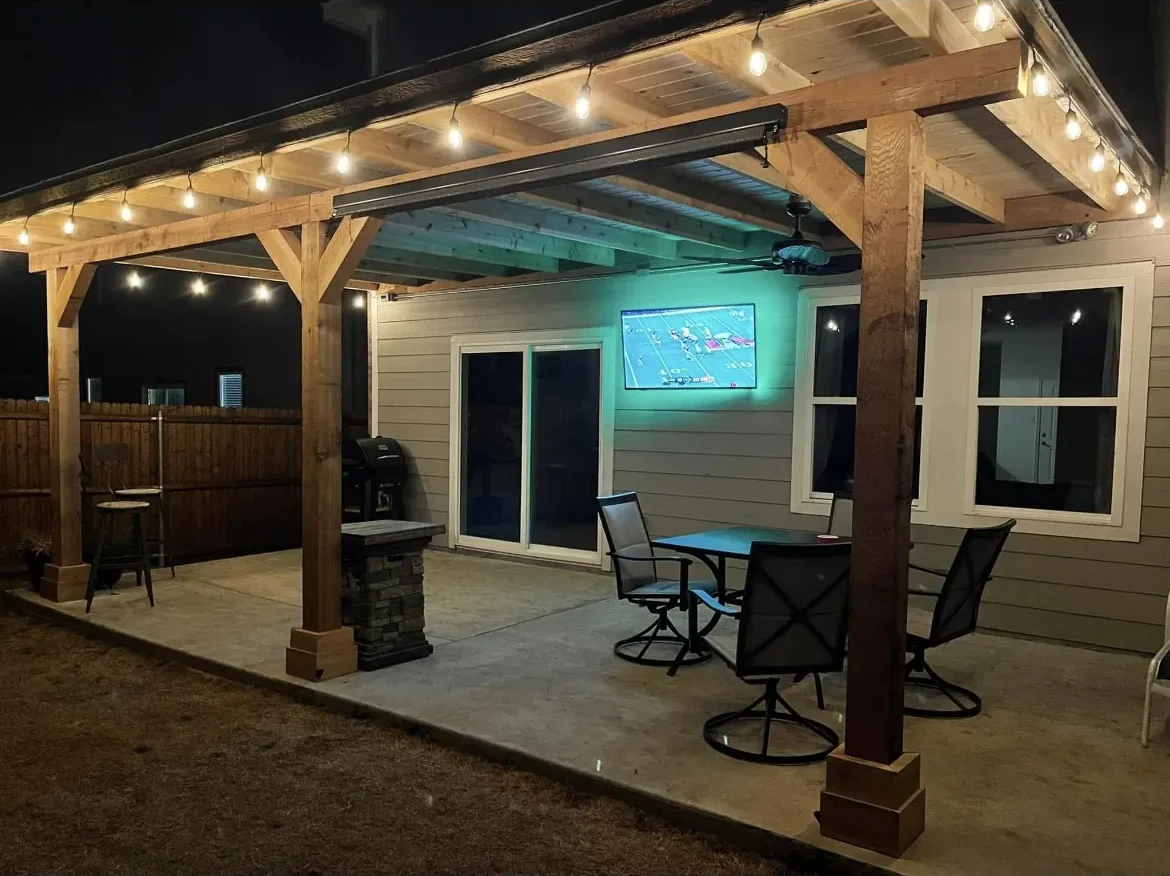
The surest way to keep hail off deck boards in Dallas is to put a roof over them. Block Renovation's Dallas guide says metal roofing on patio covers resists hail better than shingles, especially at higher gauges, and that Class 4 impact-rated shingles are worth their 10% to 20% premium.
Block also calls North Texas hailstorms "annual events" and a covered patio the first line of defense for furniture and equipment. A second Block guide says metal handles wind and hail better than asphalt but costs two to three times more.
That gives you a simple choice:
- Match the house: shingles on the cover, and pick Class 4 impact-rated ones if you go that way.
- Best for hail: metal roofing, at a higher material price.
For sizes and price ranges, see our covered deck cost guide. Archetex Outdoor Design Co. builds covered decks and pavilions, pergolas and patio covers across Dallas and nearby cities.
Wind: what storms do to pergolas and patio covers
Storms bring wind as well as hail, and the National Weather Service counts a storm as severe when it brings winds of at least 58 mph, hail of at least 1 inch, or a tornado. Our count of NOAA records found 713 thunderstorm-wind reports in the five core DFW counties from 2015 to 2025.
Pergolas and patio covers are open structures that catch wind, so how they are anchored matters. Some DFW cities set rules for this:
- Rowlett: all accessory buildings, including patio covers, carports, sheds, pergolas and arbors, must resist a 115 mph wind load. Rowlett lists three ways a patio cover can comply: posts embedded in concrete piers at least 30 inches deep and 12 inches in diameter, Simpson CBS or CBSQ column bases (or an equivalent), or a plan sealed by a Texas engineer.
- Frisco: patio covers, arbors and similar structures made of aluminum, steel or vinyl must be engineered.
A kit pergola screwed onto a slab is not one of Rowlett's three listed methods, so in Rowlett ask the city or an engineer before you install one. The 115 mph figure is Rowlett's rule only. We found no published Dallas design wind speed for pergolas or covers, so ask the city or your builder for the number where you live. See Rowlett's 115 mph anchoring rule for more on the Rowlett rule.
Roof shape helps too. Block Renovation cites research showing hip roofs see smaller wind pressures than gable roofs because they have no flat face for pressure to build on, and says freestanding covers need more posts, footings and bracing to stand up to wind than covers tied to the house.
When a tree or limb falls on the deck
Texas policies often pay when a falling tree damages a covered structure, but a tree that falls in the yard without hitting anything usually isn't covered, and a neighbor's insurer usually won't pay for an act of nature. That is TDI's summary; your own policy wording decides.
- Falling objects: TDI says many policies pay for damage from falling objects such as trees, and many give some coverage to remove trees or limbs that fell in a storm and hit the house or block the driveway.
- Yard only: trees and limbs falling in your yard usually aren't covered.
- The neighbor's tree: TDI says your neighbor isn't responsible for acts of nature, and their policy probably won't pay unless they were at fault, so you file on your own policy.
- Dead trees: MoneyGeek, a national insurance site, says a tree that falls in a windstorm is generally covered, but a claim could be denied if the tree was known to be dead or hazardous.
Before anyone walks on a deck a limb has hit, check the posts, beams, ledger and railings. Our guide on how to check a deck is safe walks through it. If in doubt, keep people off until it has been looked at.
Does homeowners insurance cover hail damage on a deck in Texas?
Often yes, if your policy covers wind and hail, but how much depends on whether the deck counts as part of the house or as an "other structure", and on your deductible. TDI says most policies define other structures as structures not attached to your house, and most cover them at 10% of the home's insured value.
TDI's example: a $300,000 house would have $30,000 of other-structures coverage. TDI adds that policies usually pay actual cash value (the cost minus depreciation) for fences.
For attached decks, MoneyGeek, a national insurance site, says an attached deck is classed as part of the dwelling (Coverage A), while a detached deck falls under Coverage B (Other Structures). MoneyGeek also lists hail as a named peril and says gradual rot isn't covered. We could not open the Texas policy forms themselves, so ask your agent how your policy treats your deck.
The deductible often decides it
TDI notes that a deductible may be a dollar amount or a percentage. TDI's own example: a home insured for $150,000 with a 5% deductible has a $7,500 deductible, so a $6,500 hail repair gets nothing, because the repair is less than the deductible.
To see how the math scales: on a $400,000 home, a 2% wind and hail deductible would be $8,000 (our calculation, 2% times $400,000, shown only to explain how a percentage deductible works). Check the actual percentage and dollar figure on your declarations page.
| What to check on your policy | Why it matters for a deck | Source |
|---|---|---|
| Is the deck attached or detached? | TDI: other structures are usually things not attached to the house. MoneyGeek: attached decks are usually dwelling coverage. | TDI, MoneyGeek |
| Other-structures limit | Often 10% of the home's insured value ($30,000 on a $300,000 house in TDI's example) | TDI |
| Wind and hail deductible type | A percentage deductible can exceed a deck repair (TDI's $7,500 vs $6,500 example) | TDI |
| Actual cash value or replacement cost | TDI says fences are usually paid at actual cash value, minus depreciation; ask how your deck is paid | TDI |
| Falling-tree and debris removal | Many policies cover falling-object damage and some removal of storm-fallen trees that hit the house or block the driveway | TDI |
How to document hail and storm damage on a deck (step by step)
Photograph everything before you clean up or pull a single board, because TDI says to take photos and video, Trex asks for photos with any claim, and Fiberon, Deckorators and TimberTech's PVC warranty all expect a chance to decide or inspect before boards come out.
- Safety first. Stay off the deck if posts, railings or the ledger look damaged.
- Photos and video, wide and close. Shoot the whole deck, then each damaged area, then single boards. TDI recommends photos and video of the damage.
- Show the size. Put a coin or ruler next to dents and next to any hailstones you saved. The NWS size chart helps you describe them: quarter (1 inch), half dollar (1 1/4), ping pong ball (1 1/2), golf ball (1 3/4), hen egg (2), tennis ball (2 1/2), baseball (2 3/4), teacup (3), grapefruit (4), softball (4 1/2).
- Write down the date and time of the storm and when you found the damage. The 30-day warranty windows run from discovery.
- List the damage. TDI says to make a list. Include the cover, pergola, railings, furniture and grill.
- Keep the damaged pieces until your insurer says you can throw them out (TDI).
- Prevent more damage. TDI says to cover holes. Fiberon's warranty requires you to make temporary repairs or cordon off the area.
- Keep receipts for tarps, rope and other temporary fixes. TDI says your policy may pay for temporary repairs.
- Find your proof of purchase and product name. Trex asks for a written description, photos and proof of purchase, and Deckorators requires the product to be registered.
- Keep a log of every call and email with the insurer, the maker and contractors, with names and dates.
Claim timelines in Texas: insurer deadlines and warranty windows
TDI says to file an insurance claim as soon as you can. Once you do, your insurer has 15 business days to acknowledge it, then 15 business days after it has what it needs to say whether it will pay.
| Step | Deadline | Source |
|---|---|---|
| You file the insurance claim | As soon as you can (we found no official filing deadline to quote) | TDI |
| Insurer acknowledges the claim | 15 business days | TDI |
| Insurer says yes or no | 15 business days after it has what it needs; it can extend by 45 days with a reason, and TDI can add 15 more after a weather catastrophe | TDI |
| Insurer pays | Within 5 business days of agreeing to pay | TDI |
| Warranty notice (TimberTech, Fiberon, Deckorators) | 30 days from discovering the problem | Maker warranties |
TDI also says the deductible comes off the payment, and you owe it to the contractor.
The warranty windows matter even though storm damage itself is excluded. If you spot something after a storm that you think is a product defect rather than storm damage, the 30-day clock for TimberTech, Fiberon and Deckorators starts when you find it.
Storm chasers and deductible waivers
Any contractor who offers to waive your deductible, or promises a rebate to cover it, is breaking Texas law, according to TDI.
TDI lists other warning signs after a storm:
- being asked to sign before you get an estimate;
- contracts with blank sections;
- large payments up front.
When a disaster is declared, TDI says out-of-area contractors can't ask for payment before they start work. TDI's general advice is to get more than one bid and not to pay in full up front.
Replace boards or replace the deck after a storm?
If only the boards are marked and the frame, footings and ledger check out, new boards on the old frame can work. If the storm cracked framing, or the deck was already near the end of its life, replacing the whole deck usually makes more sense.
We cover the cost side and the decision rules in detail elsewhere: how to repair or replace a damaged deck, and what it takes to put new boards on the old frame. If you rebuild, this is also the moment to think about a roof over part of the deck, since that is the only rated hail protection on the table.
Archetex Outdoor Design Co. builds new and replacement composite and wood decks, covered decks and patio covers in Dallas, with a free site visit and a written price.