This guide compares seven deck woods: pressure-treated southern pine, western red cedar, redwood, ipe, cumaru, garapa and teak. Hardness and decay ratings come from the USDA Forest Products Laboratory's Wood Handbook (2021) unless a figure is labeled as The Wood Database, an independent reference site we use only where the Handbook has no number. Composite, PVC and aluminum are left out on purpose. If you are still weighing those, start with every decking material compared for Texas.
What is the best wood for a deck in Texas?
No single species wins. Pressure-treated southern pine is the cheapest, ipe is the hardest and (with old-growth teak) the most decay-resistant, and cedar and redwood cost more than pine but are the softest woods on the list. Pick by budget, termite risk and how much upkeep you will actually do, then check the table below.
| Wood | Janka hardness (lbf) | Decay resistance (heartwood) | Weight or specific gravity | Tangential shrinkage (The Wood Database) | Price | Termites |
|---|---|---|---|---|---|---|
| Pressure-treated southern pine | 690 (loblolly, shortleaf) to 870 (longleaf) | Most pines in the lowest USDA class, so decking is treated | SG 0.51 (loblolly), 0.59 (longleaf) | 7.4% (loblolly) | $15 to $30/sq ft installed, Dallas (Block Renovation, 2026) | Relies on treatment |
| Western red cedar | 350 | Resistant | SG 0.32 | 5.0% | $19 to $29/sq ft installed, national (Fixr, 2023) | Not named by USDA as termite-resistant |
| Redwood | 480 (old growth), 420 (young growth) | Resistant (old growth), moderately resistant (young growth) | SG 0.40 (old), 0.35 (young) | 4.7% | $27 to $38/sq ft installed, national (Fixr, 2023) | Heartwood has some resistance above ground |
| Ipe | 3,680 | Very resistant | About 64 lb/cu ft at 12% moisture | 7.1% | $30 to $55/sq ft installed, national (Fixr, 2023); $7.07/lin ft for 1x6 +Plus (one dealer's list price) | Resists subterranean and drywood termites |
| Cumaru | 3,330 (The Wood Database) | "Very durable" (The Wood Database) | 68 lb/cu ft dried | 7.7% | $3.70/lin ft for 1x6 +Plus (one dealer's list price) | Good resistance (The Wood Database) |
| Garapa | 1,650 (The Wood Database) | "Durable" (The Wood Database) | 51 lb/cu ft dried | 7.5% | $3.44/lin ft for 1x6 +Plus (one dealer's list price) | Vulnerable (The Wood Database) |
| Teak | 1,000 | Very resistant (old growth), moderately resistant (young growth) | SG 0.55 | 5.3% | Not priced in this guide | Resistant (The Wood Database) |
A note on the prices: they are not like for like. The pine figure is a Dallas installed price, the cedar, redwood and ipe figures are national installed prices from 2023, and the tropical figures are material-only list prices per linear foot from one hardwood dealer, Advantage Lumber, read on November 4, 2026. We have not converted linear feet to square feet, because that depends on board width and gaps. For a full budget, see what a deck costs in Dallas.
The bigger Texas point is how wood decks fail. The Wood Handbook says wooden decks are most often replaced because of checking and splitting, not rot, and that decks finished with water repellents can last 40 years or more. So the finish and the sun matter as much as the species.
Best wood decking materials for a hot Texas climate (heat, UV and humidity)
Humid heat is the hard case for any wood. The USDA notes that its decay ratings may be lower for wood used in warm, humid climates, and strong sun is what drives the checking that ends most decks.
DFW gets both. The National Weather Service in Fort Worth says July and August highs sit in the 90s and often reach 100°F or more, Gulf moisture keeps it humid, yearly rainfall ranges from less than 20 to more than 50 inches, and large hail hits the Metroplex nearly every year. Block Renovation's Dallas guide adds that summers regularly pass 100°F from June through September, with intense UV from May through September.
Three things from the Wood Handbook matter most in that climate:
- Decks take the worst of it. The Handbook says horizontal surfaces such as decks are often the worst affected by checking, cracking and cupping.
- Dark finishes run hotter. Darker colors cause more solar heating, which leads to more checking. A lighter, penetrating finish is easier on the wood.
- Bare wood wears away slowly. Unfinished wood loses about 1/4 inch per century to weathering, and low-density woods wear faster. Cedar, at a specific gravity of 0.32, is the lightest wood in our table.
How hot do the boards get? We found no lab data for every species, only two single tests. In a 2012 test on a Colorado deck at 86.5°F air temperature, an infrared gun read ipe at 141.3°F, new cedar at 148.6°F, pressure-treated pine at 149.9°F and weathered cedar at 170.2°F. A hardwood seller's 2026 full-sun test found every hardwood it tried stayed cooler than composite boards, with plantation teak at about 120°F. Treat both as single tests, not rules. We cover the heat numbers and the 10-year cost math in cedar vs pressure-treated vs Trex in Dallas heat.
Janka hardness: how hard is each deck wood?
Ipe (3,680 lbf) and cumaru (3,330 lbf) are the hardest woods in this guide. Pine sits in the middle at 690 to 870 lbf, and redwood (420 to 480) and western red cedar (350) dent the most easily.
The Janka side hardness test measures the force needed to push a 0.444-inch steel ball halfway into the wood. A higher number means the surface resists denting better.
| Wood | Janka side hardness (lbf, 12% moisture) | Source | Times as hard as western red cedar (calculated) |
|---|---|---|---|
| Ipe | 3,680 | USDA Wood Handbook | 10.5 |
| Cumaru | 3,330 | The Wood Database | 9.5 |
| Garapa | 1,650 | The Wood Database | 4.7 |
| Teak | 1,000 | USDA Wood Handbook | 2.9 |
| Longleaf pine | 870 | USDA Wood Handbook | 2.5 |
| Loblolly or shortleaf pine | 690 | USDA Wood Handbook | 2.0 |
| Redwood, old growth | 480 | USDA Wood Handbook | 1.4 |
| Redwood, young growth | 420 | USDA Wood Handbook | 1.2 |
| Western red cedar | 350 | USDA Wood Handbook | 1.0 |
The last column is our own division of each figure by cedar's 350 lbf. The Handbook adds that ipe is two to three times as hard as white oak and so heavy (about 64 pounds per cubic foot at 12% moisture) that dry heartwood generally sinks in water.
Why other sites show slightly different numbers: The Wood Database lists its own figures for the same species, for example ipe 3,490, teak 1,070 and a blended redwood 450 lbf, while it matches the Handbook on cedar (350) and loblolly pine (690). Samples vary, so a few percent either way is normal.
Hardness cuts both ways. The hardest woods are also the hardest to build with: Advantage Lumber's ipe guide says every screw must be pre-drilled, and The Wood Database says cumaru needs pre-boring too.
Decay and termite resistance: USDA classes and DFW termites
The Wood Handbook rates ipe and old-growth teak "very resistant" to decay, western red cedar and old-growth redwood "resistant", young-growth redwood and young-growth teak "moderately resistant", and puts most pines in the lowest class, which is why pine decking is pressure-treated. These ratings apply to heartwood only.
The Handbook's table has four classes: very resistant, resistant, moderately resistant, and slightly or nonresistant. Among southern pines, only old-growth longleaf and slash pine are listed, as moderately resistant.
Heartwood vs sapwood
The Handbook says untreated sapwood of essentially all species has low resistance to decay. When you pay for a naturally durable wood such as cedar or redwood, the durability lives in the heartwood, so boards with a lot of pale sapwood will not perform like the ratings above.
Old growth vs second growth
Old-growth heartwood generally resists decay better than wood from younger trees. For redwood the gap is large: the Handbook says heartwood from old-growth trees has high decay resistance, while heartwood from second-growth trees generally has low to moderate resistance. Ask your supplier what you are getting.
Termites in DFW: which woods hold up?
Termites are a real factor here. Texas A&M AgriLife's urban entomology program lists Formosan termites in Dallas, Collin, Denton, Tarrant and Rockwall counties, and calls subterranean termites the most destructive insect pests of wood in the United States. Its warning is simple: wherever wood touches soil, the risk of termite entry is high.
How the woods compare on termites, per our sources:
- Ipe: highly resistant to decay and insects, including subterranean and drywood termites (Wood Handbook).
- Cumaru: good resistance to termites (The Wood Database).
- Redwood: heartwood has some resistance, especially above ground (Wood Handbook).
- Western red cedar: not named in the Handbook's short list of termite-resistant woods.
- Garapa: durable, but vulnerable to termites and other insects (The Wood Database).
Whatever wood is on top, the safest move is to keep untreated wood out of the soil. The American Wood Protection Association's use categories call for posts and ledgers rated UC4A, joists and beams rated UC3B above ground or UC4A where they touch the ground or are hard to replace, and deck boards rated UC3B or higher.
Pressure-treated southern yellow pine
Pressure-treated southern pine is the cheapest and most common deck wood, and it only lasts because of the treatment. Untreated, most pines fall in the USDA's lowest decay class, and the Handbook notes that pine used for exterior decking is usually treated with preservatives.
Cost is its main draw. Block Renovation's 2026 Dallas guide puts a pressure-treated deck at $15 to $30 a square foot installed. Nationally, Fixr's 2023 figures are $15 to $25 installed, or $3 to $8 a square foot for materials alone. Block's national guide expects 10 to 15 years of life.
It is a mid-hardness wood: loblolly and shortleaf test at 690 lbf and longleaf at 870 lbf. The Handbook says southern pines have moderately high shrinkage but are dimensionally stable when properly dried. Southern pine lumber is made mainly in the Southern and South Atlantic states, with Georgia, Alabama, North Carolina, Arkansas and Louisiana leading.
What to ask for when you buy or hire:
- The right grade. The Southern Forest Products Association lists Radius Edge Decking (1-1/4 inch thick) in Premium and Standard grades, with supports no more than 24 inches on center, or 16 inches for imported southern pine.
- The right treatment level. UC3B or higher for boards, UC4A for posts and anything in ground contact (AWPA).
- KDAT if you plan to stain soon. The Handbook says wet treated lumber is hard to finish well, and you can buy wood kiln dried after treatment, known as KDAT.
Expect the color to change. Copper-treated pine may keep its brown color for about 2 years, and the Handbook says the species and grain affect how it takes a finish more than the treatment does. For how long a pine deck lasts and when it is done, see when a worn wood deck needs replacing.
Western red cedar
Western red cedar is soft, very stable and has decay-resistant heartwood, but it is not termite-proof and it grays and checks in full sun. At 350 lbf it is the softest wood in this guide, and the Handbook rates its heartwood "resistant" to decay.
Its strength is stability. The Handbook says it has very low shrinkage, and The Wood Database's figures back that up: 5.0% tangential and 6.8% volumetric shrinkage from green to oven-dry, the lowest in our table along with redwood.
Cost and life, national figures: Fixr's 2023 numbers put cedar at $19 to $29 a square foot installed ($4 to $9 for materials), and Block Renovation's 2026 national guide gives $25 to $55 installed for cedar or redwood, with a 15 to 25 year life. The cedar industry's own association, Real Cedar, claims 25 or more years of service life. We found no Dallas-specific cedar deck price.
One honest caveat: on deck boards above the ground, the Handbook says naturally durable woods and treated woods last about the same. Cedar's edge over pine is mostly looks and stability, not years.
Redwood
Redwood is a lot like cedar, slightly harder and with some termite resistance, but it ships from California and only old-growth heartwood earns the top durability rating. Old growth tests at 480 lbf and young growth at 420 lbf.
The Handbook rates old-growth redwood heartwood "resistant" and young-growth "moderately resistant," and says second-growth heartwood generally has only low to moderate decay resistance. It also says California redwood heartwood has some termite resistance, especially above ground, which cedar does not get credit for.
Supply is the Texas catch. Redwood lumber is produced only in California, and Block Renovation notes that outside the West Coast, supply can be inconsistent with lead times. Fixr's 2023 national figures put redwood at $27 to $38 a square foot installed, or $7 to $12 for materials. The Wood Database notes the species is listed as endangered on the IUCN Red List (it is not a CITES species).
Cedar vs redwood comes down to this: redwood is a bit harder and gets some termite credit, but it comes only from California. Both move very little (4.7% tangential shrinkage for redwood per The Wood Database).
Ipe
Ipe is the hardest wood in this guide and among the most decay- and termite-resistant, at the highest price and with sourcing rules attached. The Handbook rates it 3,680 lbf and "very resistant" to decay, and says it resists both subterranean and drywood termites.
Price, national: Fixr's 2023 figures are $30 to $55 a square foot installed and $10 to $20 for materials. Advantage Lumber's list price on November 4, 2026 was $7.07 per linear foot for its 1x6 +Plus (21 mm) ipe decking, with thicker 5/4x6 starting from $9.03 and FSC-certified 5/4x6 at $11.29. Those are one dealer's prices and will change.
Ipe is not a weekend project. Advantage Lumber's install guide asks for:
- Pre-drilling every screw and using 305-grade or better stainless screws.
- Sealing cut ends with clear wax.
- A 3/32-inch gap between boards and 7 days of acclimation on site.
- Joists no more than 16 inches apart for 1x6, or 24 inches for 5/4x6.
- 18 inches of open air under the joists.
Ipe moves more than cedar (7.1% tangential and 12.4% volumetric shrinkage per The Wood Database). It is also listed in CITES Appendix II; more on that below.
Cumaru, garapa and teak: the other tropical hardwoods
Cumaru is nearly as hard as ipe for about half the dealer price per foot, garapa is lighter, easier to work and cheaper but vulnerable to termites, and old-growth teak has top decay resistance. All three are imports, and the hardness and durability notes for cumaru and garapa come from The Wood Database.
Cumaru
Cumaru rates 3,330 lbf and weighs about 68 pounds per cubic foot dried. The Wood Database calls it very durable with good termite resistance and good value for an import. Advantage Lumber listed 1x6 +Plus cumaru at $3.70 per linear foot and 5/4x6 at $5.27; that 1x6 price is about 52% of the same profile in ipe at $7.07 (our calculation).
The trade-offs: it is hard to work, needs pre-boring before screws or nails, and is hard to glue because it is oily and dense. It also moves the most of any wood here, at 7.7% tangential and 12.6% volumetric shrinkage. All cumaru (Dipteryx) species are listed in CITES Appendix II.
Garapa
Garapa rates 1,650 lbf, under half of ipe, and weighs about 51 pounds per cubic foot dried. The Wood Database says it is fairly easy to work for its density, glues and finishes well, and is moderately priced for an import. Advantage Lumber listed 1x6 +Plus garapa at $3.44 per linear foot and 5/4x6 at $4.10.
The DFW concern is termites. The Wood Database rates garapa durable but vulnerable to termites and other insects, and Texas A&M lists Formosan termites in Dallas, Collin, Denton, Tarrant and Rockwall counties. It also notes garapa is not commonly available in lumber form. It is not listed by CITES or on the IUCN Red List.
Teak
Teak rates 1,000 lbf. The Handbook rates old-growth teak "very resistant" to decay and young-growth teak "moderately resistant," and The Wood Database calls teak the gold standard for decay resistance. In Advantage Lumber's full-sun test, plantation teak read about 120°F.
On cost, The Wood Database calls teak perhaps one of the most expensive lumbers on the market, at least for large, non-figured wood, so get a current quote for decking boards. It is not a CITES species, but teak imports from Myanmar have been under sanctions since 2021, per The Wood Database.
Maintenance in the Texas sun: what each wood asks of you
Softwoods need a yearly clean and a penetrating finish every 2 to 3 years; tropical hardwoods only need oil if you want to keep their color. The Handbook recommends penetrating finishes for decks, because film-forming finishes and solid stains are very hard to maintain on a deck and tend to peel.
| Wood | Finish type | How often | If you skip it |
|---|---|---|---|
| Pressure-treated pine | Penetrating water-repellent finish (KDAT boards take it best) | Clean and reseal every 2 to 3 years (Block Renovation) | Checking and splitting, the main reason wood decks get replaced |
| Western red cedar | Semi-transparent stain | Clean once a year, stain every 2 to 3 years (Real Cedar) | Grays, then checks; soft wood also wears faster |
| Redwood | Penetrating finish | Clean and reseal every 2 to 3 years (Block Renovation) | Grays and checks, like cedar |
| Ipe | Penetrating oil | Yearly, only to keep the color (Advantage Lumber) | Weathers to gray |
| Cumaru, garapa, teak | Penetrating oil | Only if you want to keep the color (Advantage Lumber) | Weathers to gray |
Block Renovation adds that humid climates shorten the resealing cycle, which applies to DFW. And the payoff is real: the Handbook says decks protected with water-repellent finishes can last 40 years or more.
For a Texas deck, keep it simple: pick a lighter finish color, since darker colors heat the wood more and cause more checking, and keep airflow under the deck.
Sustainability and certification: FSC, CITES and the Lacey Act
Ipe and cumaru are listed in CITES Appendix II, and US law makes illegally harvested wood illegal to import or sell, so ask for FSC certification or documented legal origin. Garapa, teak and western red cedar are not CITES-listed.
- CITES: The Wood Database reports that ipe (Handroanthus, Tabebuia and Roseodendron) and all cumaru (Dipteryx) species are in CITES Appendix II, and expects lower availability and higher prices for ipe as a result. It also notes one ipe species, H. serratifolius, is listed as endangered by the IUCN.
- The Lacey Act: USDA APHIS says it is against the law to import any illegally harvested plant into the United States, and importers file a Lacey Act declaration (PPQ 505), electronic-only since January 1, 2026. The US Fish and Wildlife Service says the Act, as amended in 1981 and 2008, also bars the sale or purchase of plants taken in violation of law.
- FSC: The Forest Stewardship Council uses three labels: FSC 100%, FSC Mix and FSC Recycled. You can check a supplier's claim with FSC's Certificate Search. Expect to pay more: Advantage Lumber listed FSC 5/4x6 ipe at $11.29 a linear foot against a standard price starting at $9.03.
- Domestic woods: The Wood Database lists western red cedar as least concern and redwood as endangered on the IUCN Red List.
Which wood should a Dallas homeowner choose?
Choose pine for budget, cedar for looks and stability, ipe for the longest-lasting real wood, and cumaru if you want most of ipe's hardness for less. Here is the short version:
- Pick pressure-treated pine if price comes first. It is the only wood with a sourced Dallas price ($15 to $30 a square foot installed), and a good finish matters more than the species.
- Pick cedar if you want a warm look, very low movement and don't mind dents. Plan on a stain every 2 to 3 years.
- Pick redwood if you want cedar's look with a bit more hardness and some termite credit, and can wait for California supply.
- Pick ipe if you want the hardest, most decay- and termite-resistant wood and will pay for it and for a careful install.
- Pick cumaru if you want near-ipe hardness at about half the per-foot dealer price.
- Think twice about garapa on a low deck near soil, since it is rated vulnerable to termites.
- Consider teak for top decay resistance, but ask whether it is old-growth or young-growth (plantation) wood, since the USDA rates young-growth teak two classes lower.
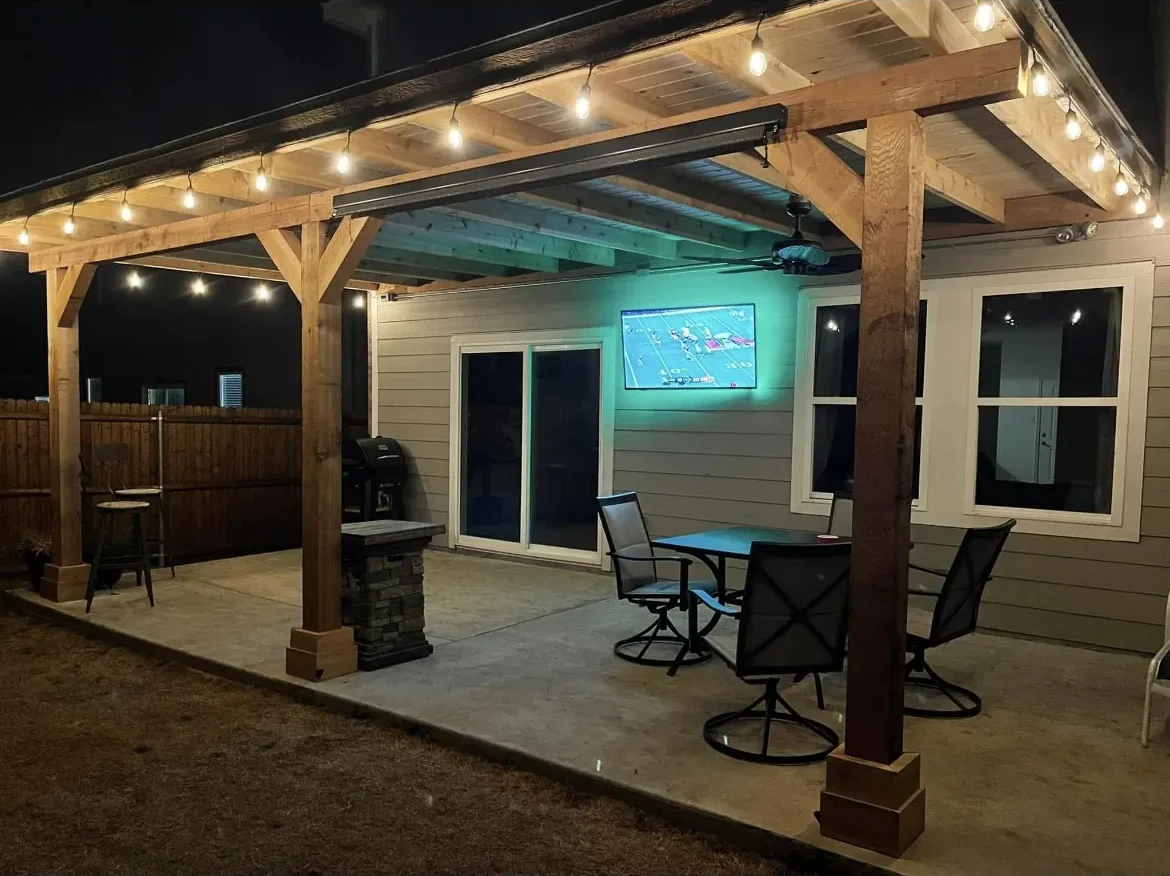
Two more options. If the upkeep table above sounds like too much, look at composite decks. If sun is your main worry, a covered deck or pavilion keeps the boards out of direct sun. Before you buy lumber, check the Dallas deck permit rules.
Archetex Outdoor Design Co. is a Dallas deck builder that designs and builds custom wood and composite decks. If you want a second opinion on which wood fits your yard, the site visit is free and you get a written price.