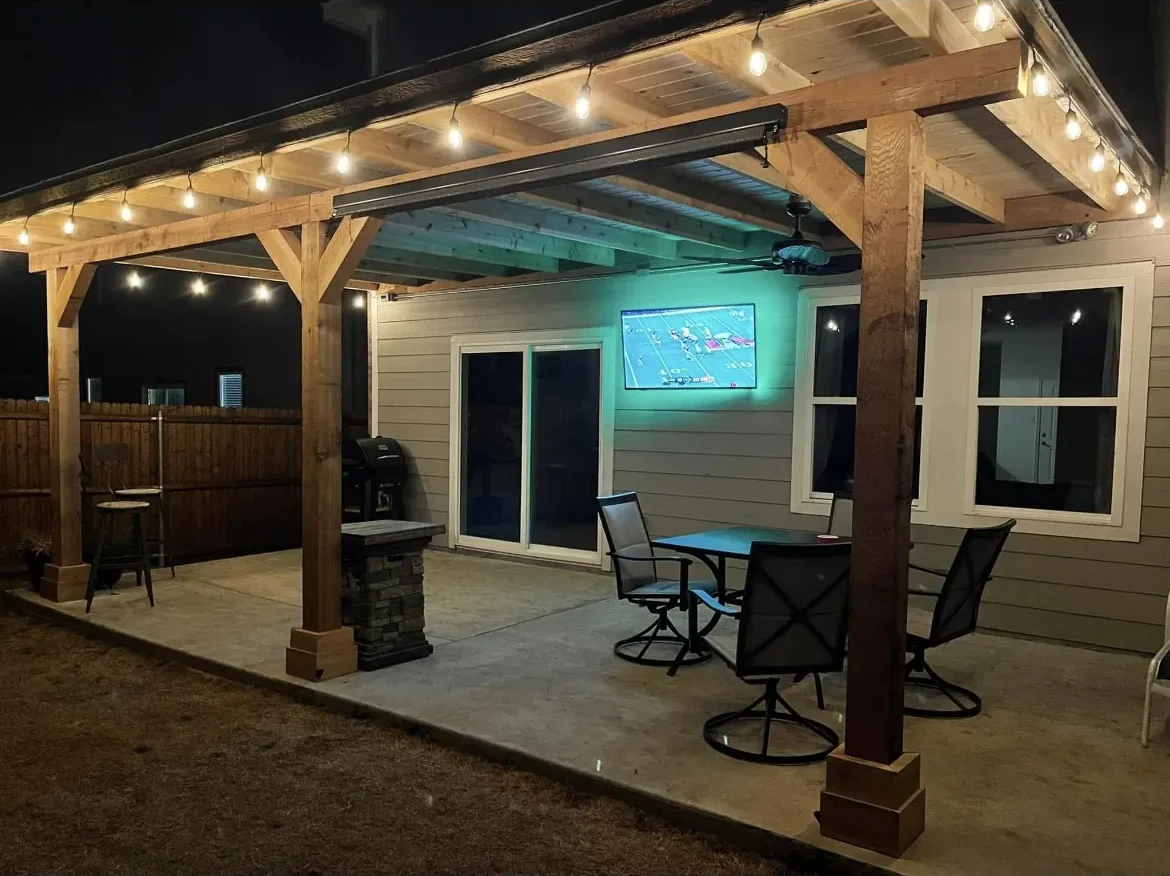
This guide covers what a cedar deck costs, which cedar to buy, how long it lasts in North Texas and what upkeep it needs. Every number is sourced and labeled by scope and date. One thing up front: we found no 2026 price list that covers cedar decks in Dallas specifically, so most cost figures here are national, and the only Dallas cedar number is a 2021 snapshot.
How much does a cedar deck cost in Dallas?
Expect roughly $19 to $55 a square foot installed, depending on whose numbers you use. On a 300 sq ft deck that works out to about $5,700 to $16,500 before railings and stairs (calculated from the ranges below).
The three published figures we could verify measure slightly different things, so read the scope column before comparing them.
| Source | Scope | Date | Installed cost per sq ft | 300 sq ft deck (calculated) |
|---|---|---|---|---|
| Fixr | National, cedar deck | Updated January 2023 | $19 to $29 | $5,700 to $8,700 |
| Block Renovation | National, cedar or redwood (not split out) | August 2026 | $25 to $55 | $7,500 to $16,500 |
| HomeBlue | Dallas, cedar deck (2021 snapshot) | December 2021 | $26 to $29 | $7,800 to $8,700 |
HomeBlue's Dallas figure is the only local cedar number we found, and it is a 2021 snapshot based on "feedback provided by local deck builders." Treat it as a rough guide to where Dallas sat five years ago, not a 2026 price.
For comparison, Fixr's same 2023 national page puts pressure-treated wood at $15 to $25 a square foot installed and redwood at $27 to $38, so cedar sits between the two.
For the full picture on Dallas deck prices, including railings, stairs and permit fees, see how much a deck costs in Dallas. If you already know your footprint, deck cost by size walks through common dimensions.
2026 Dallas TX cedar wood deck installation cost per square foot
No 2026 Dallas source lists cedar on its own. Block Renovation's 2026 Dallas guide prices pressure-treated decks at $15 to $30 a square foot and composite at $25 to $50, and cedar falls between those in the national ranges above.
That Dallas page does not say "installed" in so many words, but it is written as local project cost. Cedar simply isn't one of its lines.
What a per-square-foot price includes, and what it leaves out
Per-square-foot ranges mostly describe the deck surface and the frame under it. Railings and stairs are usually priced on top, which is why a finished deck can cost far more per square foot than the headline range.
A national example shows the gap. The 2023 Remodeling Impact Report from the National Association of Realtors and the National Association of Landscape Professionals priced a 14 x 18 ft cedar deck, attached with a ledger, with cedar decking, railing and stair treads and a clear sealer. Landscape pros put the cost at $16,900, and Realtors estimated it would add $15,000 in value, about 89% recovered.
That deck is 252 sq ft, so $16,900 works out to about $67 a square foot including railing and stairs (calculated, national, 2023). That's well above the $19 to $55 ranges, and railing and stairs are a big part of the reason.
Materials are a smaller share than most people expect. Fixr lists materials alone for a cedar deck at $4 to $9 a square foot, inside its $19 to $29 installed range (national, 2023). Framing, footings, fasteners, labor and finishing make up the rest. We found no sourced labor-only figure for installing cedar decking.
Cedar decking pricing: what the boards cost
At one national online lumber retailer, 5/4x6 western red cedar in select tight knot (STK) grade is $3.60 a foot, or $57.60 for a 16 ft board, while clear vertical grain lists at several times that.
| Board (Advantage Lumber listing) | Listed price | Notes |
|---|---|---|
| 5/4x6 WRC Select Knotty (STK) Appearance Grade, 8 ft | $28.80 | $3.60 a foot, random lengths |
| 5/4x6 WRC Select Knotty (STK), 12 ft | $43.20 | $3.60 a foot |
| 5/4x6 WRC Select Knotty (STK), 16 ft | $57.60 | $3.60 a foot |
| 5/4x6 WRC STK, pre-grooved | $4.35 ($69.60 for 16 ft) | Pre-grooved board |
| 5/4x6 WRC Clear Vertical Grain (CVG) S4S/KD | Listed at $19.20 | Unit not stated on the listing |
| 5/4x6 WRC CVG, pre-grooved | Listed at $19.95 | Unit not stated on the listing |
Three cautions before you use these numbers. First, this is one retailer, and its prices are based on shipping out of east coast warehouses, with shipping extra. Second, we could not get a Dallas lumber yard or big-box cedar price, so local prices may differ. Third, the CVG listing doesn't state its unit, so the most we can say is that the listed price is about five times the knotty price.
The same retailer's western red cedar decking range is sold in 5/4 (and 1x) sizes, from 5/4x4 to 5/4x12 and 8 to 20 ft long, with no 2x6 in that collection. That is one retailer, not the whole market, but it shows 5/4 boards are what you'll often be offered.
Western red cedar vs eastern (aromatic) cedar vs Texas cedar
Western red cedar is the cedar sold as decking. Eastern red cedar and Texas "cedar" (Ashe juniper) are really junipers, and the sources describe them mostly as small knotty boards and fence posts, not deck boards.
| Species | Botanical name | USDA decay rating (heartwood) | Hardness (Janka) | Typical uses in the sources |
|---|---|---|---|---|
| Western red cedar | Thuja plicata | Resistant | 350 lbf, dents and scratches easily | Sold as decking (5/4 boards at one national retailer) |
| Eastern red cedar (aromatic red cedar) | Juniperus virginiana | Resistant | 900 lbf | Closet and chest linings, outdoor furniture; usually knotty, small narrow boards |
| Ashe juniper ("Texas cedar", mountain cedar) | Juniperus ashei | Resistant (listed as junipers) | Not found | Fence posts |
The decay ratings come from the USDA Forest Products Laboratory's Wood Handbook (2021), which lists western redcedar, eastern redcedar and junipers as "Resistant." Imported Spanish-cedar is also rated Resistant.
The Wood Database rates western red cedar "durable to very durable" for decay with "mixed resistance to insect attack," and notes it dents and scratches very easily because it is soft.
Eastern red cedar is harder at 900 lbf, but the Wood Database says large or clear pieces are much less common than small knotty boards, and decking isn't among its listed uses.
Ashe juniper is the tree most Texans call cedar. According to Wikipedia (a secondary source citing a 1904 USDA forestry bulletin), it grows to about 33 ft, has its largest stands in central Texas, and its rot-resistant wood is used for fence posts. We found no source on whether it is sold as deck boards in DFW.
The practical takeaway: when a quote says "cedar," ask which species. For a deck surface it should almost always be western red cedar.
Cedar grades: clear, knotty and select tight knot (STK)
Clear grades (Architect Clear, Custom Clear) have few or no knots and cost the most. Knotty grades (Architect Knotty, Custom Knotty, sold by many yards as STK) are cheaper and keep their knots tight.
Here is how the Western Red Cedar Lumber Association (WRCLA) describes its decking grades:
- Architect Clear: the top grade, usually made to order, which WRCLA says "should be specified when only the best will suffice."
- Custom Clear: the next clear grade down. Some suppliers also sell clear grades labeled A & Better, B, C and D & Better.
- Architect Knotty: "sound and tight knotted" decking that limits knot size.
- Custom Knotty: the economical grade with a "hole-free knotty appearance," sold unseasoned only.
WRCLA says knotty western red cedar "is available at a lower price point," and that knots stay sound when you specify a tight-knot grade.
STK is a retail name, so ask what standard the quote uses
"Select Knotty (STK) Appearance Grade" is how retailers label their boards, but it isn't one of WRCLA's decking grade names (those are Architect Knotty and Custom Knotty). Ask your builder to write the species, the grade and the grading standard on the quote, so you can compare bids on the same board. Our guide on how to choose a deck builder has a quote checklist.
Why clear vertical grain costs more
The Forest Products Laboratory says all-heartwood vertical-grain cedar is still available "but expensive," and that vertical-grain and low-density woods check, cup and warp less. That's part of what you pay for in a CVG board.
5/4 vs 2x6 cedar deck boards (and joist spacing)
In the cedar association's span table, 5/4x6 cedar spans 16 inches between joists and 2x6 spans 24 inches, so thinner boards need joists closer together.
| Cedar decking size | Grade | Maximum span (WRCLA table) |
|---|---|---|
| 1-1/4 in (5/4) x 6 in | All clear and knotty grades | 16 inches |
| 1-1/4 in (5/4) x 4 in | Knotty | 12 inches |
| 1-1/4 in (5/4) x 4 in | Clear | 16 inches |
| 2 in x 4 in or 2 in x 6 in | All grades | 24 inches |
WRCLA's table assumes wet end-use conditions, green lumber sizes and a 220 lb concentrated load, and it tells readers to check with the local building authority.
What the deck guide says about decking
The American Wood Council's DCA 6 is builder guidance based on the 2015 IRC (we could not open the 2021 IRC text itself). It says decking should be 2 in nominal lumber or span-rated decking, fastened with two 8d threaded nails or #8 screws per joist, spaced about 1/8 in apart, with each board bearing on at least three joists. Boards can run perpendicular to joists or at up to 45 degrees.
Span-rated decking, per DCA 6's commentary, is usually rated for 16 or 24 inches. Your city inspector has the final say, so ask how your builder plans to meet the code your city has adopted.
Gaps, acclimating and cupping
- Gap: DCA 6 says about 1/8 in. A Real Cedar how-to used 3/16 in and calls the gap "a personal preference."
- Acclimate: Advantage Lumber says to let cedar decking acclimate on site for 1 to 2 weeks before installing.
- Cupping: the Forest Products Laboratory says cupping increases as a board's width-to-thickness ratio rises, so a wide, thin board cups more than a narrow, thick one.
Thicker 2x boards are easier to justify on spans and cupping. We found no sourced price difference between 5/4 and 2x6 decks installed, so get both priced if you're undecided.
Cedar frame or pressure-treated frame?
Most cedar decks sit on treated framing, because anything touching the ground must be treated for ground contact and cedar joists span shorter than southern pine.
DCA 6 (builder guidance based on the 2015 IRC) says all deck lumber must be either a naturally durable species, "such as Redwood or Western Cedars where 90 percent or more of the width of each side is heartwood," or preservative treated. Its Table 1 marks naturally durable redwood and western cedars for above-ground use only.
| Joist size (16 in on center) | Southern pine | Redwood / western cedars |
|---|---|---|
| 2x8 | 11 ft 10 in | 10 ft 7 in |
| 2x10 | 14 ft 0 in | 13 ft 0 in |
| 2x12 | 16 ft 6 in | 15 ft 1 in |
Those joist spans are from DCA 6 Table 2, based on the 2015 IRC. Shorter spans can mean more beams or posts for the same deck, though we found no source that puts a dollar figure on that.
The USDA adds two more reasons to frame with treated lumber. Decay resistance comes from heartwood, and the USDA notes that marketable sizes of some species are mostly second growth with a high share of sapwood, which has low decay resistance in nearly every species. And "even the very decay-resistant species may require preservative treatment for important structural uses."
The common setup, then, is ground-contact treated posts, a treated frame and cedar decking and railings on top. That gives you the cedar look where you see and touch it.
How long does a cedar deck last in Texas?
Block Renovation puts cedar (with redwood) at 15 to 25 years, and the cedar industry claims 25 years or more. The Forest Products Laboratory says decks usually fail from checking and splitting, not rot, so upkeep decides where you land.
The 25-plus-year figure comes from the Western Red Cedar Lumber Association, an industry group, so read it as a marketing claim. We found no independent Texas field data on cedar deck lifespan.
What the USDA research does show:
- Cedar and treated pine last about the same as decking. Naturally durable and treated woods have "quite comparable" service lives above ground as decking, and splitting and checking are the most common reasons treated decks are torn out. A penetrating sealer applied regularly reduces checking.
- Warm, humid climates shorten it. The Wood Handbook notes decay resistance "may be less" for wood in ground contact or "used in warm, humid climates."
- Heartwood matters. Resistant heartwood "generally gives satisfactory service" above ground, but sapwood does not, and second-growth wood is often less decay resistant than old growth.
Dallas weather works against wood. The National Weather Service says DFW summer highs run "consistently in the 90s, often reaching or exceeding 100 degrees," large hail falls nearly every year, and Gulf moisture keeps it humid. Sun and water are what weather a deck surface, as the graying section below explains.
If you want real wood and less weathering, shade helps a lot. Look at covered decks and pavilions if part of the deck can go under a roof.
Do termites eat cedar in Texas?
Yes. The USDA does not list cedar among termite-resistant woods, and Texas A&M lists cedar among the plants Formosan termites attack, with Dallas County among the 31 Texas counties where they have been found.
The Forest Products Laboratory says only a few U.S. woods resist termites: close-grained California redwood heartwood has some resistance, and very resinous southern pine heartwood is practically immune but seldom available. Cedar isn't on that list.
Texas A&M AgriLife's Urban Entomology program reports Formosan termites in 31 Texas counties, including Dallas, Denton, Collin and Tarrant, and reports from every major Texas metro. A&M also says the chance of meeting them outside the upper Gulf Coast is small, but homeowners anywhere in Texas should watch for isolated infestations. Native subterranean termites are a statewide concern too: A&M says "homeowners in all areas of Texas should watch for subterranean termites."
Some cost guides describe cedar as "naturally rot and insect-resistant." On termites, the USDA and Texas A&M sources above say otherwise, so don't count on cedar to keep them out.
Prevention is mostly about soil and water:
- Keep wood out of direct soil contact. A&M says termites get in through wood touching the ground.
- Use ground-contact treated lumber for posts, as DCA 6 requires for anything in contact with the ground.
- Fix leaks and drainage problems around the deck and its frame. A&M says moisture sources such as leaky plumbing and poorly maintained gutters can encourage subterranean termites.
Why cedar turns gray and checks in the Dallas sun
Sun and water leach cedar's color and dry out the surface, so unfinished boards go silver-gray and develop surface checks and end cracks.
The Forest Products Laboratory describes weathering in stages. First comes a color change and slight checking as extractives wash out, the surface chemistry changes and microbes move in. Later the wood "develops checks on lateral surfaces and checks and cracks" at the board ends, and the surface fibers erode. Real Cedar calls the gray stage a silvery patina, and some owners like it.
Weathered cedar also runs hot: in an informal 2012 Colorado test it read 170.2°F in full sun on an 86.5°F day (new cedar read 148.6°F), so see Trex vs cedar vs pressure-treated in Dallas heat for the full comparison.
Vertical-grain, low-density boards check less, which is one more reason clear vertical grain costs more.
"Let it weather first" is outdated advice
The old rule of letting a new deck weather before you finish it "is now the source of much pain," according to the Forest Products Laboratory. Film finishes put on low-density wood that has had about a week of sun exposure tend to peel. Plan to finish soon after the deck is built.
Cedar deck stain and seal schedule (and what it costs)
Use a penetrating stain or water-repellent, not a film or solid stain. Plan on a clear sealer every 1 to 2 years or a semi-transparent stain every 2 to 3, and clean once a year without a pressure washer.
| Finish type | How long it lasts on a deck | Notes | Source |
|---|---|---|---|
| Clear water-repellent preservative | 1 to 2 years | Penetrating; brush on until the wood absorbs no more | USDA FPL, 2021 |
| Lightly pigmented penetrating stain | 2 to 3 years | Penetrating; recommended type for decks | USDA FPL, 2021 |
| Semi-transparent stain | Reapply usually every 2 or 3 years | Do two or three boards at a time to avoid lap marks | Real Cedar (WRCLA) |
| Film-forming finish or solid-color stain | Not recommended | Peels on decks | USDA FPL, 2021 |
Block Renovation's 2026 guide agrees that cedar and redwood "still want a finish coat on a similar cycle if the color matters," similar to the clean-and-reseal cycle it gives treated decks.
Where the sources disagree
Some cost guides say cedar doesn't need finishing: Fixr's 2023 deck cost page says cedar "does not need to be stained or painted." The USDA Forest Products Laboratory says otherwise. It recommends penetrating finishes for decks, gives them a life of 1 to 3 years, and says regular sealing reduces the checking and splitting that end most decks. Unfinished cedar won't rot quickly above ground, but it will gray and check faster.
How to apply it
- Brush on water-repellent until the wood takes no more, and apply it liberally to end grain.
- Look for UV filters and mildewcides in the product.
- Don't put on more than the cedar can absorb. The USDA says to apply only what the wood absorbs.
- If finishing on site before building, seal all six sides of each board.
Cleaning without damage
Real Cedar recommends cleaning once a year in spring with warm soapy water, using oxygen bleach for mildew, and warns that power washers "can seriously damage cedar deck surfaces." The USDA adds: don't use steel wool or steel wire brushes, because iron reacts with cedar's tannins and leaves blue-black stains.
What staining costs
Fixr's national 2025 figures put professional deck staining at $2 to $5 a square foot, including light sanding and sealing, and sealing alone at $0.75 to $4. On a 300 sq ft deck that's $600 to $1,500 per staining and $225 to $1,200 for sealing only (calculated from Fixr's ranges). Fixr's average for cleaning, minor repairs, staining and sealing a 14 x 18 ft deck is $750.
Fasteners: why stainless screws matter on cedar
Use stainless steel fasteners on cedar decking (304 grade is enough away from salt air). Plain steel and cheap galvanized fasteners react with cedar's tannins and leave black streaks.
The Forest Products Laboratory says to expect iron stain when plain carbon steel fasteners go into tannin-rich woods like western redcedar, and that "to our knowledge, stainless steel fasteners are safe from iron stain." It also notes stains from the wrong fasteners on cedar are common "even when contractors do the work."
- Stainless is best. WRCLA says 304 (18-8) stainless gives "adequate corrosion resistance" for most uses, and 316 is for salt air.
- Hot-dip galvanized is the fallback. WRCLA calls it the most common and economical choice. The USDA says high-quality hot-dip galvanized (ASTM A153) is far less likely to stain, but poor galvanized nails corrode and stain like plain steel.
- Skip electroplated and copper. WRCLA doesn't recommend electroplated fasteners and says "copper nails also react with cedar and should not be used."
- Size and count. WRCLA calls for 8d (2-1/2 in) nails for 5/4 decking and 10d (3 in) for 2 in boards, screws that go 1 in into the supports, and two fasteners per joist for boards 4 in and wider.
The Real Cedar how-to builder picked stainless screws over galvanized "to avoid black streaks." The Wood Database makes the same point: iron-based fasteners can stain and discolor western red cedar.
The treated frame underneath has its own rules. DCA 6 (builder guidance based on the 2015 IRC) says fasteners in treated wood must be hot-dip galvanized, stainless, silicon bronze or copper, connectors must be G-185 galvanized or stainless, and "fasteners and connectors shall be of the same corrosion-resistant material."
Is cedar the right deck for you?
Cedar is a good choice if you want real wood and will put a penetrating stain on it every 2 to 3 years. If you won't, composite or treated pine fits better.
- Pick cedar if you like the look and feel of real wood, are fine with a softer board that dents, and will clean it yearly and restain every 2 to 3 years. Nationally it runs $19 to $29 a square foot installed (Fixr, 2023).
- Pick pressure-treated pine if lowest cost matters most: $15 to $30 a square foot in Dallas (Block Renovation, 2026).
- Pick composite if you don't want a staining schedule: $25 to $50 a square foot in Dallas (Block Renovation, 2026). See composite decks in Dallas and our Trex vs TimberTech vs Fiberon comparison.
For every option side by side, including ipe, thermally modified wood and PVC, read the best decking material for Texas guide.
Archetex Outdoor Design Co. designs and builds custom composite and wood decks across Dallas and nearby cities, and Matthew offers a free site visit with a written price. If you're weighing cedar against composite for your yard, see our Dallas deck builder page to set one up.