What decking doesn't get hot in the sun?
None does. Light-colored aluminum, ipe and teak read coolest in the tests that measured them, but every deck board tested in full sun still got hot enough to hurt bare feet.
In the only test we found that put wood, PVC, aluminum and other synthetic boards side by side, a Denver-area deck builder measured 16 samples on an 86.5°F day. Off-white aluminum read 131.5°F and white aluminum 133.5°F, the coolest boards in the sun. Ipe read 141.3°F. Weathered cedar was the hottest at 170.2°F.
Even the coolest board in that test read about 45°F above the air (calculated from 131.5°F minus 86.5°F).
Other tests lean the same way. Advantage Lumber, a Florida seller of hardwood, composite and PVC, ran its own test in Sarasota and found Plantation Teak about 120°F, the coolest board it tried, with several composite boards at 140°F or more. Wahoo, which makes AridDek aluminum decking, says its boards do get hot in summer but shed heat and run cooler than most wood or composite. That is the maker's claim, not a published test.
No test we found measured Trex, TimberTech, Fiberon, Deckorators and MoistureShield side by side, so nobody can honestly rank the composite brands by temperature. Here is the short version of what the data supports, in order of how much it matters:
- Shade over the part you use. In the one peer-reviewed study below, sunlit surfaces ran 36 to 56°F hotter than shaded ones.
- A light color. The same product ran 12 to 36°F hotter in darker colors in the tests that checked it.
- The material. Light aluminum, ipe and teak read coolest where they were tested; darker PVC and darker synthetic boards ran from about 155°F to 162°F in the one test that had both.
Every decking heat test, side by side
Here is every published deck-surface test we could find, with who ran it, where, the air temperature and the method, because a reading means little without its conditions.
One caution first. Only two of these (the UNLV and Texas Tech work) are research studies, and neither tested deck boards. The rest are informal tests by builders, columnists and sellers using handheld infrared thermometers or thermal cameras. Air temperature, time of day and method differ from test to test, so compare readings inside one test, not across tests.
| Test | Where and when | Air temperature | Method | What was measured |
|---|---|---|---|---|
| Kevin Stevens, Denver-area deck builder, for Networx (republished by KSAT) | His own deck in Colorado, June 25, 2012, 11:45 a.m. | 86.5°F | 16 samples in full sun, raised on lumber scraps for airflow, read after a few hours with an infrared scanning thermometer | Ipe, cedar, pressure-treated, PVC, aluminum and synthetic wood-tone boards |
| Tim Carter, AsktheBuilder | Just after noon, August 10, 2018, cloudless, after hours of sun | Not given | FLIR thermal camera on a smartphone; wood pieces held up in the air, not lying on the deck | Trex Transcend step, solid oak, treated 2x4 |
| Rosie Romero, "Rosie on the House," Arizona Daily Star | Around his Arizona home, 2 p.m., test date not given (column published June 2021) | 112°F in direct sun | Infrared thermal imaging gun | Trex composite, redwood decking, stone, tile, concrete, soil, lawn, asphalt |
| Advantage Lumber (a seller's test) | Sarasota, Florida, direct sun (posts from 2026) | Not given | Infrared thermometer | Hardwoods including teak, and several composite boards (Trex and TimberTech among them, no per-brand readings published) |
| Chestovich et al., UNLV, Journal of Burn Care & Research (peer-reviewed) | Roof of a UNLV engineering building, Las Vegas, April to August 2020; peak on August 6, 2020, at 2:10 p.m. | 120°F at the peak | Type-K thermocouples (contact sensors), sunlit and shaded samples at the same time | Rock, asphalt, brick, concrete, metal, sand (no deck boards) |
| Jennifer Vanos, Texas Tech University, with ASU | A playground in Gilbert, Arizona, at noon (reported 2015) | 41.6°C (about 107°F, converted from °C) | Handheld infrared thermometer at ground level, plus thermal imaging from an aircraft | Rubber play surface in sun and shade; two colors of the same plastic slide |
| GreatMats (a seller's test of deck tiles, not boards) | Milltown, Wisconsin, not all on the same day (2022 article) | 81 to 83°F | Infrared thermometer after at least 4 hours of sun | PVC, polypropylene, rubber and turf deck tiles |
And here are the deck-board readings from those tests. The Colorado rows come from one morning on one deck, so they can be compared with each other. The article lists two lines, "Prem Grain" and "Tropics line," without naming the brand or saying whether they are composite or PVC, so we call them synthetic wood-tone boards.
| Board and color | Surface reading in sun | Test |
|---|---|---|
| Off-white aluminum | 131.5°F | Colorado, 86.5°F air |
| White aluminum | 133.5°F | Colorado, 86.5°F air |
| Ipe | 141.3°F (86.4°F in shade) | Colorado, 86.5°F air |
| Synthetic, "Prem Grain" Sandalwood | 141.9°F | Colorado, 86.5°F air |
| New cedar | 148.6°F | Colorado, 86.5°F air |
| Pressure-treated | 149.9°F | Colorado, 86.5°F air |
| PVC, Cedar color | 150.1°F | Colorado, 86.5°F air |
| Synthetic, "Prem Grain" Western Redwood | 152.4°F | Colorado, 86.5°F air |
| Synthetic, "Tropics line" Cypress / Jatoba / Mahogany | 153.6°F / 154.6°F / 157.3°F | Colorado, 86.5°F air |
| Synthetic, "Prem Grain" Driftwood Grey / Tuscan Walnut | 155.8°F / 157.1°F | Colorado, 86.5°F air |
| PVC, Mocha / Driftwood / Redwood | 159.8°F / 161.4°F / 162.1°F | Colorado, 86.5°F air |
| Weathered cedar | 170.2°F (hottest) | Colorado, 86.5°F air |
| Treated 2x4 | 138.2°F | AsktheBuilder, air not given |
| Trex Transcend step | 152.3°F | AsktheBuilder, air not given |
| Solid oak, 3/4 in | 152.3°F | AsktheBuilder, air not given |
| Trex composite | 150 to 175°F, depending on color | Arizona, 112°F air |
| Natural redwood decking | 154°F | Arizona, 112°F air |
| Plantation Teak | About 120°F | Florida seller's test, air not given |
| Several composite boards | 140°F or more | Florida seller's test, air not given |
On that one Colorado deck, the coolest and hottest boards were almost 39°F apart (calculated from 170.2°F minus 131.5°F).
Does composite decking get hotter than wood?
Sometimes, but not always: in one test a Trex board and solid oak read exactly the same 152.3°F, while in another, new cedar and pressure-treated pine read about the same as many synthetic boards.
The AsktheBuilder test is the only one we found that measured a named composite brand next to wood at the same moment. The Trex Transcend step and a piece of 3/4-inch solid oak both read 152.3°F. A treated 2x4 read 138.2°F, about 14°F cooler than both (calculated from 152.3°F minus 138.2°F).
In the Colorado test, new cedar (148.6°F) and pressure-treated (149.9°F) landed right next to PVC in a cedar color (150.1°F) and below most of the darker synthetic boards. Weathered cedar beat them all at 170.2°F. In the Arizona test, natural redwood decking at 154°F fell inside the 150 to 175°F range for Trex.
The Florida seller's test is the one result that clearly favors wood: every hardwood it tried ran cooler than the composites, with teak at about 120°F. Keep in mind the seller sells the hardwoods it recommends, and it did not publish the air temperature, time or colors.
So, is composite decking hot to walk on? Yes, in full sun, but so is wood. Dense hardwoods like ipe and teak have the best record in these tests; ordinary cedar and treated pine do not. For cost, upkeep and lifespan of the common options, see our Trex vs cedar vs pressure-treated comparison.
Is light-colored pressure-treated pine or cedar cooler?
Lighter is cooler, but wood doesn't stay light: new cedar and treated pine read 148.6°F and 149.9°F in one test, and weathered gray cedar was the hottest board of all at 170.2°F.
The common advice that "light wood stays coolest" is only partly true. Here is what the readings say:
- New light cedar and treated pine were not cooler than synthetic boards in the Colorado test. They read within about 1.5°F of PVC in a cedar color (calculated from 150.1°F minus 148.6°F).
- Weathered cedar, the gray color unsealed cedar turns over time, read 170.2°F, about 21.6°F hotter than new cedar on the same deck (calculated from 170.2°F minus 148.6°F).
- Treated pine did run about 14°F cooler than a Trex step and solid oak in the AsktheBuilder test, which is the best result for light wood we found.
The finish matters too. The USDA Forest Products Laboratory's Wood Handbook says darker finishes cause more solar heating, and with it more warping and checking.
If you want wood, pick a light finish and keep it up. Our guide to the best wood for a Texas deck covers species and upkeep.
Color changes the reading more than the material does
Dark colors absorb more sunlight, and in measured tests the same material ran 12°F to 36°F hotter in a darker color.
| Same material, different colors | Lightest reading | Darkest reading | Gap | Test |
|---|---|---|---|---|
| PVC deck boards | 150.1°F (Cedar) | 162.1°F (Redwood) | 12°F (calculated) | Colorado, 86.5°F air |
| Trex composite | 150°F | 175°F | 25°F (calculated) | Arizona, 112°F air |
| Plastic playground slide, same material and coating | About 147°F, beige (63.9°C) | About 161°F, green (71.7°C) | About 14°F (converted from °C) | Gilbert, Arizona, about 107°F air |
| Perforated raised PVC deck tiles (not boards) | 87°F (light blue) | 123°F (black) | 36°F (calculated) | Wisconsin seller's test, 81 to 83°F air |
A Virginia pool builder, River Pools, measured six patio surfaces on a 99°F day in Warsaw, Virginia (concrete, two kinds of pavers, bluestone and two travertines) and came to the same conclusion: patio temperature "is more a consequence of color than the actual material."
The decking makers say the same. Trex says "the darker the color, the hotter the deck will feel," tells hot-climate buyers to choose lighter colors or a heat-mitigating option, and suggests Salt Flat or Carmel if heat is a concern. TimberTech notes that all decking gets hot in the sun, darker colors feel hotter, and buyers in hot climates should choose a lighter color. In a 2021 article, TimberTech recommended its grays (Coastline, Slate Gray, Whitewash Cedar) and tans (Weathered Teak, Brownstone) for full sun; check the current color list, since lines change.
In practice: pick the lightest color you can live with. A dark board in full sun will be the hottest choice whatever it is made of.
How cool-touch caps work: reflectance, infrared and SRI
About half of sunlight is invisible near-infrared, so a cap that reflects that part can run cooler than a normal board of the same color.
The Heat Island Group at Lawrence Berkeley National Laboratory explains that slightly less than half of sunlight is visible light, and near-infrared makes up nearly half. "Cool" colored materials stay moderately cool by reflecting the invisible part. Swapping a standard color for a matching cool color can raise solar reflectance by as much as 0.4. That research is on roofing and pavement, not decking. Deckorators markets its Surestone cap as infrared-reflective, which is the same idea, but LBNL did not test deck boards.
Two properties decide how hot a surface gets, according to the US EPA. Solar reflectance (albedo) is "the most important." Thermal emittance is how well a surface sheds the heat it does absorb. For scale, the EPA says conventional roofing can run up to 66°F warmer than the air on a warm day, and asphalt can reach 152°F at mid-day.
The yardstick that combines both is the Solar Reflectance Index (SRI). ASTM E1980 is the standard practice for calculating it for horizontal and low-sloped surfaces: a relative temperature compared with black and white reference surfaces, worked out from measured solar reflectance and emittance. The current edition is E1980-24.
If you are comparing two "cool" boards, ask the supplier whether they have solar reflectance or SRI figures for the exact color you want.
Heat-mitigating decking lines and what each maker claims
Trex, TimberTech, MoistureShield and Deckorators all sell boards marketed as cooler, but each measures against a different baseline, so their numbers can't be compared with each other.
Every figure below is the maker's own claim.
| Maker | Line and colors | Claim | Compared against | Test details given |
|---|---|---|---|---|
| Trex | SunComfortable heat-mitigating technology: Transcend Lineage, which Trex says is engineered with it (colors Island Mist, Rainier, Carmel, Biscayne, Jasper, Salt Flat, Hatteras); in Enhance only Cinnamon Cove, Golden Hour, Honey Grove, Pebble Beach and Tide Pool; in Select only the newest color collection (colors not listed) | Up to 35°F less heat buildup | Trex's own original boards | Lab test simulating extended full summer sun at noon; Lava Rock (without) vs Salt Flat (with); results vary with conditions, color and use |
| TimberTech (AZEK) | Cool Touch, TimberTech Advanced PVC: Vintage, Landmark, Harvest, Harvest+ | Stays up to 30 degrees cooler | "Other composite decking options" / "competitive products," not named | Method not given. The AZEK install guide (REV 12/22) says AZEK boards are cooler to the touch than many boards in similar colors |
| MoistureShield | CoolDeck: Vision (Cathedral Stone, Mochaccino, Cold Brew) and Meridian (Shoal, Citadel, Catalina, Shoreside; not Mariner) | Up to 30° cooler; up to 35% less heat absorption | Leading competitors' composite boards of similar or lighter brightness (L* value); the 35% baseline is not named | Method not given |
| Deckorators | Surestone, a mineral-based board with an infrared-reflective cap | Cooler than traditional composite (no figure) | Traditional composite | None; from a sponsored trade article |
| Wahoo (aluminum) | AridDek aluminum decking | Gets hot in summer, but a cooler surface than most wood or composite | Most wood or composite | None given |
First, Trex's 35°F test compared Lava Rock, a dark color without the technology, against Salt Flat, a light color with it. Part of that gap could come from color alone, not only the technology.
Second, every maker says its cooler boards still get hot. Trex says SunComfortable boards "will still get hot when high temperatures and sun converge." TimberTech and AZEK both say "all decking products will get hot in the sun." MoistureShield also cites an unnamed "one study" saying regular composite in direct sun can run 34 to 76°F hotter than the air, "more than 150°" on an 80° day.
Treat "up to" figures as each maker's best case, not a ranking. Warranties, tiers and colors for each brand are in our Trex vs TimberTech vs Fiberon comparison.
How much cooler is a shaded deck?
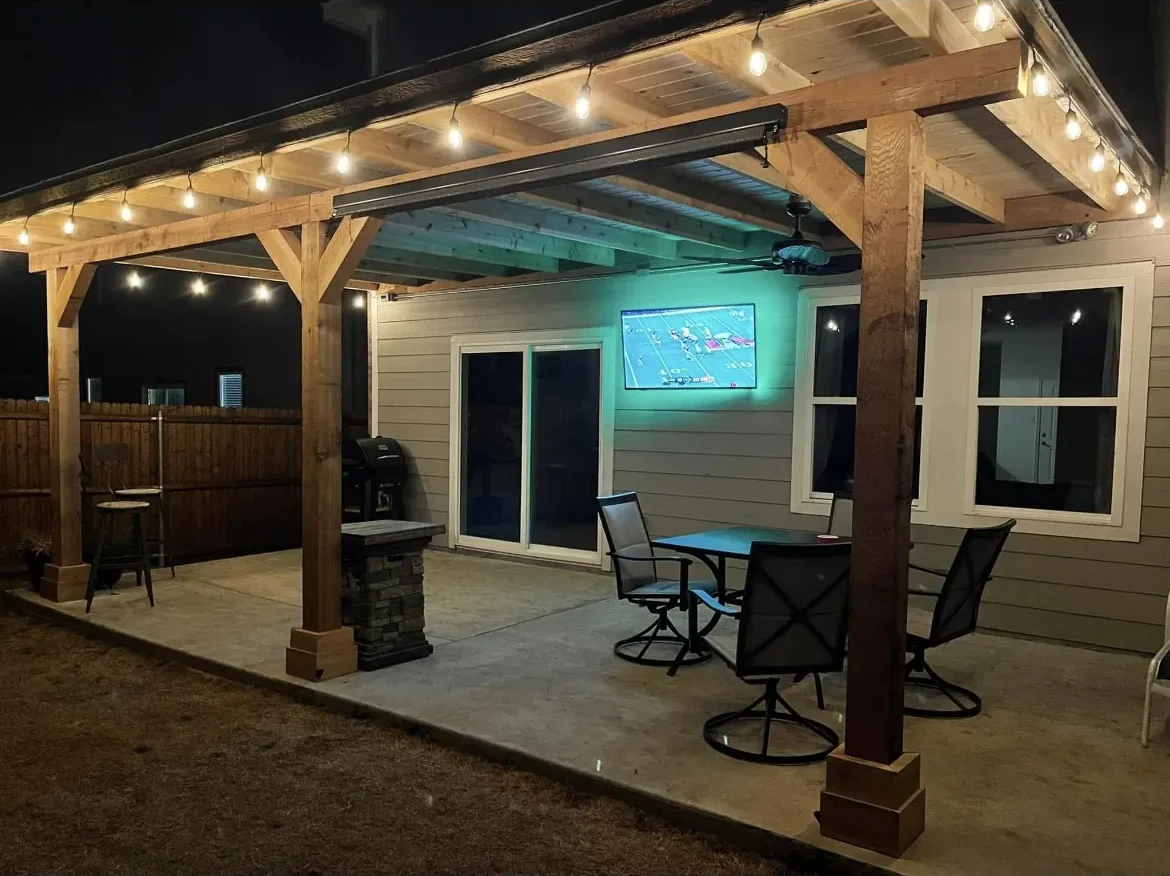
Shade is the biggest single factor: in a peer-reviewed Las Vegas study, sunlit surfaces ran 36 to 56°F hotter than the same materials in shade.
The UNLV team measured surfaces on a campus roof with contact sensors from April to August 2020. At the peak, on August 6 at 2:10 p.m. with 120°F air and strong sun (940 W/m²), sunlit porous rock read 170°F, asphalt 166°F, brick 152°F, and concrete and metal 144°F each. Shaded samples measured at the same time maxed out at 104 to 108°F. No deck boards were in that study, but the sun-to-shade gap is the clearest number we have.
The deck tests show the same thing on a smaller scale:
- In the Colorado test, the same ipe board read 141.3°F in sun and 86.4°F in shade, about 55°F apart (calculated).
- On the Arizona playground, the same rubber surface read about 189°F in sun, about 108°F under a tree and about 116°F under a shade sail (all converted from 87.2°C, 42.2°C and 46.7°C).
- Block Renovation's Dallas guide says a covered patio drops the temperature underneath by 15 to 25 degrees compared with an exposed surface.
Trex agrees: in moderate climates and partial shade, heat "may be less of a concern," and in cooler climates and full shade, "You're free to go dark or light."
Dallas makes shade more valuable than in most places. Block Renovation notes that Dallas UV is intense from May through September and summers regularly pass 100°F from June through September. Decks on the west or south side of a house take the afternoon sun, so that is where a roof, pergola or tree will help most.
Cover the part where you sit and eat. For what that costs, see covered deck cost in Dallas, and for what the build involves, see our covered decks and pavilions page.
How hot is too hot for bare feet, kids and pets?
Burn researchers treat about 110°F as the start of injury risk, and every deck board tested in full sun read well above it.
The UNLV study cites classic burn research by Moritz and Henriques (1947): 140°F hot water can cause a serious burn in 3 seconds, and 120°F contact can cause one in 10 minutes. The authors used 110°F as the injury threshold, and none of their shaded materials reached it. That is water and contact data, not a deck-board test, but it shows how fast skin gets hurt in this range.
A separate UNLV burn-center review found hot pavement can cause second-degree burns within two seconds, and that on a 111°F day pavement can reach 147°F in direct sun.
Now compare the deck readings. The coolest board in the Colorado test, off-white aluminum, read 131.5°F on an 86.5°F day. Trex read 150 to 175°F in the 112°F Arizona test. All of those are above 110°F.
Kids' and pets' skin wasn't measured in any source we found, so we won't give a number for paws. Common sense applies: wear shoes on a sunny deck in summer, put a rug or mat where people walk, test the surface with the back of your hand before kids or dogs go out, and use an unshaded deck in the morning or evening.
Can low-E windows melt or scorch a deck?
Yes: Trex and AZEK both warn that sunlight reflected from low-E glass can scorch, warp or even melt deck boards, and one deck magazine editor reported sunspots over 200°F.
Low-E glass reflects more sunlight than ordinary glass. Trex's 2026 installation guide says that if the glass has any concavity, it can act like a concave mirror and concentrate sunlight on decking and railing. "This can sometimes char/discolor the decking surface or cause the decking to bow." Trex gives no remedy.
AZEK's installation guide (REV 12/22) says reflected sunlight from low-E glass can cause unusual heat build-up that may make AZEK boards "melt, sag, warp, discolor," increase expansion and speed weathering.
The editor of Deck Builder (JLC) explained that insulated glass can go concave and focus reflected light, and that "it's not unusual to see temperatures exceeding 200°F in some of these sunspots." For context, Trex says its boards can soften at temperatures as low as 176°F, a figure it gives for fire pits, not sun.
Deckorators' warranty excludes damage from "abnormally high heat sources," naming grills, fire pits and low-E glass windows or doors. So if glare damages the boards, the warranty may not help.
What to do, from the one maker that gives advice:
- In spots that catch the reflection, AZEK says to add framing with tighter joist spacing (6 to 8 inches maximum) and use only top-down fastening.
- If you are worried about low-E damage, AZEK says to contact the window maker for a fix.
Before you order boards, stand on the deck site on a sunny afternoon and look for bright reflected spots from your own windows or a neighbor's.
Picking boards for a full-sun Dallas deck
For a full-sun Dallas deck, pick the lightest color you like in a heat-mitigating line or a light wood, and plan shade over the part you sit on; a dark board in full sun will be the hottest choice whatever it's made of.
Dallas summers are long. The National Weather Service Fort Worth office says July and August highs are consistently in the 90s and often reach or pass 100°F, Gulf moisture keeps humidity high, and some nights stay above 80°F. Over the 1899 to 2024 record, DFW's average first 100°F day is July 1 and the average last is August 27; the most in one year was 71, in 2011.
Pick by what matters most to you:
- Full sun and barefoot use: add shade first, then choose a light color. If you want composite, look at the makers' heat-mitigating colors listed above and ask for reflectance data.
- A pool edge: in the Arizona test, gray troweled concrete (128°F) and travertine (136°F) read cooler than Trex composite (150 to 175°F). Our pool deck material guide covers grip, chlorine and barrier rules.
- You want real wood: dense hardwoods read coolest among the woods tested; light cedar and treated pine read about like synthetic boards and get hotter as they gray. Keep a light finish.
- The coolest board, budget allowing: light aluminum read coolest in the one test that had it. Block Renovation's 2026 installed planning figures (general, not Dallas-specific) put aluminum at $50 to $85 per sq ft and PVC at $40 to $70, against $30 to $60 for composite and $15 to $30 for pressure-treated. The full breakdown is in our decking materials guide for Texas.
- Big low-E windows facing the deck: check for glare spots before choosing a synthetic board, and follow the framing and fastening advice above.
Archetex Outdoor Design Co. builds composite and wood decks, covered decks and pergolas across Dallas, Plano, Frisco, McKinney and nearby towns. If you'd like a second opinion on color and shade for your yard, Matthew does a free site visit and gives a written price. More on that is on our composite deck builder page.