Texas doesn’t license deck builders, so most of the checking falls to you. It is general consumer guidance, not legal advice; for your own contract, ask a Texas attorney. For prices, see what a deck costs in Dallas.
How do you choose a deck builder in Dallas?
Shortlist builders whose finished decks you can see, compare at least three written quotes for the same scope, check insurance and registration yourself, and never pay most of the price up front. The Better Business Bureau recommends at least three quotes and warns that the lowest bid “may not necessarily be the best bid.” The Texas Attorney General adds that most legitimate bids “fall into a fairly close range.”
- Look at each builder’s finished decks.
- Check city registration and call the insurer on each certificate.
- Read recent reviews and call references.
- Ask every builder the same questions and compare itemized quotes.
- Check the contract for Texas homestead protections and stage the payments.
Best deck builders in Dallas TX: reviews, portfolio, licensed and insured (what each means in 2026)
“Licensed and insured” means less in Texas than you might expect: the state doesn’t license general contractors, so the phrase tells you little until you check insurance and registration yourself. TexasLawHelp.org, the Texas Legal Services Center’s site, says plainly that “Texas does not require general contractors to be licensed or bonded.”
“Best of” lists each use their own method. Expertise.com’s 2026 list of Dallas deck contractors says it reviewed 324 providers, curated 200 and picked 16, scoring them on “more than 25 variables across five categories.” Other directories and AI answers name different firms. Treat any list as a starting point and check every name.
Do deck builders need a license in Texas?
No. Texas has no state license for general or deck contractors, though builders must still be a state-registered business and licensed trades such as electricians and plumbers still apply. TexasLawHelp.org says contractors must still register as a business with the state, and to check local rules with your city. The state agency that registered home builders, the Texas Residential Construction Commission, was “abolished and the Act expired on September 1, 2009” (Texas Sunset Advisory Commission).
If your deck has lights, outlets or a fan, the electrician must hold a state license. The Texas Attorney General says to check licensed trades with their licensing agency, and the Texas Department of Insurance (TDI) notes that plumbers are licensed by the Texas State Board of Plumbing Examiners. To confirm a company is a registered business, a business search on the Texas Secretary of State’s online system costs $1.00 per search.
What Dallas requires instead: contractor registration
Inside Dallas city limits, a contractor must hold a city registration to build or repair a structure and to get a permit. Chapter 52 of the Dallas City Code makes it unlawful to build, alter or repair a structure in Dallas, or have it done, without a valid registration, and a listed contractor who isn’t registered “may not obtain any permit” (Sec. 1102.1). Its residential general contractor definition covers building “residential structures, buildings, or other improvements” on property that isn’t the contractor’s own homestead (Sec. 1101.1); the code doesn’t name decks, but our reading is that deck builders fall under it.
Registration is not a license. Chapter 52 says “no manner of license is proffered” and makes no statement of a registrant’s technical competency. What it does tell you:
- It costs $120 and lasts one year, so ask whether it is current (Secs. 1104–1105).
- No one may claim to be a registered Dallas contractor without a valid certificate (Sec. 1102.2).
- The city’s registration form lets a contractor declare their home as the place of business, so “no storefront” isn’t a red flag by itself.
Residential contractors whose work includes remodeling or additions to a single-family or duplex home must also hold a current City of Dallas home repair license to register (Sec. 1103.1.1). That license is issued by Code Compliance’s Consumer Protection unit for $68; its phone number is 214-948-4351 (City of Dallas, Home Repair License page). The code doesn’t say whether a deck counts, so ask each builder which city credentials they hold.
To check a builder, look them up in DallasNow, the city’s permitting portal, which has a public “Search for a Licensee” function, or call the city. Suburbs such as Plano, Richardson and Garland set their own registration rules; check with your city.
What insurance should a Dallas deck builder carry, and how do you check it?
Ask for current certificates for general liability and workers’ comp, then call the insurer listed to confirm them, because Texas doesn’t require most private employers to carry workers’ comp. TexasLawHelp.org says contractors should carry personal liability, workers’ comp and property-damage coverage, and that without current certificates “you could be held liable for any injuries or damages.”
General liability
A certificate proves little until you confirm it. TDI says to “call the companies listed to verify the coverage,” and the BBB says the same for workers’ comp, property-damage and liability cover.
Workers’ comp in Texas (opt-outs and TXCOMP)
TDI says Texas private employers don’t have to carry workers’ comp “in most cases.” Those that opt out (non-subscribers) must notify their employees and the state’s Division of Workers’ Compensation, and TDI points to TXCOMP (NCCI) to verify a subscriber’s coverage.
Subcontractors
TexasLawHelp.org says to check that subcontractors are insured too.
How to read deck builder reviews in Dallas
Read recent reviews for how the job ran (communication, schedule, cleanup, surprise costs) rather than just the star rating, and treat clusters of near-identical wording as a reason to dig further. TexasLawHelp.org suggests asking references the same things: on time, unexpected costs, workers punctual, site cleaned up.
Two rules cover fake reviews, though neither guarantees clean ratings:
- Google’s policy: reviews on Google Maps “should reflect a genuine experience at a place or business.” Paid or incentivized reviews and conflict-of-interest reviews, such as from employees or family, are removed.
- The FTC’s fake-review rule: the Federal Trade Commission’s rule, in effect since October 21, 2024 (16 CFR Part 465), bans fake reviews and testimonials, buying reviews on condition of a positive or negative sentiment, suppressing reviews through threats, and insider reviews that don’t disclose the connection.
Also search the company name with “scam,” “review” or “complaint” (TexasLawHelp.org), and call the BBB and the builder’s references (TDI).
How to judge a deck builder’s portfolio
Ask to see finished decks like yours, and ideally one under construction, because photos of the footings and framing tell you more than photos of finished boards. The Texas Attorney General suggests asking to visit past customers’ homes to inspect the work, and TexasLawHelp.org says you can ask to visit jobs in progress. The BBB notes that some businesses post photos or videos of completed projects on their BBB profile.
Check the parts that carry the load. Pro Builder’s deck checklist, based on the North American Deck and Railing Association (NADRA), says the ledger should attach to a wood rim joist or concrete, “not brick or masonry veneer,” with flashing above the ledger and behind the siding. It also flags post-to-beam connections, guard height and baluster gaps.
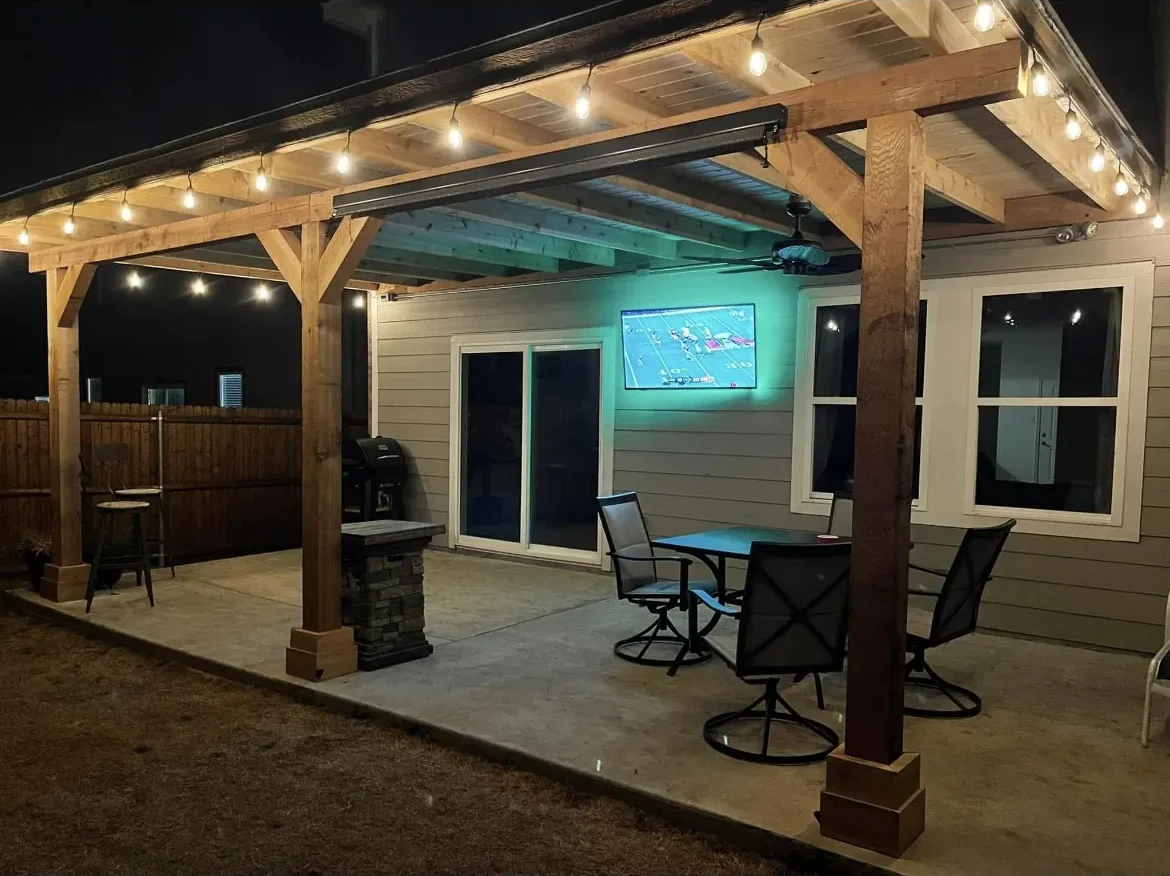
See photos of finished Archetex decks and patios, or our composite decks and covered decks pages. Replacing an old deck? Have each builder look under the boards before quoting; see whether to repair or replace an old deck.
Questions to ask a deck builder before you sign
Ask who pulls the permit, who will be on site, how payment is staged and what happens if they find something unexpected, and get the answers into the contract:
- Are you registered with the City of Dallas, or with my city?
- Will you pull the permit? (See when a Dallas deck needs a permit.)
- Can I see your certificates of insurance, and may I call the insurer?
- Do you carry workers’ comp, or are you a non-subscriber?
- Will subcontractors work on my deck, and are they insured? (Texas law entitles you to a list.)
- Can I talk to three customers with decks like mine?
- Can I see a deck you have in progress?
- What lumber grade, decking line and fasteners will you use?
- How will the footings be sized and how deep will they go?
- How is the ledger attached to the house and flashed?
- What is the payment schedule, and how are change orders priced?
- What does cleanup include, and what warranty do you give, in writing?
What should a written deck quote include?
A good quote names every material and step: footings, framing lumber and grade, fasteners and hardware, decking, railing, stairs, demolition and haul-off, the permit, the timeline and the payment schedule. The Texas Attorney General says to get written bids that spell out exactly what will be done, and that you may specify the “grade or thickness” of materials. Compare quotes line by line:
| Line item | What to look for |
|---|---|
| Company details | Name, phone and address on the bid (TDI) |
| Footings | Number, size and depth stated; NADRA’s checklist calls for footings at least 12 in into undisturbed ground |
| Ledger | Attached to the rim joist or concrete, not brick or masonry veneer, with flashing (NADRA checklist) |
| Framing lumber | Grade or thickness named, not just “treated lumber” (Texas AG) |
| Fasteners and hardware | Corrosion-resistant fasteners, such as hot-dipped galvanized or stainless steel, in treated lumber (International Residential Code) |
| Decking | Material and product line named |
| Railing | Type and height; guards at least 36 in high where the deck is more than 30 in above grade, with openings a 4 in sphere can’t pass (2021 IRC, per Jaspector) |
| Demolition and haul-off | Whether tear-out, cleanup and trash hauling are in the price (TexasLawHelp.org) |
| Permit | Who gets it and whether the city fees are included (BBB) |
| Schedule | Start and completion dates (Texas AG) |
| Payments and change orders | Each payment tied to a stage; how changes are priced (Texas AG, BBB) |
| Warranty | Written terms for work and materials (TexasLawHelp.org, Checkbook) |
The fastener rule is from the International Code Council’s 2018 IRC text; the guard figures are from Jaspector’s summary of the 2021 IRC, which Dallas adopted effective May 12, 2023 (City of Dallas, Know the Code). For choosing boards, see Trex vs cedar vs pressure-treated.
What a Texas deck contract must say (and the homestead rules most homeowners miss)
Texas law and state consumer guidance add protections your contract should show: a bold homestead notice, a construction account on larger jobs, a disclosure statement and, if you signed at home, a three-day right to cancel.
- Homestead notice. Texas Property Code §41.007 requires a contract to improve a homestead to carry a conspicuous warning in at least 10-point bold type that begins “IMPORTANT NOTICE: You and your contractor are responsible for meeting the terms and conditions of this contract.” Leaving it out is actionable as a deceptive trade practice.
- Construction account. Under Property Code §162.006, for a written homestead improvement contract over $5,000 the contractor must deposit your payments in a construction account at a financial institution. The Texas Attorney General suggests asking for written proof the account exists.
- Disclosure statement. Property Code §53.255 requires the contractor to give you a disclosure statement before you sign. It says you are entitled to a list of subcontractors and suppliers before work starts (unless you waive it in writing) and warns that “an oral promise that is not included in the written agreement” may not be enforceable.
- Right to cancel. If you signed at home, TexasLawHelp.org says to make sure the contract states your right to cancel within three business days.
- Liens. If the contract creates a lien on your home, a notary other than the salesperson must witness your signature (Texas AG). Unpaid subcontractors or suppliers can put a lien on your property even though you never hired them, so ask for a lien waiver confirming that “all suppliers and subcontractors have been paid” (BBB).
The Texas Attorney General also says not to sign a contract with blanks or before reading every word, and to get start and finish dates and change-order charges in writing. TexasLawHelp.org suggests a “broom clause” making the contractor responsible for cleanup.
How much should you pay up front for a deck in Texas?
Expect a partial payment up front, with the rest tied to stages and the final payment after you inspect the finished deck. The Texas Attorney General says a partial advance payment is normal, but “you should not pay in full until the work is complete” and you have inspected it, with partial payments usually due as stages of work are done.
Texas law sets no deposit percentage that we found. Kevin Brasler of Consumers’ Checkbook, a Washington D.C. consumer group, told WTOP in March 2026 that when a job needs a lot of materials, a deposit of “say 10 or 20%” is reasonable. Paying half or all up front means “you don’t get to say when the work is done.”
- Tie payments to stages: footings, framing, decking and rails, final walkthrough.
- Don’t sign a certificate of completion until the work is finished, the site is cleaned up and you are satisfied (Texas AG).
- Pay by check or card, not cash (TDI).
- In a good-faith workmanship dispute on a Texas home project, TexasLawHelp.org says you may withhold payment up to 110% of the disputed difference.
Red flags when hiring a deck contractor in Dallas
Walk away from a builder who asks you to pull the permit, says no permit is needed without checking, wants most of the money or cash up front, won’t put the price in writing, or pressures you to sign today.
- Asking you to get the permits (TexasLawHelp.org). Checkbook’s Brasler calls a builder who says the permit is your job, or that none is needed, “a huge, red flag” (WTOP). Dallas’s homeowner registration is for owners doing their own work with no paid help, so a permit in your name puts you in the contractor’s role.
- Knocking on doors because they’re “in the area,” or pressing for an immediate decision.
- Asking for full payment up front, a large down payment, or cash only.
- Asking you to sign something before you get an estimate; it may be a contract (TDI).
How Archetex plans and builds a Dallas deck
Archetex designs each deck around the home’s actual elevation and use, then builds it in four steps. Wood or composite is chosen on maintenance and budget, footings and framing are sized to the home’s elevation and load (“not a one-size prefab kit”), and railings are built to code from the start.
- Consultation and material selection.
- Footings and framing.
- Decking and railing installation.
- Final walkthrough and cleanup, with care recommendations.
Archetex doesn’t publish set prices. Matthew gives a free site visit and a written price for your yard. See our Dallas deck builder page and our work, or contact us to book a visit. Use the same questions and quote checklist with every builder you call.