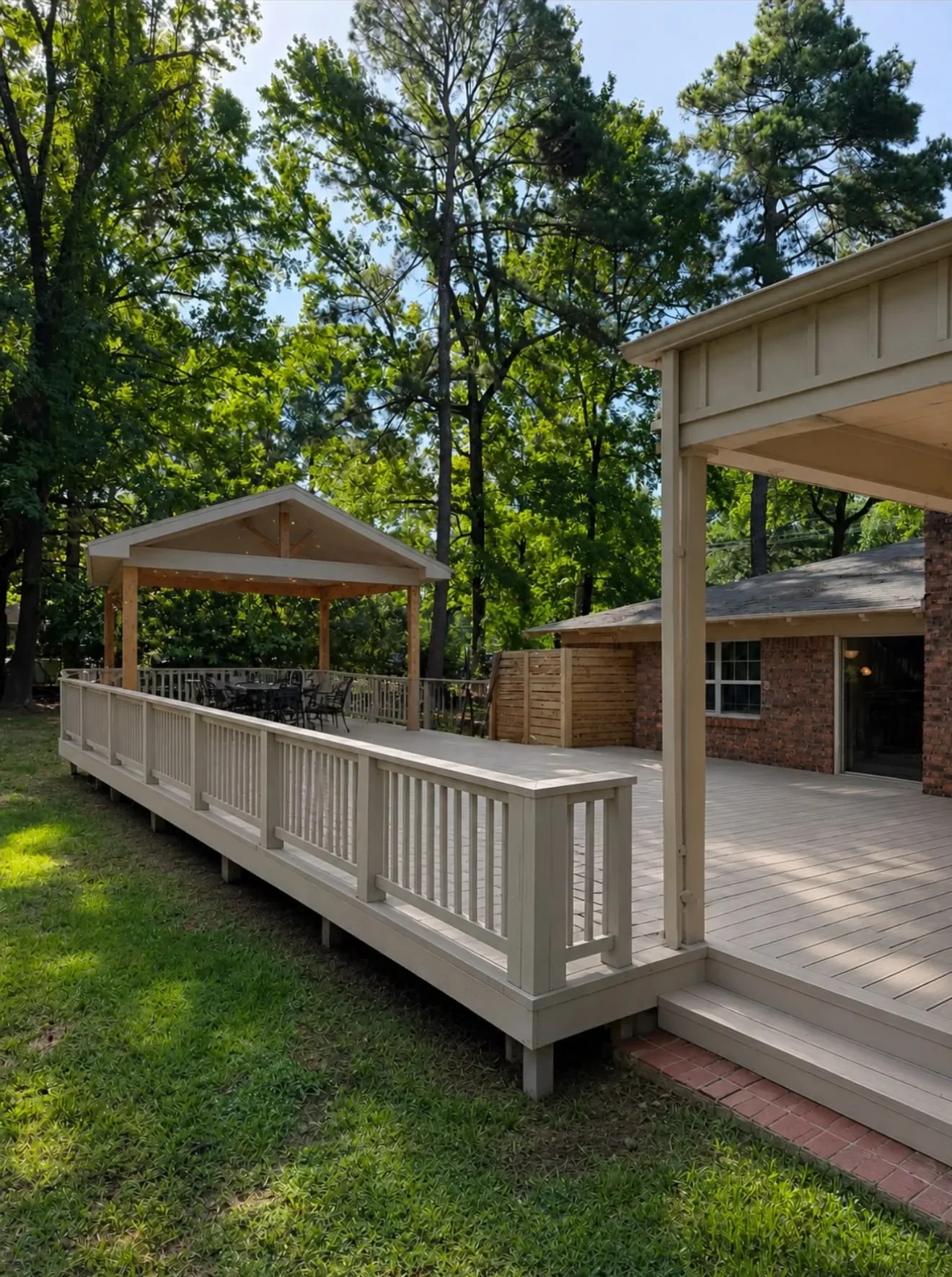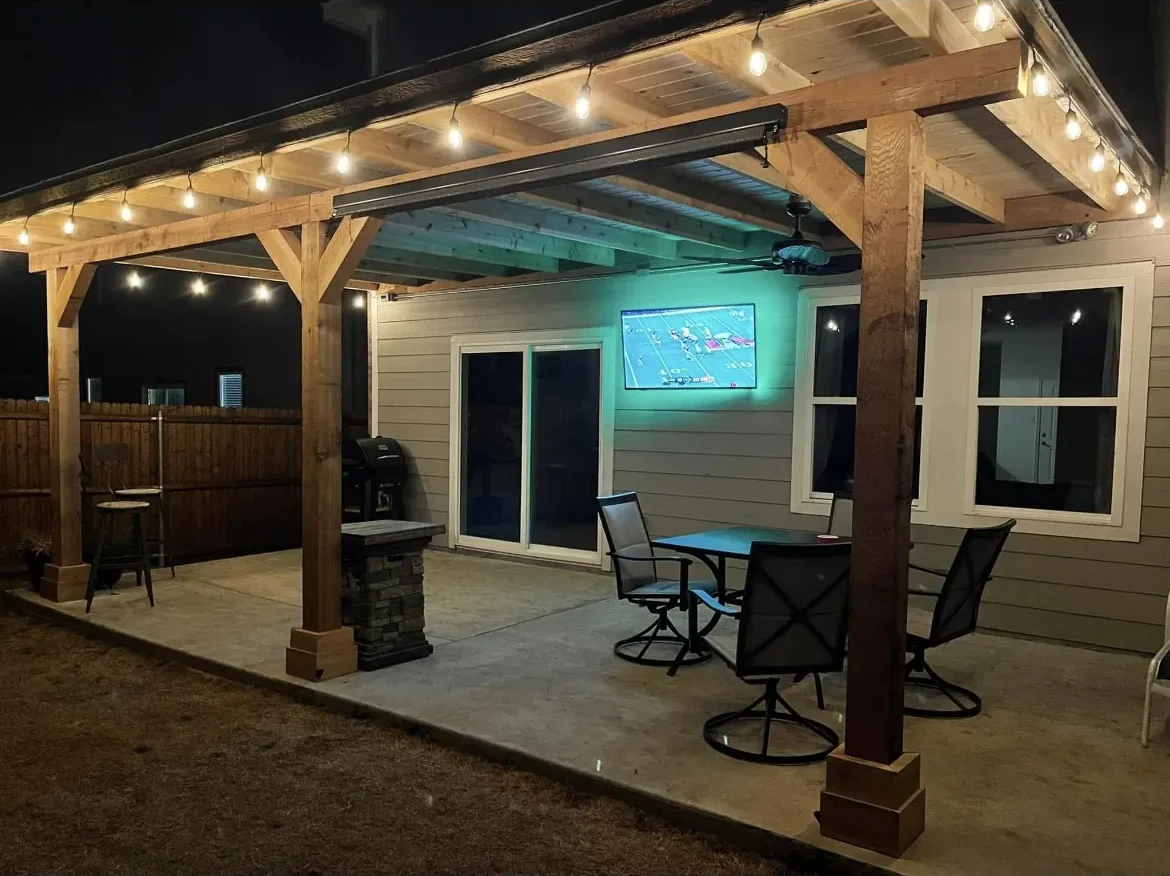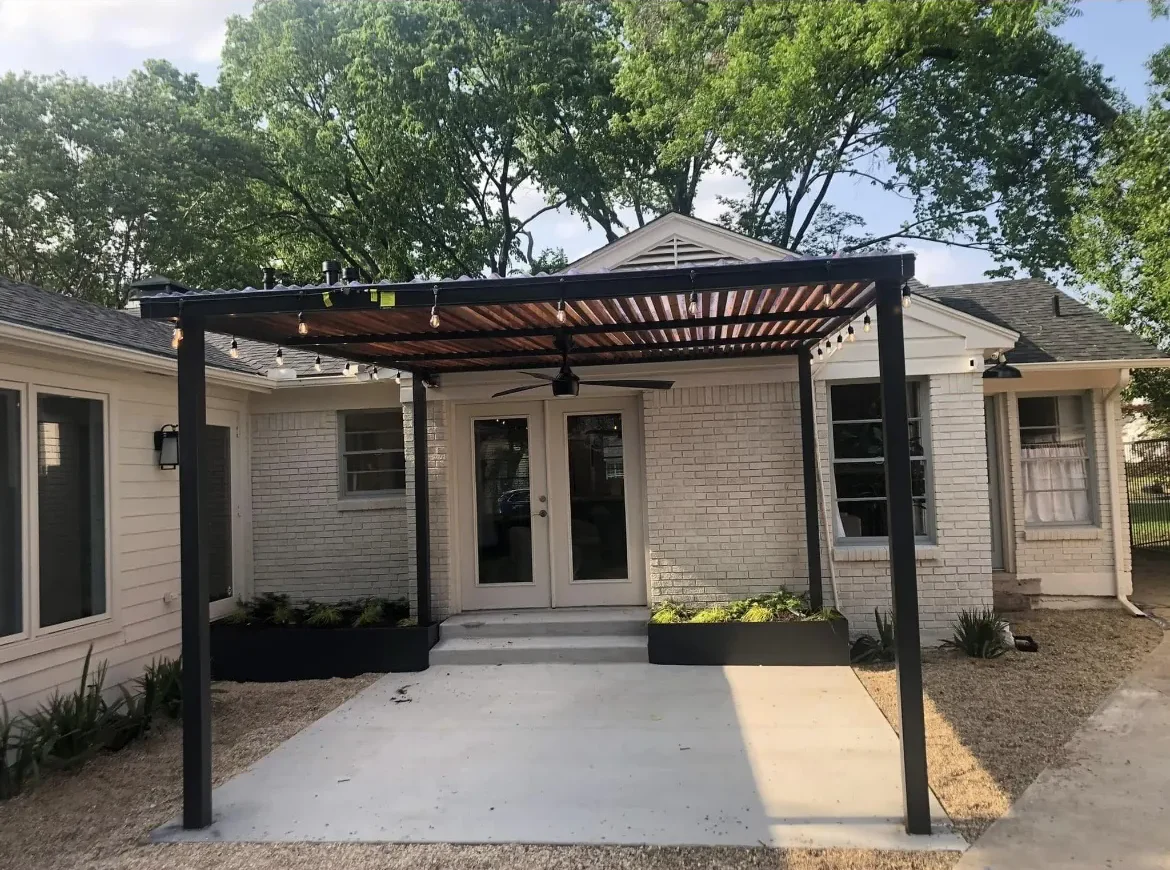
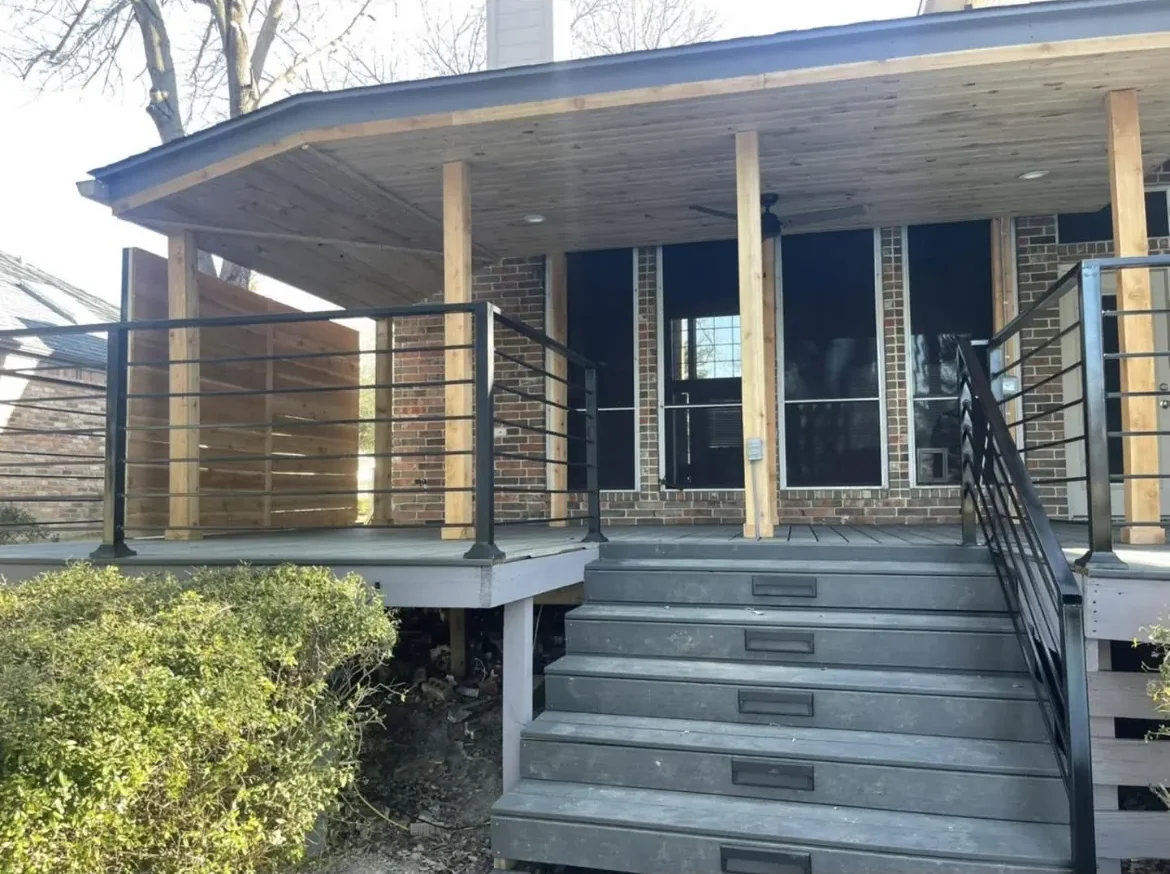
Composite decking is the low-maintenance choice for a Dallas back yard, but it is not a no-decision choice. The board line, the color, the joist spacing and the shade plan all change how the deck lives through a North Texas summer. This guide covers what a composite deck costs in Dallas in 2026, how hot the boards get, how the main brands compare on heat, and how a composite deck should be framed and permitted here. For decks in general, including cedar and pressure-treated builds, see our Dallas deck builder page.
How much does a composite deck cost in Dallas TX in 2026 per square foot?
A composite deck in Dallas typically costs $25 to $50 per square foot installed, according to Block Renovation's 2026 Dallas guide, which puts pressure-treated wood at $15 to $30. Other sources run in a similar band or higher. The table shows each figure next to its source, so read across a row rather than down a column.
| Source | Scope | Composite | Pressure-treated | Cedar |
|---|---|---|---|---|
| Block Renovation (2026) | Dallas, installed | $25 to $50 per sq ft | $15 to $30 per sq ft | Not listed |
| Fixr (2023) | National, installed | $28 to $40 per sq ft | $15 to $25 per sq ft | $19 to $29 per sq ft |
| Advantage Lumber (2026) | Retailer cost guide, installed | $40 to $70 per sq ft standard; $70 to $100+ complex | Not listed | Not listed |
| Trex FAQ | Materials incl. substructure | $15 to $30 per sq ft | Not listed | Not listed |
On the Dallas numbers, a 300 square foot composite deck works out to roughly $7,500 to $15,000 before you add stairs, premium railing, lighting or a roof. Height off the ground, the number of steps and the railing style move the total most, along with the board line. Advantage Lumber's 2026 retail prices show how wide that spread is: starting prices per linear foot of board run from about $2.30 (Trex Enhance Basics) to $9.96 (Trex Signature), $3.43 (TimberTech Prime+) to $7.36 (TimberTech Legacy), and $5.28 (AZEK Harvest) to $7.68 (AZEK Vintage). Those are board prices, not installed prices, and the retailer notes they change.
Archetex Outdoor Design Co. does not publish a price list. Matthew walks the yard, measures the drop from the door to the grade, and gives you a written price after a free site visit. For a broader breakdown, read our Dallas deck cost guide.
Composite vs wood vs pressure-treated in Dallas heat
Composite costs the most to build and the least to keep, pressure-treated pine is the cheapest start, and cedar sits between them. In Dallas the deciding factors are sun exposure, how long you will own the house, and whether you are willing to seal a deck on a schedule.
- Composite. Trex says a Trex deck needs only soap-and-water cleaning and never needs sanding, staining or painting. Block Renovation's Dallas guide notes that composite handles UV better than wood, which matters where July and August highs often reach or pass 100 degrees (National Weather Service). The trade-off is surface heat (below) and a higher price per square foot.
- Pressure-treated pine. The lowest installed cost in both the Dallas and national figures above. It needs sealing or staining on a schedule to slow checking and graying in Texas sun. It is also the usual framing lumber under composite boards, which is why the frame deserves as much attention as the decking.
- Cedar. Lighter, naturally rot-resistant and good-looking, with an installed national range of $19 to $29 per square foot (Fixr). Like pine, it needs regular finishing to keep its color.
Matthew has built with cedar, pressure-treated pine and gray composite decking, so the recommendation comes from the spot and the budget, not from a single material he prefers to sell.
How hot do composite deck boards get in a Texas summer?
Composite boards get hot in direct sun, and the manufacturers say so themselves. Trex states that its decking will get hot in direct sun on hot days, and that the darker the color, the hotter it will feel. TimberTech's footnote is blunter: all decking products will get hot in the sun.
Independent measurements are scarce. The best side-by-side figure we found comes from Advantage Lumber, a decking retailer that sells both composite and hardwood. In its direct-sun test in Sarasota, Florida, several composite boards reached 140°F or higher, while a hardwood sample read about 120°F. Treat that as one retailer's infrared-thermometer test, not a lab standard, but it matches what people feel on a bare composite deck in a Dallas August. The National Weather Service describes Dallas–Fort Worth highs in July and August as consistently in the 90s and often reaching or exceeding 100 degrees, with some nights that do not drop below 80.
Color and heat
Color is the lever you control. Both Trex and TimberTech recommend lighter colors for hot climates. TimberTech names its grays (Coastline, Slate Gray, Whitewash Cedar) and tans (Weathered Teak, Brownstone) as the colors that stay coolest in direct sun. A dark brown board on a west-facing deck is the combination most likely to send people back indoors.
Shade beats board choice
The most reliable fix is not a cooler board but a roof or pergola over part of the deck. Block Renovation's Dallas guide says a covered patio lowers the temperature underneath by 15 to 25 degrees. Archetex plans a deck and its cover as one design when you want both; see covered patios and pergolas for the structures.
Trex vs TimberTech vs AZEK: what the brands claim on heat
Trex and TimberTech each sell a line marketed as cooler in the sun. Both figures are manufacturer claims, not independent tests. These are market options, described here from the makers' published claims. Archetex is not certified by, registered with or partnered with any decking brand.
| Brand line | Material | Heat claim (maker's own) | Compared against |
|---|---|---|---|
| Trex Transcend Lineage | Capped composite | Up to 35 degrees less heat buildup | Trex's original boards, in lab testing simulating full summer sun |
| TimberTech AZEK | Capped PVC | Up to 30 degrees cooler | Competing products |
| TimberTech PRO and EDGE | Capped composite | No figure; lighter colors perform better | Not stated |
The two claims use different baselines, so you cannot subtract one from the other. Trex's footnote names a dark board without SunComfortable technology (Lava Rock) and a light one with it (Salt Flat), so part of that gap may be color. TimberTech does not say what it compared against. Ask any builder for samples and leave them in your own yard for an afternoon before you choose.
Framing, joist spacing and hidden fasteners for a composite deck
Composite boards are less stiff than wood, so the frame under them has to be closer together and flatter. Trex's installation guide calls for joists no more than 16 inches on center for standard decks, 12 inches when the boards run diagonally, and 12 inches or less for joists carrying heavier loads and for stair stringers. It also calls for blocking between joists, which it notes is required by code to stop joists rolling or twisting, and for every joist to go in crown-up.
That spacing is the reason an old wood deck cannot always be re-boarded with composite. A frame built at wider spacing for 2x6 wood boards may need sistered or added joists before composite goes on top.
Hidden fasteners
Grooved-edge composite boards take hidden clip fasteners, which Trex says create a secure fit while still gapping the boards. The result is a face with no screw heads, which looks cleaner and leaves nothing to catch bare feet. Square-edge boards are face-screwed and are used where the edge shows, such as stair treads and the picture-frame border.
Footings in Blackland Prairie clay
Much of the Dallas area sits on Blackland Prairie clay such as Houston Black, the soil the Soil Science Society of America describes as swelling when wet and shrinking and cracking when dry. A deck footing set shallow in that soil moves with it. Archetex sizes footings and framing to the home's elevation and load, so the deck stays level with the door through wet springs and dry Augusts.
Dallas permits and HOA approval for a composite deck
Most composite decks in Dallas need a building permit. The Dallas Building Code exempts a deck only when it meets every one of these conditions: 200 square feet or less, no more than 30 inches above grade at any point, not attached to the house, and not serving the home’s required exit door (Dallas Building Code, Chapter 52, Sec. 301.2.1). A deck attached to the house, or one with a roof, needs a Residential Alteration/Addition permit. The City of Dallas permit fee schedule (effective July 1, 2025) has no flat deck fee: a residential permit carries a plan review fee of $0.046 per square foot or $577, whichever is greater, plus a base permit fee and an inspection fee of $125 per trade. Ask the city for the exact total when you apply.
In the suburbs, the HOA is often the slower approval. Block Renovation notes that HOA setbacks of 5 to 15 feet from rear and side boundaries are common, along with rules on height and materials. In master-planned neighborhoods in Plano, Frisco and McKinney, plan on submitting a drawing, the board color and the railing style to the architectural committee before the city permit.
How Archetex builds a composite deck
Every Archetex deck follows the same four steps, whether it is a ground-level platform or a raised deck with stairs.
- Consultation and material selection. Matthew looks at how you use the yard, where the sun lands and how far the ground falls from the door, then talks through composite against wood on maintenance and budget, and board color against sun exposure.
- Footings and framing. Footings and framing are sized to the home's elevation and the load, not taken from a one-size prefab kit, with joist spacing set to the board maker's rules.
- Decking and railing installation. Boards, fascia, stairs and railing go on, with railings built to code from the start rather than added after an inspection.
- Final walkthrough and cleanup. You walk the deck with Matthew, the site is cleaned up, and you get care recommendations for the boards you chose.
Customers in Archetex's Google reviews repeatedly mention communication and daily updates, punctuality, help with the design, a clean site and reasonable prices. You can see finished decks on our work page.
Composite deck maintenance in Dallas
Composite maintenance comes down to cleaning. Trex says a soap-and-water wash is all its boards need and that you will never sand, stain or paint them. In Dallas that means rinsing off pollen in spring, clearing leaves before they sit wet in the gaps, and washing off grill grease before it bakes in. Keep the gaps between boards open so water drains and air moves under the deck, and check the frame and footings if a board starts to bounce. Trex lists 25-, 35- and 50-year limited warranties for most of its products; those are the manufacturer's warranties on the boards, so read the terms for what they cover.
How to choose a composite deck builder in Dallas (reviews, portfolio, written quote)
Look for finished composite decks in the builder's portfolio, read recent reviews, and insist on a written quote that spells out the materials. A good quote for a composite deck in Dallas should list:
- The board brand, line and color, and the fascia and stair treads.
- Framing lumber, joist size and joist spacing, and the footing type and depth.
- Fastening method (hidden clips or face screws, and where each is used).
- Railing type, height and material.
- Who pulls the City of Dallas permit and who handles HOA submittal.
- Demolition and haul-off of any old deck, site cleanup, and a payment schedule tied to stages of work.
Archetex Outdoor Design Co. builds composite decks across Dallas, Richardson, Garland, Rockwall and the northern suburbs. To get a written price, contact Matthew or call or text (430) 318-6275.