Flagstone walkway installation in Dallas TX: why the installer matters
Flagstone is natural stone split into flat, irregular slabs and laid as a walkway or patio. In Dallas you can buy it from stone yards, but buying the stone and getting it laid are separate jobs. The stone is the cheap part. Lawn Love’s 2026 national figures put flagstone material at $3.95 to $5.95 per square foot against $11 to $15 for labor. What you are really paying for is the base, the setting and the drainage, and that is where most flagstone paths in North Texas go wrong.
The reason is the ground. Dallas sits on the Blackland Prairie, where the Houston Black clay soils, according to the Texas Water Development Board, “shrink and swell markedly with changes in moisture content,” taking water in fast when dry and cracked and very slowly when moist. A stone set straight on that soil rides up after a wet spring and drops in a dry August, so the walkway rocks underfoot within a season or two.
Flagstone walkway and patio cost in Dallas TX per square foot (2026)
Installed flagstone typically runs about $15 to $27 per square foot, according to Lawn Love’s 2026 national cost guide, and Homewyse’s May 2026 national estimate for a complete walkway (6-inch gravel base, 1-inch bedding sand, edging and polymer sand) is $29.53 to $37.75 per sq ft. For Dallas specifically, Block Renovation’s 2026 guide puts pavers and natural stone at $10 to $25 per sq ft, with natural stone such as flagstone at the high end.
| Item | Typical cost | Source |
|---|---|---|
| Flagstone, installed | $15 to $27 per sq ft | Lawn Love (national), 2026 |
| Flagstone walkway with 6" gravel base, edging and polymer sand | $29.53 to $37.75 per sq ft | Homewyse (national), May 2026 |
| Pavers and natural stone, Dallas | $10 to $25 per sq ft | Block Renovation, 2026 |
| Flagstone material only | $3.95 to $5.95 per sq ft | Lawn Love (national), 2026 |
| Labor | $11 to $15 per sq ft | Lawn Love (national), 2026 |
| 12 × 12 ft patio (144 sq ft), installed | $2,160 to $3,890 | Lawn Love (national), 2026 |
| 20 × 20 ft patio (400 sq ft), installed | $6,000 to $10,800 | Lawn Love (national), 2026 |
| Concrete slab base instead of gravel (Dallas, under pavers) | add $4 to $7 per sq ft | HomeBlue, Dallas, 2022 |
A narrow walkway costs more per square foot than a square patio, because there is more edge and more cutting for the area. Mortared work on a slab costs more than dry-laid because you are paying for the slab first. These are market figures, not Archetex prices; Archetex Outdoor Design Co. gives a written price after a free site visit.
Dry-laid flagstone vs mortared on a slab
Dry-laid is the forgiving choice for a walkway on clay; mortared on a slab is the choice for a patio you want dead flat.
Dry-laid on gravel or decomposed granite
The stones sit on a compacted aggregate base with a thin bedding layer, and the joints are filled with sand, polymeric sand, decomposed granite or plants. Water drains down through the joints, and if the clay moves a stone, that stone can be lifted and reset without breaking anything. Bruce Zaretsky’s method in the Journal of Light Construction is a good benchmark: dig about 8 inches below finished grade (more on poor soil), put landscape fabric down on clay, build 5 to 6 inches of crushed-stone base in 3-inch lifts compacted until the tamper “starts to hop,” then 1 to 2 inches of sand, and take the excavation at least 6 inches past the finished edge so the sides don’t slough off. Decomposed granite, common around Dallas, can serve as the bedding and joint fill on top of that base.
Mortared on a concrete slab
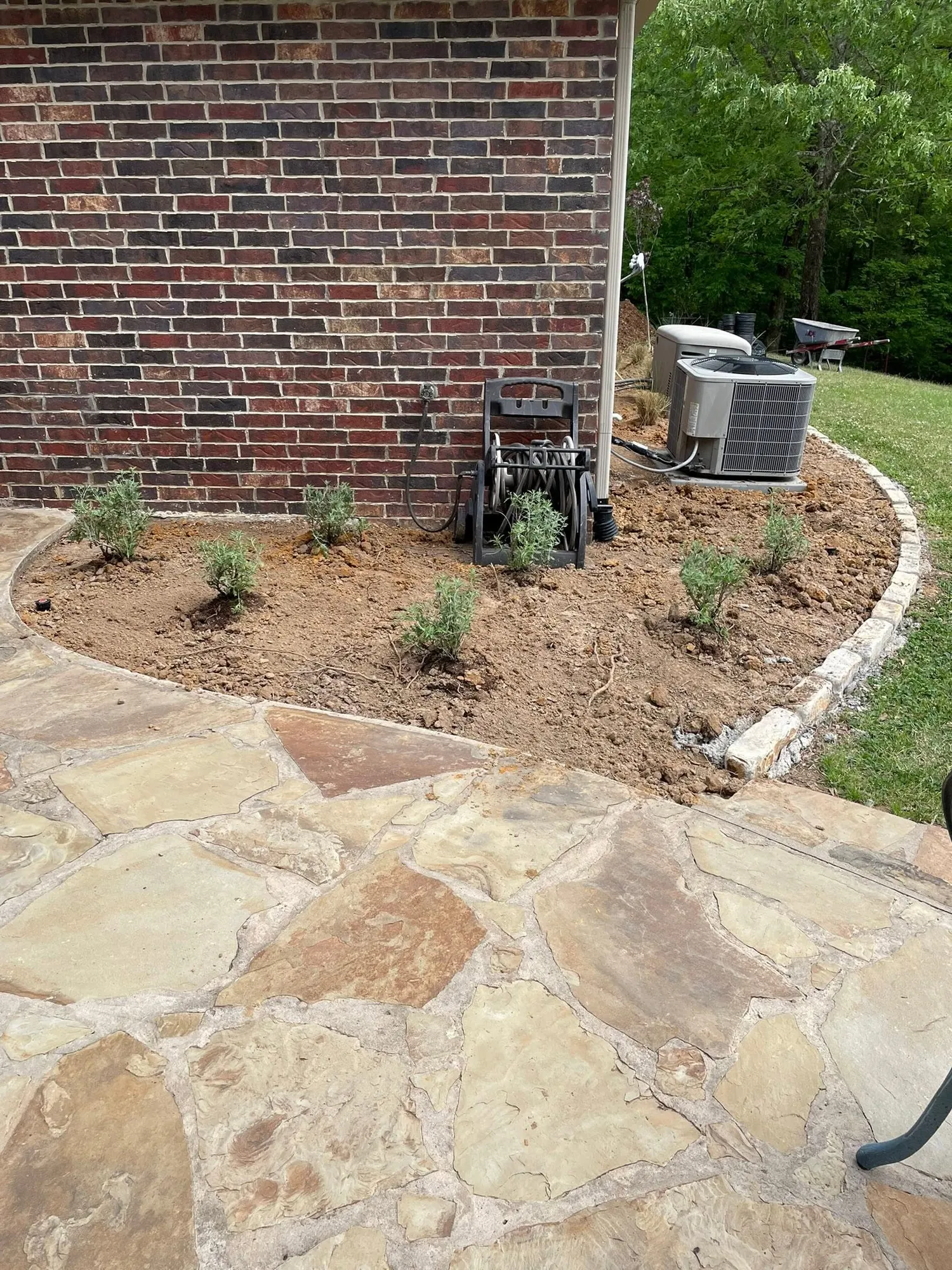
Here a reinforced slab is poured first and the flagstone is set in a mortar bed with mortared joints, like the walkway in the photo above. The result is a fixed, flat surface with no weeds and nothing to wash out, which suits a patio with dining chairs or a path along the house. The trade-offs: it costs more, it sheds water across the surface instead of through it, and it is only as good as the slab underneath. A slab on Dallas clay needs the same care as any patio: control joints spaced, in feet, no more than 2 to 3 times the slab thickness in inches (8 to 12 feet for a 4-inch slab, per Concrete Network), and ideally the stone layout is planned so slab joints sit under mortar joints rather than under the middle of a stone.
Oklahoma flagstone vs Texas flagstone
Two common choices in Dallas are Oklahoma sandstone and Texas limestone such as Lueders. Both work; the choice comes down to color, the sun on the spot and how the surface will be used.
| Oklahoma flagstone | Texas Lueders limestone | |
|---|---|---|
| Stone | Fine-grained sandstone | Limestone, quarried in the Lueders Basin outside Abilene |
| Colors | Brown tones with gray | Gray and buff through brown, rose and charcoal |
| Typical thickness | 1.5 to 2 inches for patio stone; one pallet covers about 220 sq ft | Ask the yard; Lueders is also sold with sawn finishes |
| In use | Porous, and runs cooler in summer sun | Dense and heavy; can be marked by acids |
Sources: Texas Garden Materials (Oklahoma stone specification), Champion Stone Company (Lueders quarry, colors, finishes and density), LandscapingNetwork (sandstone and limestone properties). For a walkway that will be dry-laid, thicker stone is steadier; thin stone is better set in mortar on a slab, where the slab carries the load. Buy all the stone for one job from the same lot, and look at it wet as well as dry, because the color changes a lot after rain.
Drainage, clay movement and where the path goes
Drainage decides whether a flagstone walkway lasts on Blackland clay. Water that sits under the stones softens the clay and lets it swell; water that runs toward the house wets the soil at the foundation. The Journal of Light Construction method builds in about 2 inches of fall over 8 feet, roughly a 2 percent grade, away from the house. Downspouts should discharge clear of the path, not under it.
Route matters too. People walk the shortest line from the driveway to the door and from the back door to the gate; a path that ignores that line gets cut across, and the lawn beside it wears through. Archetex lays out walkways and patios from how the yard is actually used, and plans the grading, drainage and the connection to the house along with the stone.
Joints: polymeric sand, mortar or groundcover
The joint is a choice between low maintenance and a softer look.
- Polymeric sand hardens when it is wetted, resisting washout and weeds. Check the product’s limits: Alliance Gator Maxx Sand, for example, is rated for natural stone joints from 1/8 inch up to 2 inches wide and at least 1.5 inches deep, which rules out the widest gaps in irregular flagstone.
- Decomposed granite or gravel suits wide joints on a dry-laid path and drains freely, but it moves and needs topping up.
- Mortar is the fixed, clean finish, used on slab-set work.
- Groundcover between stones gives a garden-path look. It works best on paths that don’t get daily traffic and on a dry-laid base with soil in the joints.
Flagstone can also be sealed; Lawn Love puts resealing at every 18 to 36 months where a sealer is used.
Edging that holds a flagstone walkway in place
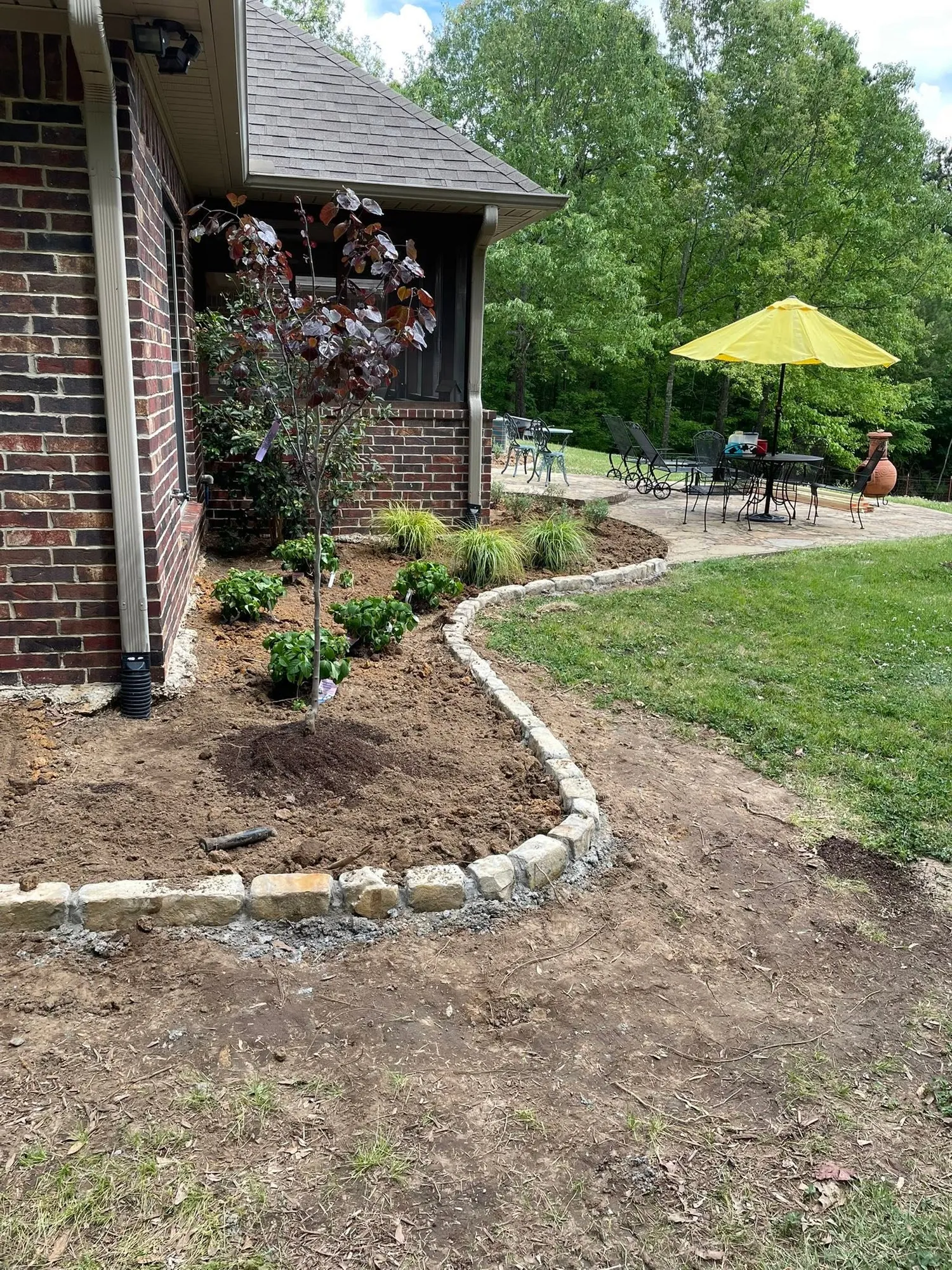
A dry-laid walkway needs its edges restrained, or the outer stones slide outward as the clay moves and mowers knock them. Common choices are steel edging, a soldier course of brick, a border of natural stone, or a mortared edge on slab work. The photo above shows the pairing that finishes a walkway: flagstone on one side and a planting bed with natural stone edging on the other, so bed, edge and path read as one piece. Archetex builds natural stone, brick and steel bed edging alongside its walkways; see walkways and stone features and landscape design.
Permits and HOA approval
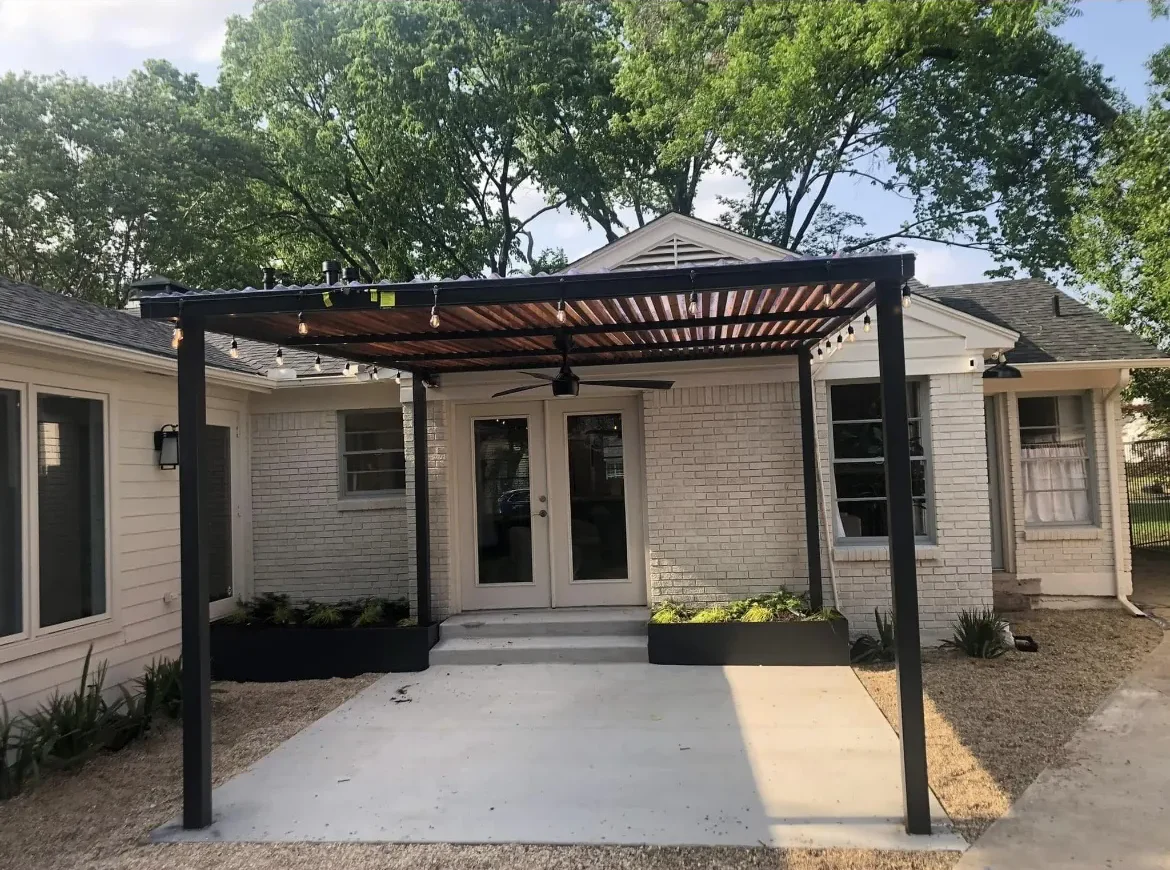
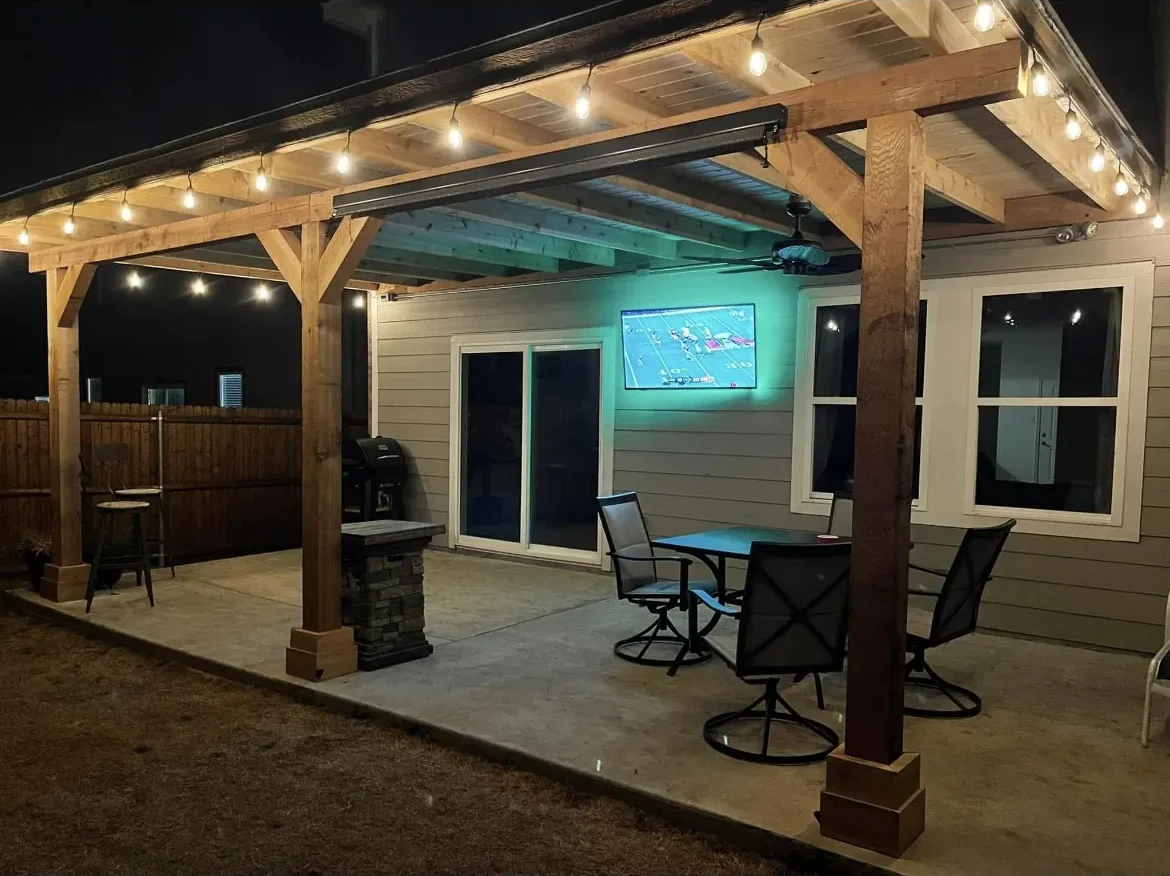
A ground-level flagstone patio or walkway with no roof usually doesn’t need a building permit in DFW cities, according to Block Renovation’s 2026 Dallas guide, but a pergola or cover over it usually does. In the HOA-heavy suburbs (Plano, Frisco, McKinney, Rockwall) front-yard hardscape and visible materials often need architectural approval first, so get the stone and layout approved before anything is ordered. If you want shade over the patio later, plan the footings now; see covered patios and pergolas.
How to choose a flagstone installer in Dallas
Choose on the base and the written scope, not the stone price. A good written quote for flagstone in Dallas lists:
- Stone type, color and thickness, and who supplies it.
- Dry-laid or mortared; if mortared, the slab thickness, reinforcement and joint layout.
- Excavation depth, base material and depth, compaction, and whether fabric goes under it.
- Bedding layer (sand or decomposed granite) and joint fill.
- Edging type.
- Which way the surface drains and where the water goes.
- Haul-off of soil and any old stone, and cleanup.
Ask to see work that has been through a couple of summers, not just new installs. Archetex’s walkways, edging and patios are in our work, and Google reviewers mention Matthew’s communication, punctuality and a clean site.
Archetex Outdoor Design Co. works across Dallas, Plano, Frisco, McKinney, Richardson, Garland and Rockwall, plus Addison, Rowlett and Farmers Branch. For a free site visit and a written price, get in touch or call Matthew on (430) 318-6275; texts are welcome.