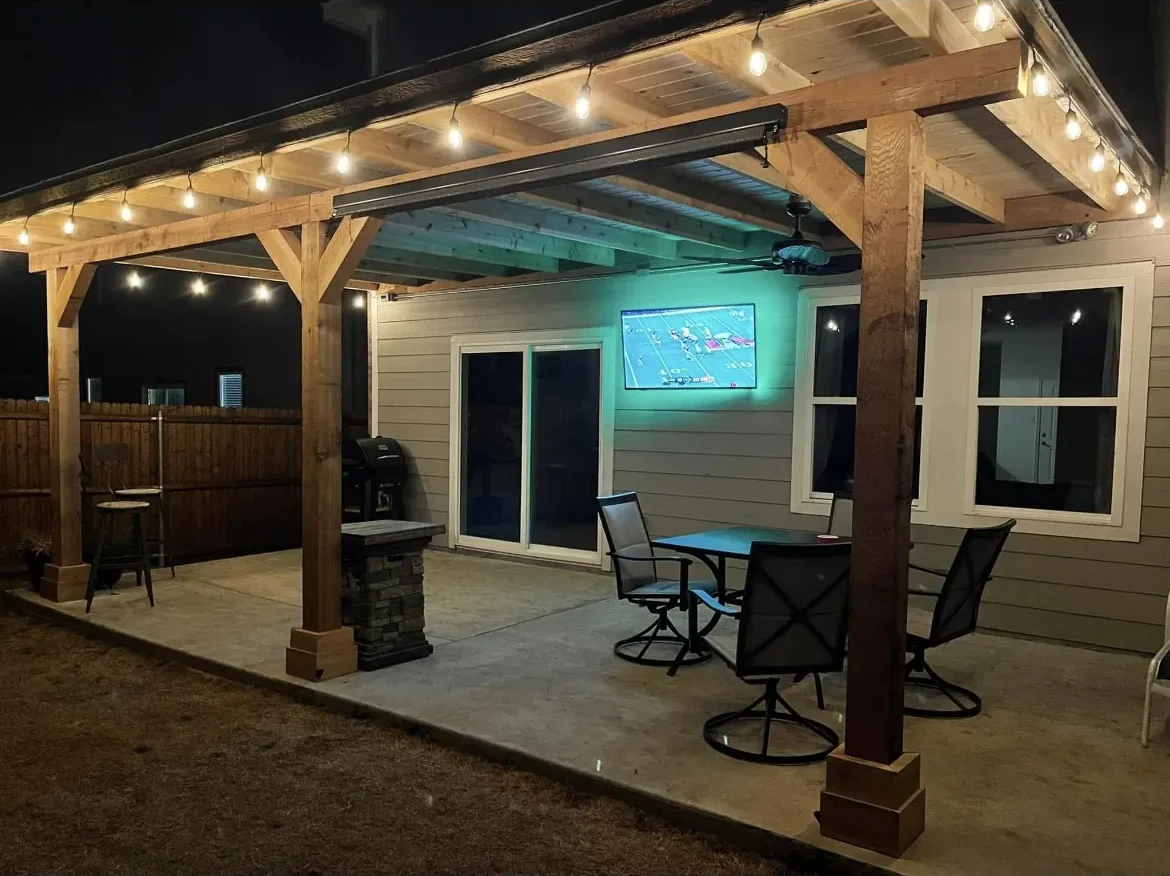
Most pages on deck resale value quote one national percentage, often from an older year, and stop there. This guide puts the Dallas numbers next to the regional and national ones, shows how much they have moved since 2019, and covers the parts other pages skip: how an appraiser counts a deck, what it does to your Dallas County property taxes, and what happens at sale if the deck was never permitted. If you want build prices rather than resale figures, start with what a deck costs in Dallas.
One thing to know up front: every resale number below is a Realtor estimate from a survey. No source we found measures what a deck actually adds to a Dallas sale price.
Does a deck add value to a home in Dallas? (the short answer)
Yes. Realtors estimate that a typical Dallas deck addition gets back most or nearly all of its cost at sale: 99.8% for a wood deck and 92.1% for a composite deck in Remodeling's 2025 Cost vs Value report. In dollars, the wood deck cost $15,841 and added an estimated $15,813 in resale value. The composite deck cost $23,519 and added an estimated $21,658.
That makes the deck one of the better paybacks in the report. Counted from the 2025 Dallas table, the wood deck ranks 7th of 28 projects by cost recouped and the composite deck ranks 9th. The only jobs ahead of the wood deck are a garage door, a steel entry door, stone veneer, a minor kitchen remodel, fiber-cement siding and vinyl siding. Both deck types finish well ahead of a midrange bath remodel (75.7%), a midrange major kitchen remodel (51.8%) and a midrange primary suite addition (33.2%).
The catch is in how the value side is made. Resale value in Cost vs Value comes from an online Zonda survey of over 6,000 Realtors, who were shown project descriptions, photos, local construction costs and median home prices. It is their estimate of what the project adds, not a measured result from closed sales.
What does the 2025 Cost vs Value report say about deck resale value in Dallas?
Dallas sits between the regional and national numbers: a wood deck recoups 99.8% here, 106.6% across the West South Central region and 94.9% nationally. Composite follows the same pattern at 92.1% in Dallas, 94.4% in the region and 88.5% nationally. The national figures match Remodeling's national summary page, which rounds them to 95% and 89%.
| 2025 Cost vs Value | Job cost | Resale value (Realtor estimate) | Cost recouped |
|---|---|---|---|
| Wood deck, Dallas | $15,841 | $15,813 | 99.8% |
| Wood deck, West South Central | $15,709 | $16,743 | 106.6% |
| Wood deck, national | $18,263 | $17,323 | 94.9% |
| Composite deck, Dallas | $23,519 | $21,658 | 92.1% |
| Composite deck, West South Central | $23,631 | $22,304 | 94.4% |
| Composite deck, national | $25,096 | $22,199 | 88.5% |
Source: Remodeling / JLC, Cost vs Value 2025, Dallas page and national report. The 2025 report covers 28 remodeling projects in 119 U.S. markets.
Building costs are lower here than the national average. By our calculation from the 2025 figures, a Dallas wood deck costs about 13% less than the national number and a composite deck about 6% less.
What deck the report prices
The Cost vs Value wood deck is a 16x20 ft deck (320 sq ft) framed with pressure-treated joists on 4x4 posts set on concrete piers. It has pressure-treated deck boards in a simple straight pattern, a built-in bench and planter, three steps down to the yard and a full pressure-treated railing. The composite version uses the same pressure-treated frame and layout with composite decking and matching composite railing, bench and planter.
Calculated from Remodeling's 2025 Dallas cost and its 16x20 ft spec, that works out to about $49.50 per square foot for wood and $73.50 per square foot for composite. Those figures include the bench, planter, stairs and railing, so they run higher than a bare deck surface. For real per-square-foot ranges, see the Dallas deck cost guide linked at the top of this page.
How the numbers are made
Costs come from Verisk's XactRemodel building cost data for all 28 projects, with the national baseline built from federal price indexes starting in 2019. Values come from the Zonda survey of Realtors.
The report's editors warn that small differences in size, scope or finishes "can dramatically affect the price." So when you get a bid, compare what is actually included with the 16x20 spec above before you compare the totals.
Why do deck ROI numbers keep changing? Dallas 2019 to 2025
Because resale value is a yearly survey of Realtors, the Dallas wood deck figure has swung from 46.4% in 2023 to 99.8% in 2025, in just two years. That is why one website says a deck returns about half its cost and another says nearly all of it. Both can be quoting a real Cost vs Value number from a different year.
| Year (Dallas) | Wood: cost | Wood: resale | Wood: recouped | Composite: cost | Composite: resale | Composite: recouped |
|---|---|---|---|---|---|---|
| 2019 | $12,460 | $10,073 | 80.8% | $18,321 | $12,606 | 68.8% |
| 2020 | $13,311 | $8,484 | 63.7% | $18,637 | $9,591 | 51.5% |
| 2021 | $15,678 | $9,575 | 61.1% | $20,857 | $11,433 | 54.8% |
| 2022 | $18,285 | $10,950 | 59.9% | $23,186 | $12,404 | 53.5% |
| 2023 | $16,673 | $7,732 | 46.4% | $23,516 | $8,497 | 36.1% |
| 2024 | $16,433 | $13,252 | 80.6% | $21,422 | $13,681 | 63.9% |
| 2025 | $15,841 | $15,813 | 99.8% | $23,519 | $21,658 | 92.1% |
Source: Remodeling / JLC, Cost vs Value Dallas pages, 2019 through 2025.
The 2025 jump came mostly from higher resale estimates, not cheaper builds. From the Cost vs Value tables, the Dallas wood deck cost dropped only from $16,433 in 2024 to $15,841 in 2025, while its estimated resale value rose from $13,252 to $15,813. Composite tells the same story: cost went up, from $21,422 to $23,519, and estimated resale value went up much faster, from $13,681 to $21,658.
The national numbers moved the same way. The national wood deck went from 50.2% in 2023 to 82.9% in 2024 and 94.9% in 2025, and national composite went from 39.8% to 68.2% to 88.5%. If a page tells you a composite deck returns about 68% and calls it current, it is most likely quoting the 2024 national figure.
The takeaway: payback depends partly on what agents think of the market the year you sell. Plan the deck around how you will use it, and treat resale value as a likely bonus.
Wood or composite: which deck recoups more at resale?
Wood recoups a higher share in Dallas, 99.8% against 92.1% in 2025, and the Dallas wood deck has beaten composite on that measure every year from 2019 to 2025 in the Cost vs Value tables. But composite adds more dollars of estimated resale value, because it costs more to build in the first place.
Here is the 2025 Dallas math, by our calculation from the report's figures:
- Wood deck: $15,841 to build, $15,813 in estimated resale value, so the net cost after resale is about $28.
- Composite deck: $23,519 to build, $21,658 in estimated resale value, so the net cost after resale is about $1,861.
- The difference: composite costs $7,678 more and adds $5,845 more in estimated resale value.
To put the size of the spend in perspective, the Cost vs Value Dallas wood deck (2025 cost) equals about 4.1% of the September 2026 DFW single-family median close price of $384,900, and the composite deck about 6.1%. That is our calculation and mixes a 2025 cost report with a 2026 price report, so treat it as a rough scale, not a rule.
Resale is only one part of the material choice. Upkeep, surface heat in a Texas summer and how long the boards last matter more if you plan to stay. We cover those in composite vs cedar vs pressure-treated in Texas heat, and you can see what goes into a build on our page on composite decks in Dallas.
A simple way to decide:
- Pick wood if you expect to sell within a few years and want the highest share of your money back on paper.
- Pick composite if you plan to stay, care more about lower upkeep, and are comfortable with a smaller share coming back at sale.
How does Dallas compare with Houston, Austin and San Antonio?
Dallas wood decks recoup more than Houston or Austin and less than San Antonio in the 2025 Cost vs Value report. The same order holds for composite decks.
| 2025 metro | Wood deck: cost | Wood deck: recouped | Composite deck: cost | Composite deck: recouped | Backyard Patio package: recouped |
|---|---|---|---|---|---|
| Dallas | $15,841 | 99.8% | $23,519 | 92.1% | 53.2% |
| Houston | $16,118 | 92.9% | $24,412 | 82.1% | 49.1% |
| Austin | $14,807 | 93.9% | $22,613 | 85.8% | 49.7% |
| San Antonio | $14,807 | 104.1% | $22,613 | 95.3% | 50.3% |
Source: Remodeling / JLC, Cost vs Value 2025 pages for Dallas, Houston, Austin and San Antonio.
Two notes on this table. First, Fort Worth is not a Cost vs Value market, and neither are Plano, Frisco or McKinney, so the Dallas page is the closest published figure for the whole area. Second, the "Backyard Patio" column is not a plain patio. It is a large outdoor package, explained in the NAR section below.
Do Dallas buyers want a deck? Outdoor living and buyer appeal in Texas
Buyers say yes: nationally, 79% of recent and prospective buyers rate a deck essential or desirable, but builders in Texas and nearby states rarely include one. In the West South Central division (Texas, Oklahoma, Arkansas and Louisiana), 82% of new single-family homes started in 2024 had a patio and only 3% had a deck.
Nationally, the share of new homes with a deck fell to an all-time low of 17.4% in 2024, down from a peak of 27.0% in 2007 and 2008. NAHB found patios and decks act as substitutes for each other over time. The decks that do get built on new homes here are small: 163 sq ft on average in the West South Central, against 278 sq ft nationally.
Our reading: if you sell an existing Dallas home, much of your competition is new construction with a patio and no deck, so a good deck can help your listing stand out. That is a reading of the numbers, not a measured price premium.
Many owners add the deck later. In late 2024, decks ranked 7th of 22 remodeling projects in NAHB's national remodeler survey, a common job for 23% of remodelers. Patios still rank higher on buyer wish lists: in NAHB's 2024 national study of more than 3,000 buyers, the patio tied for the most-wanted feature at 86%, with exterior lighting at 82%, a front porch at 81% and landscaping at 80%.
Listing data points the same way for outdoor space in general. Zillow analyzed 359 features across nearly 1 million 2023 home sales and found that six of the top 10 features linked to higher sale prices were outdoor features. An outdoor kitchen was linked to a 1.7% premium, a bluestone patio 2.3% and an outdoor TV 3.1% ($10,749 on a typical U.S. home). Zillow did not publish a deck figure. Zillow also cautions that adding a feature only for resale "may not deliver these kinds of returns," because those features tend to show up in homes that have a lot else going for them.
For scale, the DFW-Arlington single-family median close price was $384,900 in September 2026, down 1.31% from a year earlier, and homes took 94 days to sell. In a slower market like that, features that make a listing look ready to enjoy can matter.
Deck vs patio vs outdoor kitchen: what NAR says about outdoor projects
Nationally, Realtors estimate a new wood deck recovers 89% of its cost, close to a paver patio (95%) and an outdoor kitchen (100%), and far ahead of an in-ground pool (56%). These figures come from the National Association of REALTORS 2023 Remodeling Impact Report on outdoor features, the latest outdoor edition, and all of them are national.
| NAR 2023 project (national) | Cost estimate | Value recovered (Realtor estimate) | Cost recovered | Joy Score (1 to 10) | Realtors who recommend it before selling |
|---|---|---|---|---|---|
| New wood deck (14x18 ft cedar) | $16,900 | $15,000 | 89% | 9.8 | 9% |
| New patio (18x16 ft concrete pavers) | $10,500 | $10,000 | 95% | 9.9 | 3% |
| Outdoor kitchen | $15,000 | $15,000 | 100% | 9.0 | 1% |
| In-ground pool | $90,000 | $50,000 | 56% | 10 | 1% |
Source: NAR Research Group with NALP, Remodeling Impact Report: Outdoor Features, March 2023.
NAR's deck is a 14x18 ft cedar deck attached to the house with a ledger, with cedar decking, railing and treads, 4 ft open-riser stairs, a clear sealer and a lattice skirt. The outdoor kitchen has an inset grill, stainless drawers, an ice chest, a sink, 60 sq ft of concrete countertop and stone veneer.
Across all 11 outdoor projects NAR scored, the cost-recovery order was: standard lawn care 217%, landscape maintenance 104%, overall landscape upgrade 100%, outdoor kitchen 100%, new patio 95%, new wood deck 89%, tree care 87%, irrigation 83%, landscape lighting 59%, fire feature 56% and in-ground pool 56%.
NAR's cost estimates came from 160 landscape professionals and its value estimates from 1,891 NAR members, both surveyed in early 2023 for a 2,500 sq ft house on a 14,000 sq ft lot.
Why the Cost vs Value "Backyard Patio" looks so much worse
In the 2025 Cost vs Value report, the Dallas "Backyard Patio" cost $47,446 and added an estimated $25,264, only 53.2% recouped. That project is not a plain slab. It is a 20x20 ft flagstone patio with a lift-and-slide glass door, a gas fire pit, a stone-veneer outdoor kitchen with a grill, a 20x20 cedar pergola, low-voltage lighting, and new gas and electrical lines. Don't compare it one-to-one with a $15,841 deck. A fair reading is that the bigger and more custom the outdoor package, the smaller the share Realtors expect to come back. For what larger projects cost, see outdoor kitchens and full outdoor living spaces.
Does a deck count as square footage in an appraisal?
No. Appraisers measure a home's living area under the ANSI Z765-2021 standard, and a deck is reported as a separate feature, not as gross living area. Fannie Mae requires appraisers to follow that standard, and the standard's publisher says it is used to sort a home into gross living area and non-living areas.
You can see this on the appraisal form itself. On the Uniform Residential Appraisal Report (Fannie Mae Form 1004, Freddie Mac Form 70), "Patio/Deck" is an amenity checkbox, separate from the line for square feet of gross living area. In the comparison grid where the appraiser weighs your home against recent sales, "Porch/Patio/Deck" has its own adjustment line, separate from "Gross Living Area."
That adjustment line gets used a lot. A CoreLogic study of about 1.3 million appraisals from 2012 to 2015 found "Porch and Deck" was adjusted on 50% or more of reports, while living-area differences were the most adjusted item at 96.4%. In practice, the appraiser puts a value on the deck and adjusts comparable sales up or down depending on whether they have one.
What you can do to help the appraiser:
- Keep the permit, the final inspection and the plans in one folder.
- Keep the material receipts and note the size and built-ins, so the deck is described correctly.
A roof or walls can change how an outdoor space is treated. We explain that in our guide to adding a roof over a deck.
Will a new deck raise my property taxes in Dallas County?
It can. In Texas, the 10% yearly cap on homestead appraisal increases does not cover new improvements, so the appraisal district can add a new deck's market value on top of the cap. The Texas Comptroller explains that a homestead's appraised value can't rise more than 10% a year, plus the market value of new improvements.
The Dallas Central Appraisal District (DCAD) says the homestead limitation does not apply to new improvements added that year, and gives additions, pools and garages as examples. DCAD may inspect a property after it receives a copy of a building permit for an amenity, and it reappraises property at least once every three years. DCAD's examples don't name decks, so we can't say a deck is always added. A new deck can be treated as a new improvement and added to your appraised value.
Repairs are different. Under Texas Tax Code section 23.23, a "new improvement" does not include repairs to or ordinary maintenance of an existing structure. Replacing a few rotten boards is maintenance. A brand new deck is an improvement.
We don't estimate the tax dollars here, because no source we found does it for a Dallas County deck. Don't skip the permit to avoid DCAD either. The permit is what protects you at sale, as the next sections explain, and the rules are in our guide to Dallas deck permit rules.
Which decks get the best return (and which overbuild the neighborhood)?
The decks that recoup best are mid-size, simple and in line with the neighborhood. The Cost vs Value benchmark is a 16x20 ft deck with stairs, a railing and a bench, and the projects that underperform at resale are the ones overbuilt for the street.
Block Renovation's Dallas guide gives an example of overbuilding: a $100,000 outdoor kitchen in a neighborhood of $400,000 homes. Its advice is to match what you spend to your neighborhood's price tier. The Cost vs Value editors make a similar point: how buyers value a project depends on the condition of the rest of the house, the value of similar homes nearby and local price trends, and the report is "less successful" at predicting value for one specific address. They suggest getting estimates from local remodelers and talking to an experienced real estate agent.
A checklist for a deck that holds its value:
- Size it near the benchmark. The report prices a 320 sq ft deck. New-home decks in our region average 163 sq ft, so anything around the benchmark already stands out.
- Match the price tier. Look at what nearby homes at your price point have in the backyard before you add upgrades.
- Fix the rest of the house too. A new deck behind a tired house won't be valued like one behind a well-kept house.
- Get it permitted and inspected. Unpermitted work becomes a disclosure question when you sell.
- Get HOA approval in writing first. See the note below.
Bigger, higher and covered builds can make sense for your own use, but there is no Cost vs Value data for covered, elevated or upscale decks, so don't expect the 2025 percentages to carry over.
HOA and neighborhood comps
Many DFW HOAs cap patio cover and pergola heights and require setbacks, often 5 to 15 ft from rear and side property lines. Block Renovation suggests asking the architectural review committee what has been approved recently. Those recent approvals also show you what your neighbors have built, which is a useful guide to how far to go without overbuilding for the street.
Should you build or fix a deck right before you sell?
Usually not as a pure resale play. Only 9% of Realtors recommend building a new wood deck before listing, while 92% have suggested sellers improve curb appeal before listing. In the same NAR report, 97% said curb appeal matters in attracting a buyer, 53% recommend standard lawn care before selling and 23% recommend an overall landscape upgrade.
A deck built the month before listing also gives you none of the years of use, and Zillow warns that features added only for resale may not deliver average returns.
An existing deck is a different question. If yours has soft boards, loose railings or a worn finish, it will show when buyers walk the yard. Deciding whether to fix it or tear it out is a repair-or-replace call, which we cover in repair or replace an old deck.
Permits matter at this stage. The Texas Seller's Disclosure Notice in Property Code section 5.008(b) asks whether the seller knows of "room additions, structural modifications, or other alterations or repairs made without necessary permits." A deck that needed a permit and never got one is something you may have to disclose. If you are planning a deck now and may sell in a few years, permit it now.
The value you can't sell: how much a deck gets used
The strongest payoff is daily use. NAR's survey gives a new wood deck a Joy Score of 9.8 out of 10, and 74% of owners say they have a greater desire to be home since building it. In the same survey, 71% reported more enjoyment at home and 66% a major sense of accomplishment. The most important result owners named was better functionality and livability (57%).
The Joy Score combines the share of owners who were happy with the project and the share who were satisfied, divided by 10. For comparison, a new patio scored 9.9, an outdoor kitchen 9.0, and an in-ground pool and landscape lighting both scored 10.
In Dallas, how much use you get depends a lot on shade. A deck facing afternoon sun can sit empty for much of the summer, while a shaded deck gets used in the evenings for more of the year.
Archetex Outdoor Design Co. designs and builds custom composite and wood decks, covered decks and pavilions across Dallas and nearby cities, and gives a free site visit and a written price. If you are weighing a deck for resale, use, or both, talking to a Dallas deck builder about your yard and budget is the simplest next step.