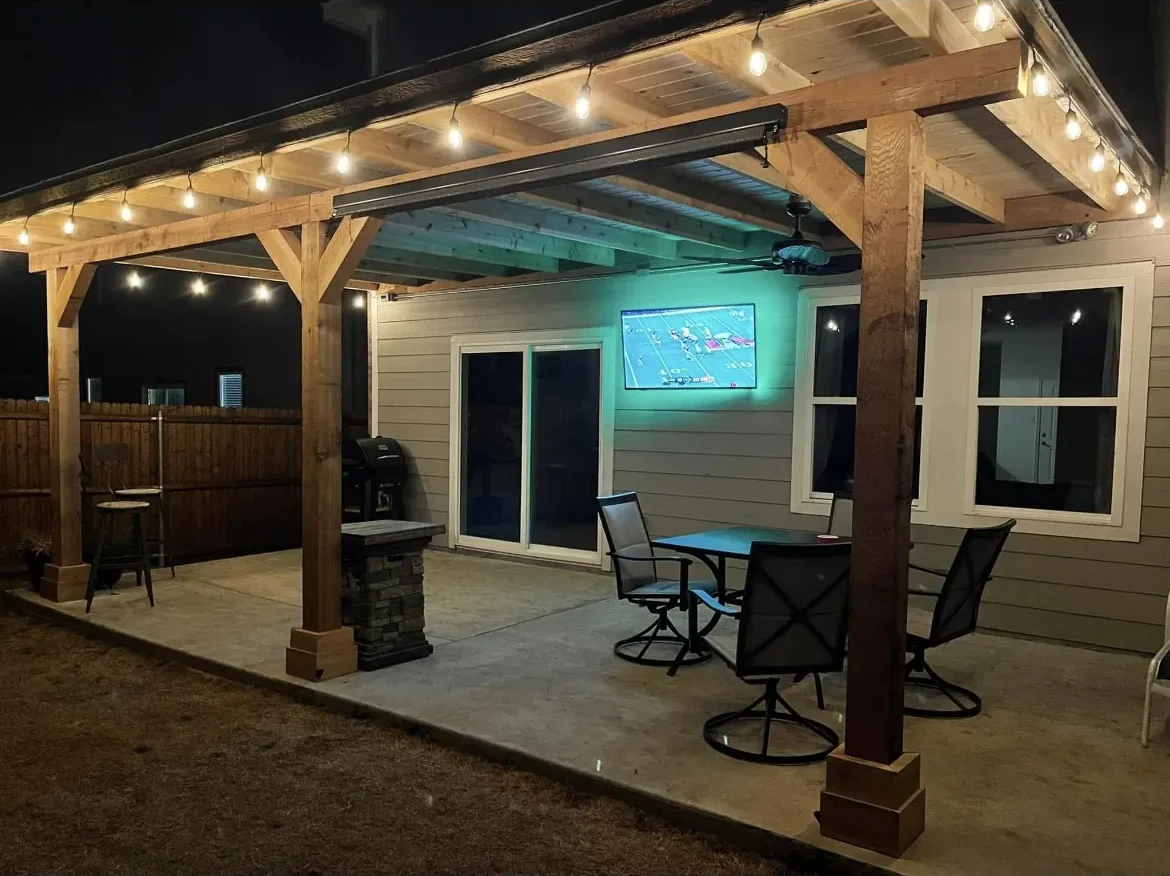
Most deck vs patio articles online use national prices, mix per-square-foot and per-project numbers, and skip the two things that matter most in Dallas: the heat and the clay. This guide puts Dallas prices for every common surface side by side, prices the same 16x20 space both ways, and then works through the tie-breakers: slope, surface heat, clay soil, drainage, upkeep, permits and resale. Every number comes from a named source listed at the end, and each one is marked as Dallas or national.
Is a deck or patio cheaper in Dallas?
On a flat Dallas lot, a patio is cheaper per square foot, often by half or more. A deck only closes the gap when the yard slopes or the floor has to sit well above the ground.
The reason is simple. A patio is a surface laid on prepared ground. A deck is a small structure: footings, posts, beams, joists and boards, and once it is high enough, stairs and a railing. Bob Vila's cost guide puts it the same way: patios take less labor and fewer materials, which usually makes them the cheaper option.
The Dallas numbers show the size of the gap:
- Basic concrete patio: Block Renovation's 2026 Dallas guide puts a 400 to 600 sq ft basic concrete patio at $3,000 to $8,000. That works out to roughly $5 to $20 per sq ft (calculated from Block Renovation's range).
- Pavers: $10 to $25 per sq ft installed in Dallas, with concrete pavers at the low end and natural stone at the high end (Block Renovation).
- Pressure-treated wood deck: $15 to $30 per sq ft installed in Dallas (Block Renovation).
- Composite deck: $25 to $50 per sq ft installed in Dallas (Block Renovation).
HomeBlue's Dallas figures, which use one method across concrete, pavers and decks, show the same order: reinforced concrete at $7 to $13 per sq ft, a treated-pine deck at $16 to $18 and composite at $30 to $32. Those HomeBlue prices date from 2021 and 2022, so treat them as a floor for 2026, not a quote. They are most useful for the ratio between surfaces.
Texas deck vs patio cost per square foot (2026): concrete, pavers, flagstone, wood and composite installation
In Dallas, plain concrete is the cheapest floor at about $7 to $13 per sq ft (HomeBlue, 2022) and composite decking the most expensive common choice at $25 to $50 (Block Renovation, 2026). Stamped concrete, pavers, treated pine and flagstone fall in between.
The table below keeps Dallas and national figures in separate columns, because they come from different surveys and years.
| Surface | Dallas installed cost per sq ft | National installed cost per sq ft |
|---|---|---|
| Plain concrete patio | $7 to $13 reinforced, $6 to $12 un-reinforced (HomeBlue, 2022) ; about $5 to $20 (calculated from Block Renovation's 2026 project range) | $4 to $26 (Lawn Love) |
| Stamped concrete patio | $10 to $18 reinforced, $9 to $16 un-reinforced (HomeBlue, 2022) ; stamping adds $3 to $10 over plain (Block Renovation, 2026) | $10 to $14 basic, $14 to $20 mid-range, $20+ custom (Concrete Network, 2026) ; $8 to $12 basic up to $18 to $30 complex (Fixr) |
| Concrete paver patio (sand-set) | $15 to $18 (HomeBlue, 2022) ; pavers overall $10 to $25 (Block Renovation, 2026) | $8 to $24 (Lawn Love) |
| Standard brick paver patio (sand-set) | $16 to $19 (HomeBlue, 2022) | n/a |
| Flagstone or natural stone patio | Top of Block Renovation's $10 to $25 paver range (2026) | $15 to $27 (Lawn Love, 2026) |
| Pressure-treated pine deck | $16 to $18 (HomeBlue, 2021) ; $15 to $30 (Block Renovation, 2026) | $15 to $30 (Block Renovation, 2026) |
| Cedar deck | $26 to $29 (HomeBlue, 2021) | $25 to $55 cedar or redwood (Block Renovation, 2026) |
| Composite deck | $30 to $32 (HomeBlue, 2021) ; $25 to $50 (Block Renovation, 2026) | $30 to $60 (Block Renovation, 2026) |
| PVC deck | n/a | $40 to $70 (Block Renovation, 2026) |
A few notes on reading it:
- Patio prices can climb. If an old slab has to come out first, HomeBlue's Dallas figure for demolition is $1.30 to $2.10 per sq ft (2022). Setting pavers on a concrete slab instead of sand adds about $4 to $7 per sq ft.
- Stamped vs pavers vs flagstone is its own decision, with its own costs and trade-offs. Our pages on stamped concrete patios in Dallas and flagstone patios and walkways go into each one in detail.
- Deck prices vary most with height, railing and stairs. The full breakdown is in our Dallas deck cost guide.
What a 16x20 deck and patio cost side by side
At the same 320 sq ft, a plain concrete patio comes to about $2,240 to $4,160 and a composite deck about $9,600 to $10,240 at HomeBlue's Dallas rates (calculated). That is roughly two and a half to four times the price for the deck (calculated from the same ranges).
We used 16x20 feet because that is the size Remodeling's Cost vs Value report uses for both of its deck projects. Every figure below is calculated by multiplying 320 sq ft by the source's per-square-foot range. HomeBlue's rates are from 2021 and 2022, so expect 2026 quotes to come in higher; the point of the table is the gap between surfaces.
| 320 sq ft surface | At HomeBlue Dallas rates (2021 to 2022, a floor) | At Block Renovation Dallas rates (2026) |
|---|---|---|
| Plain reinforced concrete | $2,240 to $4,160 | n/a |
| Stamped reinforced concrete | $3,200 to $5,760 | n/a |
| Sand-set concrete pavers | $4,800 to $5,760 | $3,200 to $8,000 (pavers or natural stone) |
| Pressure-treated pine deck | $5,120 to $5,760 | $4,800 to $9,600 |
| Cedar deck | $8,320 to $9,280 | n/a |
| Composite deck | $9,600 to $10,240 | $8,000 to $16,000 |
Cost vs Value's own 2025 Dallas numbers for a 16x20 deck are higher still: $15,841 for wood and $23,519 for composite. That is about $49.50 and $73.50 per sq ft (calculated from the report's job cost and 320 sq ft). The difference is what is included. The report's decks sit on concrete piers with posts and joists, and include a built-in bench, a planter, three steps down to the yard and a full railing. A ground-level slab needs none of that, which is a big part of why a patio is cheaper on flat ground.
Sloped or flat yard: is a deck or patio better?
A deck is usually better on a sloped yard, because it handles the slope with taller posts. A patio needs the ground made level first, which on a real slope means cutting, filling and often a retaining wall.
Concrete Network, a concrete industry site, says plainly that decks work well on sloping or uneven ground and that slope is rarely a limit for them, while sloped lots are harder for a concrete patio. Retaining walls can make a sloped patio possible. Trex notes that building a patio on uneven ground can raise the cost noticeably because of the leveling labor.
If a wall is needed, LawnStarter's national 2026 figure is $20 to $53 per sq ft of wall face, with an average of $33. In Dallas, a retaining wall up to 4 feet tall, measured from the bottom of the footing to the top of the wall, is exempt from a building permit unless it holds back extra load.
Most DFW yards are not steep. Block Renovation notes that elevated decks are needed on some sloped lots but are less common in DFW's generally flat terrain, and that they cost more because of the extra framing and railing. So in Dallas the slope question is usually a back door question: if your door sits several steps above the yard, a deck at door height avoids steps down onto a slab. If the door is close to grade, a patio is the natural fit.
Which gets hotter in Dallas sun, a deck or a patio?
Light gray concrete is usually the coolest hard surface underfoot, and dark composite or weathered wood the hottest. But color and shade matter more than whether the floor is a deck or a patio.
The National Weather Service describes DFW summer days as consistently in the 90s and often reaching or exceeding 100 degrees, with July and August the hottest and sunniest months. At those temperatures, every outdoor surface in full sun gets hot. Two informal tests show how much:
| Surface | Surface temperature | Test conditions |
|---|---|---|
| Green lawn (for reference) | 102°F | Arizona, 2 p.m., 112°F air, direct sun, infrared reading (Rosie Romero, Arizona Daily Star, 2021) |
| Gray troweled concrete | 128°F | |
| Travertine | 136°F | |
| Flagstone | 144 to 152°F by color | |
| Concrete pavers | 146°F | |
| Natural redwood decking | 154°F | |
| Trex composite decking | 150 to 175°F by color | |
| Aluminum decking | 131.5 to 133.5°F | Colorado, full sun after a few hours, 86.5°F air, infrared thermometer (Networx test via KSAT, 2012) |
| Other synthetic decking samples (non-PVC) | 141.9 to 157.3°F | |
| New cedar | 148.6°F | |
| Pressure-treated wood | 149.9°F | |
| PVC decking | 150.1 to 162.1°F | |
| Weathered cedar | 170.2°F |
These are single, informal tests in different places and years, so compare surfaces within each test rather than across the two. Within the Arizona test, gray concrete ran 128°F while composite ran 150 to 175°F. River Pools, after its own pool-patio temperature test, concluded that surface temperature depends more on color than on the material itself. Trex says the same about its boards: decking gets hot in direct sun, and the darker the color, the hotter it feels. Its Transcend Lineage line uses heat-mitigating technology.
Shade beats material choice. In the same Arizona column, on a 110°F day, a west-facing concrete tile patio read 123°F in sun and 96°F behind a pull-down shade screen. Block Renovation's Dallas guide says a covered patio lowers the temperature beneath it by 15 to 25 degrees compared with an exposed surface. So if you plan to use the space on summer afternoons, budget for shade on either a deck or a patio. Our post on how hot Trex, cedar and treated pine get covers the deck side in more detail.
Clay soil: will a patio crack or a deck move in Dallas?
Dallas clay moves both, in different ways. A slab rests on the top layer of clay and cracks where it is not jointed, while a deck sits on buried footings that can heave or drop but are easier to adjust.
Much of the Dallas area sits on Blackland Prairie soil. Houston Black clay alone covers about 1.5 million acres of the Blackland Prairie, which runs from north of Dallas south to San Antonio, and it shrinks and swells markedly as its moisture changes. Its very high shrink-swell potential commonly limits building in metro areas. The Texas Department of Licensing and Regulation calls expansive soils a very common cause of foundation problems: when they get wet, they heave and lift what sits on them. That guidance is about houses, but the same movement acts on a patio slab or a deck footing.
How a patio slab handles clay
Concrete will crack as it dries and as it moves with temperature. Control joints are planned cracks that decide where it happens. Concrete Network's rule is to space them, in feet, no more than 2 to 3 times the slab thickness in inches, and to cut them a quarter of the slab's depth. A slab without enough joints cracks wherever the clay pushes it. Concrete Network also notes that repairing cracks in stamped concrete can be challenging and may not fully restore its original look, which is one more reason the joint plan matters.
Pavers deal with movement differently. Mutual Materials, a paver manufacturer, says interlocking pavers can be lifted and reinstated with the same units, leaving no patches, and that settled areas can be lifted, the base re-compacted and the pavers relaid. It says settlement is often caused by poor soil or base compaction, with water in the base among the other causes.
How a deck handles clay
A deck rests on footings, not on the surface soil. Dallas's amended building code requires exterior footings at least 12 inches below undisturbed ground, with deck footings following IRC Section R507.3. Footings in clay can still heave or settle, but the boards are not in contact with the soil, and the structure above can be adjusted. Our post on deck footings in Dallas clay goes into depth and pier types.
On clay, no choice is immune. What protects either one most is the next topic: water.
Drainage: where the water goes decides how long either lasts
A patio is a hard surface that sheds water, so it must slope away from the house. A deck lets rain fall through to the ground below, so the grade under the deck has to drain.
The model residential code's drainage section (R401.3) calls for the ground to fall at least 6 inches within the first 10 feet from the foundation, and for hard surfaces within 10 feet of the foundation to slope at least 2% away from it. Confirm the current rule with your city, but either way the principle is the same. TDLR's guidance on expansive soils says water must drain away from the foundation on all sides, and that surface drainage, plant choices and sprinkler habits all help limit moisture swings in the soil.
Dallas rain comes in bursts. The National Weather Service notes that spring and fall are typically the wettest periods, and that annual rainfall in the area ranges from under 20 to over 50 inches. A patio pitched toward the house, or a deck over a low spot that holds water, sends that water straight into the clay you most want to keep stable.
How long does a deck last vs a patio, and what upkeep does each need?
A concrete patio is commonly rated at 25 to 30 or more years, about what composite decking is now rated. Pressure-treated wood is rated at 10 to 15 years and needs a fresh coat of sealer or stain every 2 to 3 years.
| Surface | Typical lifespan | Upkeep |
|---|---|---|
| Concrete patio | At least 25 years (Fixr) ; 30 years or longer (Concrete Network) | Low; jointing at install matters most |
| Stamped concrete patio | About 25 years, same as standard concrete (Fixr) | Reseal every 2 to 3 years, up to 5; first coat after at least 28 days of curing; glossy finishes are slick when wet |
| Paver or natural stone patio | No reliable year figure found | Keep joints filled with sand and pull weeds, which grow from windblown seeds in the joints |
| Pressure-treated wood deck | 10 to 15 years | Wash and seal or stain every 2 to 3 years; staining runs about $2 to $5 per sq ft (national) |
| Cedar or redwood deck | 15 to 25 years | Wash and seal or stain every 2 to 3 years |
| Composite deck | 25 to 30 years | Wash 2 to 3 times a year with soap, water and a soft brush |
| PVC deck | 30+ years | Wash 2 to 3 times a year |
A few points behind the table:
- Stamped concrete is low upkeep, not no upkeep. Concrete Network says it can last decades with minimal maintenance, but the sealer needs renewing.
- Cheap pavers can cost more over time. Concrete Network points out that pavers and natural stone need ongoing work on weeds and joint sand. The upside is that a sunken patch can be lifted and relaid with the same pavers.
- Composite takes the staining off your list. Trex says its boards never need staining or painting, just soap-and-water cleaning, and its limited residential warranties run 25 years for Enhance, 35 for Select and 50 for Transcend and Lineage.
- Wood decks in Dallas face termites. The City of Dallas climate table rates the termite hazard as "very heavy." A concrete or stone patio has nothing for them to eat.
Do you need a permit for a patio or a deck in Dallas?
A ground-level patio usually needs no permit in Dallas. A deck needs one unless it is 200 sq ft or less, no more than 30 inches above grade, freestanding and not serving the required exit door.
The City of Dallas building code (Chapter 52, Section 301.2.1) lists the exemptions:
- Paving: no building permit is required for paving or grading on a single-family or duplex property of less than two acres. That covers a typical concrete, paver or flagstone patio.
- Decks: a deck on a single-family or duplex lot is exempt only if all of these are true: 200 sq ft or less, no more than 30 inches above grade at any point, not attached to the house, clear of overhead service-drop wires, and not serving the required exit door. Otherwise it needs a permit.
- Patio covers: only one-story detached patio covers under 200 sq ft are exempt. So the slab may need no permit while a cover attached to the house over it does.
- Digging and walls: excavations under 4 feet deep are exempt, and so are retaining walls up to 4 feet unless they hold back extra load.
There is no flat deck permit fee in Dallas's fee schedule. The residential plan review fee is $0.046 per sq ft or $577, whichever is greater, plus other fees, effective July 1, 2025. Block Renovation notes that across most DFW cities, a ground-level patio without a roof doesn't need a building permit, while covered structures, elevated decks, gas outdoor kitchens and electrical work typically do. Suburbs set their own rules, so check with your city. Our Dallas deck and patio cover permit guide covers the details.
HOA approval for a deck or patio
Permit or not, check with your HOA first, especially for anything with a roof or a fire feature.
Block Renovation's Dallas guide notes that HOA rules can limit patio cover height, setbacks (often 5 to 15 feet from rear and side property lines), materials and fire features, and advises contacting the HOA's architectural review committee before design or bids. A patio the city exempts can still break an HOA setback, so get the approval in writing before anyone pours or digs.
Deck vs patio resale value in Dallas (Cost vs Value 2025)
In Remodeling's 2025 Cost vs Value report, a Dallas wood deck recoups 99.8% of its cost and a composite deck 92.1%. The report's 53.2% "Backyard Patio" is a $47,446 outdoor-living package, so it is not a fair deck vs patio comparison.
| Cost vs Value 2025 project | Dallas job cost | Dallas resale value | Dallas cost recouped | National cost recouped |
|---|---|---|---|---|
| Deck addition, wood (16x20) | $15,841 | $15,813 | 99.8% | 94.9% |
| Deck addition, composite (16x20) | $23,519 | $21,658 | 92.1% | 88.5% |
| Backyard patio package (20x20 flagstone plus extras) | $47,446 | $25,264 | 53.2% | 46% |
Look at what each project includes. Both decks are 16x20 feet with a bench, planter, three steps and a full railing. The "Backyard Patio" is a 20x20 flagstone patio on flat ground plus a gas fire pit, four chairs, a stone-veneer outdoor kitchen with grill, fridge and sink, a cedar pergola, low-voltage lights, a lift-and-slide glass door, and underground gas and electric lines. Much of its cost is the kitchen and extras, not the stone. The report does not measure a plain patio, so it cannot tell you whether a simple slab pays back better or worse than a deck.
The safer lesson is about scale. Block Renovation warns that a $100,000 outdoor kitchen in a neighborhood of $400,000 homes is unlikely to return its full cost. Build what you will use and what fits the street. For full outdoor living budgets, see our outdoor living space cost guide.
Deck or patio in Texas: which should a Dallas homeowner choose?
Pick a patio for a flat yard, a tighter budget and heavy features like a fireplace. Pick a deck for a sloped yard, a raised back door or the look of wood. You can also do both: a deck at the door stepping down to a patio.
A patio is usually the better fit if
- The yard is flat and the back door is close to the ground. At HomeBlue's Dallas rates, plain concrete costs less than half as much per sq ft as composite decking.
- You want a fireplace, kitchen or other heavy feature. Concrete Network notes that heavy items suit a patio better than a deck.
- You want to skip a building permit for the floor itself. Dallas exempts paving on single-family lots under two acres.
- You want the coolest bare surface. Gray concrete tested cooler than composite and wood decking in the Arizona test.
A deck is usually the better fit if
- The yard slopes, or leveling it for a slab would take a retaining wall.
- The back door sits several steps above the yard, and you want to walk straight out at floor level.
- You like the look and feel of wood or composite boards, and accept the upkeep that comes with your material.
- You want a floor that is not resting on the surface clay.
Mistakes to avoid with either one
- Comparing a ground-level slab price with a raised deck price that includes railings and stairs. Compare at the same size and height.
- Choosing a dark surface for a west-facing yard with no shade plan.
- Pouring a slab without a control joint plan, or with water running toward the house.
- Assuming no city permit means no HOA approval.
Archetex Outdoor Design Co. builds both custom composite and wood decks and stamped concrete and flagstone patios, so the choice does not have to be made before someone looks at the yard. Matthew offers a free site visit and a written price for either option, or for a deck and patio combined.