How much does a pergola or patio cover cost in Rowlett in 2026?
A pergola typically costs $1,900 to $6,500 installed, with a national average of $4,500, according to Fixr. A covered patio averages $8,500 nationally, and most covered-patio projects run $25 to $40 per square foot. Larger solid-roof covers with electrical and fans cost far more in the Dallas area. Block Renovation's 2026 Dallas guide puts a 300 to 500 sq ft covered patio with a solid roof, posts, electrical and ceiling fans at $20,000 to $60,000.
| Structure | Typical installed cost | Source |
|---|---|---|
| Pergola, attached to the house | $1,700 to $5,000 | Fixr (national) |
| Pergola, freestanding | $2,500 to $6,500 | Fixr (national) |
| Louvered pergola, custom | $2,000 to $8,000 | Fixr (national) |
| Wood patio cover | $15 to $35 per sq ft | Fixr (national) |
| Aluminum patio cover | $20 to $70 per sq ft | Fixr (national) |
| Insulated-panel patio cover | $26 to $59 per sq ft | Fixr (national) |
| 12 x 18 patio with a gabled cover (patio and cover together) | $3,928 to $18,900 | Fixr (national) |
| Solid-roof covered patio, 300 to 500 sq ft | $20,000 to $60,000 | Block Renovation, 2026 Dallas guide |
| Rowlett accessory permit, under 250 sq ft | $75 | City of Rowlett fee schedule, 2026 |
| Rowlett accessory permit, 250 sq ft and up | $75 plus 10 cents per sq ft | City of Rowlett fee schedule, 2026 |
On Rowlett's fee line, a 20 x 20 patio cover (400 sq ft) works out to a $115 permit, plus the card fee if you pay by card. In Rowlett the pier and post-base work behind the 115 mph wind requirement is part of the job, so compare quotes on how each one anchors the posts, not only on the roof. Archetex gives a written price after a free site visit.
Why wind is the first design question for a Rowlett patio cover
Rowlett has been hit hard before. On December 26, 2015, the strongest tornado of that evening's North Texas outbreak tracked about 13 miles through Dallas and Rockwall counties, according to the National Weather Service. It caused EF4 damage in Garland and EF3 damage in Rowlett, and ended at Lake Ray Hubbard. The NWS estimated its peak winds at 170 to 180 mph.
No residential patio cover is designed for a tornado of that strength, and none of the codes below claim to be. What the city does require is design for everyday severe wind. Rowlett's amended 2021 residential code sets a 115 mph design wind speed. The city's accessory building permit says all accessory buildings must resist a 115 mph wind load, and it asks you to show how.
A lake lot raises the stakes. Under the American Wood Council's Wood Frame Construction Manual, "Exposure D" covers flat, unobstructed areas exposed to wind blowing over open water for at least 1 mile. It extends inland 1,500 feet, or 10 times the structure's height, from the shoreline. It applies only to wind coming from over the water. Whether your Rowlett lot qualifies depends on how much open water lies upwind, so on a waterfront patio cover it is a question for the designer or engineer, not a guess.
How Rowlett requires patio covers and pergolas to be anchored
For patio covers and carports, which on Rowlett's form include pergolas and arbors, the city's accessory building permit offers three ways to meet the 115 mph requirement:
- Embedded posts. Set the posts in concrete piers at least 30 inches deep and 12 inches in diameter.
- Column bases. Anchor every post with a Simpson CBS/CBSQ column base or equivalent. The form requires at least 12 inches of concrete depth for beams and 12 x 30-inch piers.
- Engineered design. Attach a sealed plan from a Texas-licensed engineer.
That rules out the most common shortcut: screwing a kit pergola's posts straight to an existing patio slab with light brackets. In Rowlett, the slab usually isn't the anchor; the pier under it is.
Archetex designs this in at the start. We check whether there is an existing slab, how thick it is, where the posts can land, and whether new piers go beside or through it. Then the frame goes up on bases that match the method on the permit.
Attached or freestanding: what changes in Rowlett
An attached patio cover follows the house's rules, while a freestanding pergola or pavilion follows Rowlett's accessory-building setbacks. The city's permit form spells them out:
| Rule | Attached to the house | Freestanding (detached) |
|---|---|---|
| Rear setback | Same as the required rear setback for the house | 3 feet from the rear property line |
| Side setback | As for the house | 3 feet if at least 90 feet from the front property line; 5 feet if closer |
| Where the property line is | Normally the fence line. Alley paving and sidewalks are not the property line. | |
| Size | Any accessory building, or combination of them, over 500 sq ft needs a Special Use Permit from Planning | |
| Wind | Must resist 115 mph | |
Choose attached when the patio is right against the back of the house and you want the cover to read as part of it. Archetex ties attached covers into the existing roofline so the pitch and fascia match. On a house close to its rear setback, attached may also be the only cover that fits.
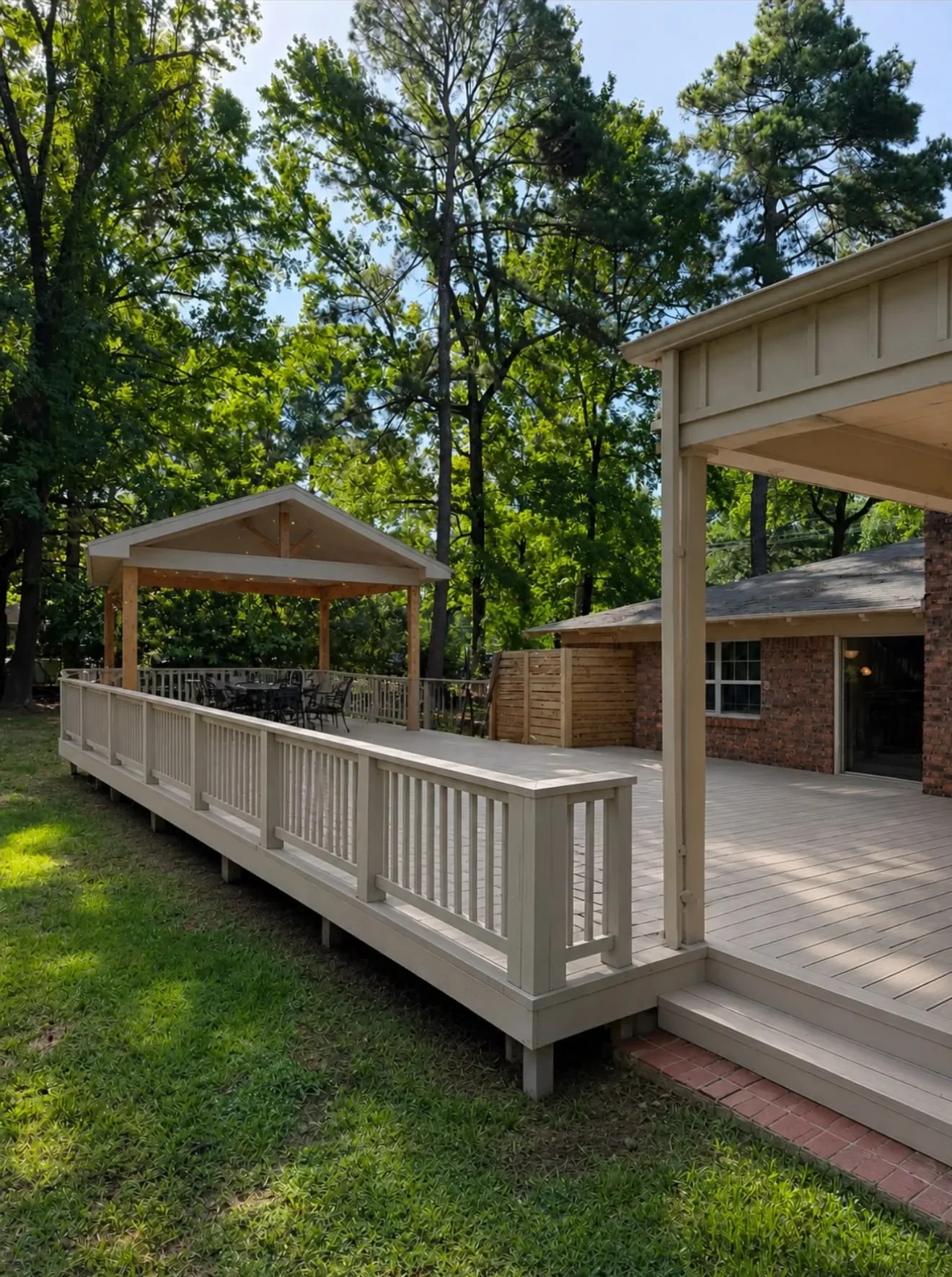
Choose freestanding for a pavilion over a hot tub or outdoor kitchen out in the yard, or a pergola placed where the lake view is best, away from the house. Keep the 500 sq ft limit in mind: an existing shed counts toward the combined total.
Pergola or solid patio cover for Rowlett shade?
A solid roof gives full shade and keeps rain off. A pergola gives filtered light and lets air move. In Rowlett, wind adds a third point: an open slatted pergola presents far less roof area for wind to lift than a solid roof of the same size. So a pergola is the lighter structure, while a solid cover asks more of its piers and connections.
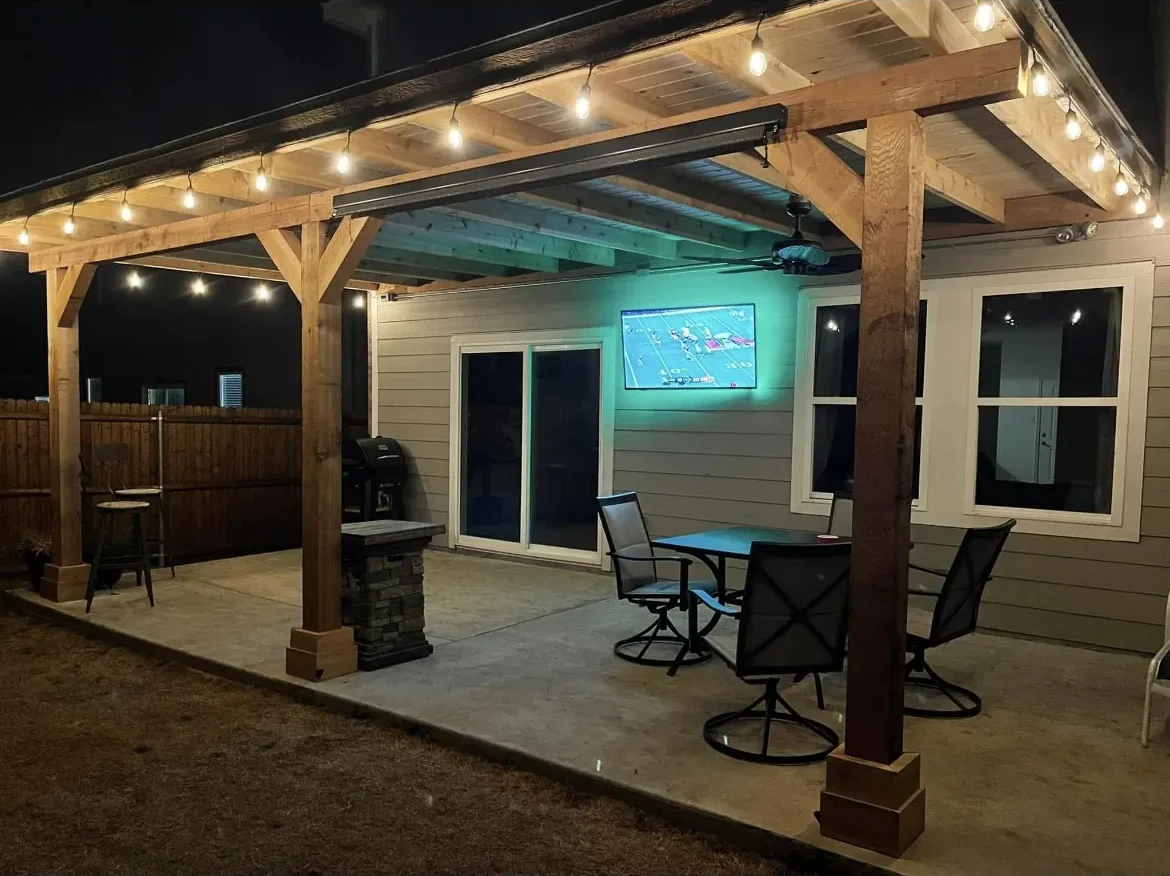
- Solid roof for an afternoon-sun patio you want to use all summer, with fans and lighting wired in during framing.
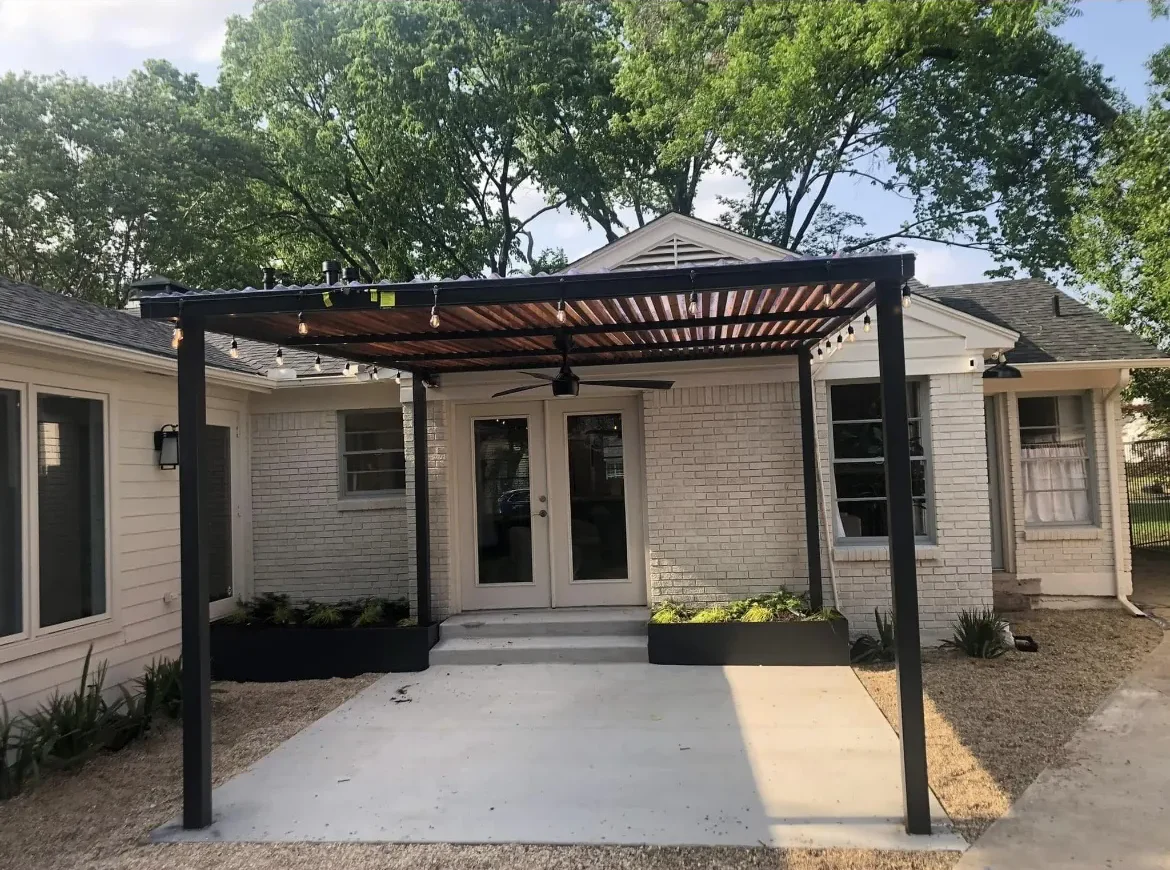
- Black slatted or cedar pergola for a patio that already gets some shade, or where you don't want to block the view of the lake from inside.
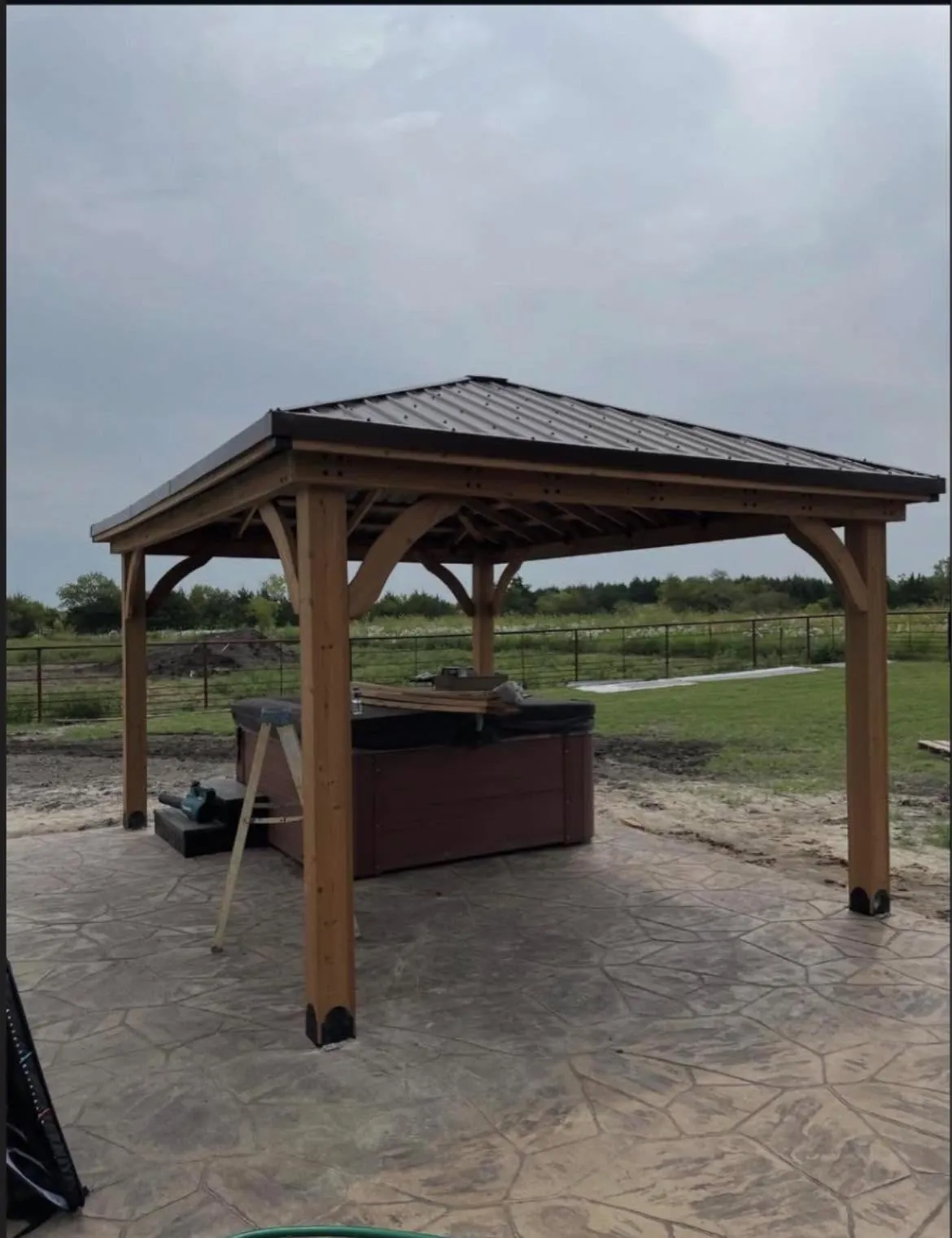
- Freestanding pavilion with a metal roof for a hot tub, grill or seating area out in the yard. That is the structure in the photo at the top of this page.
Orientation decides a lot. Rowlett sits on two peninsulas in Lake Ray Hubbard, so a lake-facing patio can face almost any direction. We look at where the afternoon sun falls on the patio before recommending slat spacing or a solid roof.
Covers and gazebos on the Lake Ray Hubbard take area
A covered structure past your take line is a gazebo under Rowlett's take-area rules, and it is much more tightly controlled than one in your yard. The take area is City of Dallas land leased to Rowlett. You must sublease it first ($600 initial, $350 renewal) and then get a take-area site improvement permit ($80). For a gazebo, the regulations require:
- no more than 14 x 20 feet outside, no more than 12 feet tall, and one story only;
- steel-reinforced concrete piers;
- a roof that either matches the house's roof, or is a pre-finished standing-seam galvanized hip roof at a 2:1 slope with one centered cupola, and an overhang of no more than 1 foot 6 inches unless it matches the house;
- no part below 438.0 feet above sea level, and a 6-foot setback from the side-yard centerlines;
- no use as living space, storage or an animal shelter, and no placement in a neighbor's view clear zone.
For most Rowlett lakefront homes, the bigger shade structure goes on the home lot under the normal accessory permit. A gazebo, if any, goes nearer the water.
HOA approval and choosing a builder
If your subdivision has an HOA, get its written approval before the city permit. HOAs commonly rule on roof material, color and height. Rowlett keeps a directory of its neighborhood associations and HOAs, but HOA rules are private and vary by subdivision.
When you compare builders, a good written quote for a Rowlett patio cover or pergola should state:
- attached or freestanding, the size, the height, and the distances to the property lines;
- which of Rowlett's three anchoring methods it uses, with pier size and post-base model;
- roof or slat material, and how an attached cover ties into the existing roof;
- any electrical, such as fans and lights, and who pulls that permit;
- who pulls the accessory permit, whether the fee is included, and the schedule and payment stages.
Ask to see finished covers and read the reviews. Homeowners who have reviewed Archetex mention communication, punctuality, help with design and reasonable prices. See recent work on our work page.
Shade around Rowlett: Garland, Rockwall and Dallas
Rowlett is in far east Dallas County, with a portion in west Rockwall County. The city puts it about 20 minutes east of downtown Dallas. Archetex builds covers and pergolas across the area. See Garland, Rockwall, and the main covered patios and pergolas page. If the cover is going over a new deck, see our deck builder page and the Dallas deck cost guide. To start, send a photo of your patio or call Matthew on (430) 318-6275.