What a horizontal cedar fence is, and what it costs in Dallas TX in 2026
A horizontal cedar fence runs the boards level between posts instead of standing them on end. It is the modern-plank look Archetex Outdoor Design Co. builds alongside vertical board-and-batten. It costs more than a standard vertical privacy fence because it needs closer posts, center stiffeners and straighter boards. House Digest puts the premium at about 10 to 20% over a vertical fence of the same materials.
Published per-foot figures disagree, so the table shows each one with its source rather than a single blended number.
| Fence type | Installed cost per linear foot | Source |
|---|---|---|
| Horizontal wood fence (national) | $15–$22 | Fixr, wood fence cost guide (Jan 2025) |
| Horizontal wood fence (national) | $50–$70, average $60 | The Spruce (Apr 2024) |
| Cedar fence (national) | $20–$35 | Fixr, cedar vs pine fence |
| Pine fence (national) | $10–$20 | Fixr, cedar vs pine fence |
| Removing the old fence | $2–$5 | Fixr |
As a worked example using Fixr’s national horizontal-fence range (our arithmetic): 150 feet at $15 to $22 per foot is $2,250 to $3,300, before gates, tear-out and stain. The Spruce’s higher $50 to $70 per foot would put the same run at $7,500 to $10,500, which is why a written quote for your own line matters more than any average.
These are market ranges, not Archetex prices. Archetex gives a written price after a free site visit, once the line has been walked and measured. See the main Dallas fence installation page for vertical and board-on-board options.
Board sizes and spacing: tight, gapped or board-on-board
The board layout decides how private the fence is and how it reads from the yard. Most horizontal fences use one of three layouts:
- Tight-butted. Boards stacked edge to edge. It is fully private when new, but cedar shrinks as it dries in a Dallas summer, so thin gaps open up.
- Gapped (slat style). A consistent gap between boards for a lighter, modern look. The wider the gap, the less privacy you get. House Digest notes that horizontal fences with widely spaced slats are easier to climb, which matters around a pool or with dogs.
- Horizontal board-on-board. Two offset rows, one on each side of the frame, so the second row covers the gaps in the first. In one documented DIY build with 5.5-inch cedar pickets, a 4-inch spacer set the first row and the second row overlapped each gap by 3/4 inch on each side. It reads the same from both sides and stays private even after the boards shrink.
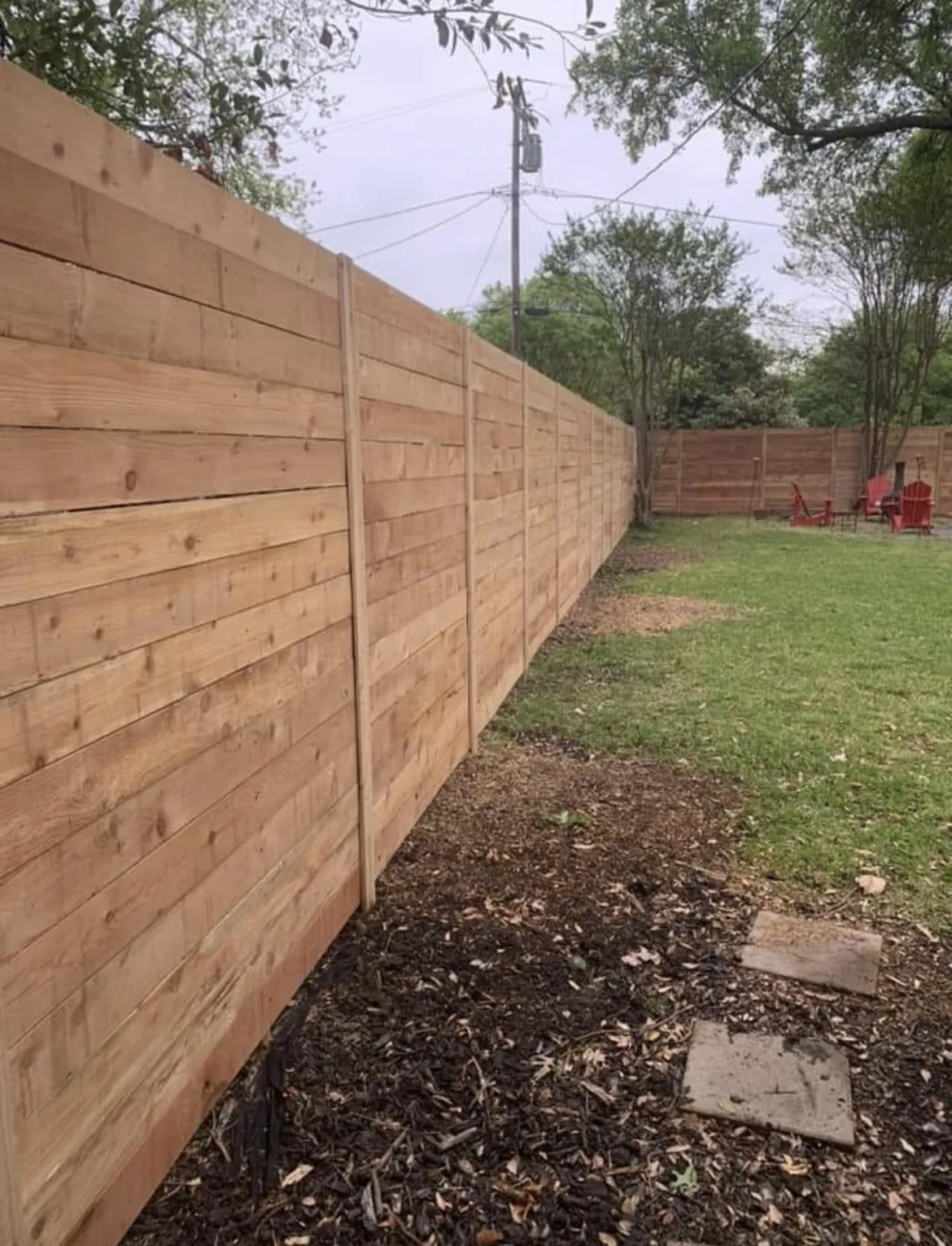
Ask for a vertical trim strip or batten over the joints at each post, like the one in the photo above. It hides board ends, keeps them from curling and gives the run a finished line.
Why horizontal boards need closer posts or stiffeners
Short answer: a horizontal board is a beam, and a beam sags in the middle. On a vertical fence the rails carry the load and the pickets hang from them. On a horizontal fence each board spans the whole bay from post to post. Trex notes that horizontal fences are more likely to sag than vertical ones if the boards are not properly supported, and that typical post spans run about 6 to 8 feet.
Two fixes work, and a good build often uses both:
- Space posts to the board, not to a standard. House Digest makes the point that posts must be spaced no wider than the length of the horizontal boards, so 8-foot boards mean posts no more than 8 feet apart. Tighter is stiffer.
- Add a center stiffener. A vertical 2x4 between the top and bottom rails, in the middle of each bay, gives every board a third fastening point. In a documented 6-foot-bay horizontal cedar build, these center boards were what kept the pickets from bowing and warping.
A top cap (a flat board across the top of the posts) also helps. It ties the posts together and keeps the sun and rain off the top edge of the highest board.
Steel posts vs wood posts in Dallas clay
Most of Dallas sits on Blackland Prairie soils. The Texas Water Development Board's state soil sheet describes the Houston Black series, which runs from north of Dallas south to San Antonio, as highly expansive clay that shrinks and swells markedly with changes in moisture. It also says that shrink-swell commonly limits building site development in metro areas. Every dry summer the ground cracks and pulls away from posts. Every wet spring it swells and pushes them. A wood post also rots at the soil line, which is exactly where it carries the load.
That matters more on a horizontal fence. A post that leans half an inch on a vertical picket fence is hard to spot. On a horizontal fence it bends a straight line across several bays. Archetex builds cedar fences on galvanized steel posts; his fences in photos have the cedar fastened to the steel above ground with brackets, and finished runs are on the our work page. Steel does not rot at the soil line. With the posts set at the right depth for the clay, the boards stay where they were set.
| Galvanized steel post | Wood post | |
|---|---|---|
| Rot at the soil line | No | Can rot where the soil stays damp |
| Look | Can be hidden behind a batten or face board | Matches the boards |
| Up-front cost | Higher | Lower |
| Replacing boards later | Unbolt and re-board; posts stay | Often means resetting posts too |
Cedar vs pine for the boards
Cedar is the usual board for a horizontal fence, and pine is the budget option. Fixr puts pine at about $10 to $20 per linear foot installed and cedar at $20 to $35. It gives pine a 10 to 15 year life and maintained cedar 20 to 25 years. Pressure-treated pine resists the soil better, which is why it is often used for wood posts. As a board, though, Fixr rates pine as more at risk of buckling, warping and shrinking, and any warp shows on a horizontal line. Fixr calls cedar the stronger, more durable wood, with a low risk of warping and shrinking. Archetex has built with both cedar and pressure-treated pine.
Stain and seal: keeping the color in Texas sun
New cedar is the color in the photo above. Left alone, it weathers to silver-gray, faster on the south and west faces that take the afternoon sun. If you want to keep the warm tone, use a penetrating, UV-blocking stain once the wood has dried enough to absorb it, and recoat every few years. Fixr estimates about $1,500 to stain an average-size fence. If you are in an HOA, check the approved stain colors before you buy; many associations list them.
Dallas fence height limits and permits
In the City of Dallas, a 6 ft backyard fence needs no permit, but a 7 or 8 ft one does. The city's fence permit checklist says a permit is required for any fence over 4 feet tall in a front yard or over 6 feet anywhere else. The maximum height of any fence is 9 feet. A fence over 9 feet needs Board of Adjustment approval for its location in a setback, a building permit and a licensed engineer's seal. The site plan must show easements, alleys and visibility triangles where they apply. Fences in Conservation Districts need a CD work permit, and Planned Developments and Historic Districts may have their own rules, so check your zoning before choosing a height.
Horizontal fences are often built at 7 or 8 feet for privacy, so plan the permit into the schedule. The suburbs differ:
- Plano: fences may not exceed 8 ft. In the required front yard the limit is 40 inches, and the fence must be at least 50% open. Repairs under 25% of the fence area in 12 months need no permit (City of Plano residential fence permit sheet, rev. Aug 2025).
- Frisco: a permit is required for every new fence. Fences may be up to 8 ft on rear and side yards and 4 ft in front of the house, and no part may extend past the property line (City of Frisco FAQ).
Town-by-town details are on the Plano, Frisco and Dallas service-area pages.
HOA approval in Plano and Frisco
Get the HOA's written approval first, then the city permit. Plano's permit sheet tells applicants to contact their homeowners association for additional requirements from deed restrictions and covenants. In master-planned neighborhoods in Plano and Frisco those covenants often cover height, style, stain color and which side faces the street or alley. A horizontal fence can be a harder sell than a standard board-on-board, so submit a drawing and a photo of a finished horizontal fence with the application. If the HOA requires a uniform alley-side or street-side look, ask whether a horizontal fence on the inside face with a conforming outside face is allowed.
How Archetex builds a horizontal fence
- Property walk. Matthew walks the line with you, sets style and height, and places the gates. Corners, slopes and odd lot lines are worked out here rather than forcing a standard panel.
- Post setting. Posts are set to the real line and grade, including corners, slopes and gate openings, with bay widths chosen for the boards.
- Fence and gate install. Rails, stiffeners, cedar boards, trim and cap go on, then the gates and hardware, including automation where it is part of the job.
- Final walkthrough. Every gate is checked for swing and latch before the job is closed out.
Reviews of Archetex mention communication and daily updates, punctuality, help with design and a clean site. A fence often goes in alongside planting along the new line; see landscape design.
Choosing a horizontal fence contractor in Dallas
Look for finished horizontal fences in their photos, not just vertical pickets, and ask how they stop sag. A good written quote should state:
- linear footage and height of each run, and the number and width of gates;
- post type (steel or wood), post spacing and setting depth, and whether there are center stiffeners;
- board species and grade, board layout (tight, gapped or board-on-board) and gap size;
- top cap, trim and kickboard, if included;
- tear-out and haul-off of the old fence;
- who pulls the city permit and who handles HOA paperwork;
- stain or sealer, the product named, or a clear "unfinished".
For a free site visit and a written price, call Matthew on (430) 318-6275 or use the contact page.